After Grandpa stopped driving, my sister-in-law Melissa suddenly became the only person available to take him to the bank. At first nobody thought much of it. It just seemed like one of those helpful family arrangements that take the weight off an old man’s shoulders. Then every conversation about his money started going through her too. She would tell us what bills he had paid, what transfers he had made, and what cash he had supposedly needed.
If anyone asked Grandpa directly, Melissa would interrupt and say he got confused with numbers now. After a while, everybody just let her answer for him.
The change happened slowly, like grease soaking into a brown paper bag. We were all so busy with our own jobs and kids that we handed the reins right over to her without checking behind the curtain. Melissa loved playing the martyr. She would sigh and talk about how exhausting it was keeping track of retirement accounts and medical deductibles. My cousin Kyle thought she was a saint for doing it. But I watched Grandpa’s hands whenever she started talking about his business. His fingers would stop tapping against the wood. His jaw would tighten just enough to show the muscle jumping under his skin.
Three weeks before that Sunday, I dropped by his house to drop off some mail. The front door was unlocked, which wasn’t like him.
I found him standing in his small home office, leaning over an old metal filing cabinet with a magnifying glass and a stack of yellow legal pads. When he heard me, he shut the drawer fast. He didn’t look scared. He just looked tired. He told me he was checking his garden seed orders, but the papers on the desk were deposit slips from the First National branch downtown. I let it go then because I didn’t want to make something out of nothing. I figured he was just missing his independence.
Then came Sunday dinner. The house smelled like roast beef and rosemary, the usual heavy comfort food my aunt always made before her knees started acting up. Melissa brought her little notebook to dinner like she was giving a quarterly report. It was a black leather-bound ledger with an elastic band wrapped around the middle. She set it down right next to the gravy boat as if it belonged there.
I whispered to Grandpa that he didn’t have to sit through any of it. He just smiled and kept breaking his biscuit apart piece by piece, dropping the crumbs into his palm.
Halfway through dessert, Melissa opened the notebook. She licked her thumb and turned a page with a sharp little snap. I figured the family deserved an update on where things stand, she announced to the whole room. My cousin Kyle nodded immediately. Melissa is the only one actually helping him, he said, popping a piece of peach cobbler into his mouth. Then Melissa sighed dramatically and looked around the table. At the rate he spends, there won’t be much left if somebody responsible doesn’t stay involved.
Grandpa didn’t argue. Didn’t ask for the notebook. Didn’t even look embarrassed. He just sat there quietly while Melissa explained his own bank balance to the table like he wasn’t even there.
The silence in the dining room got heavy, the kind where you can hear the grandfather clock ticking in the hall. Melissa looked pleased with herself, pen poised over the page like a corporate bean-counter ready to sign off on a deficit.
Then Grandpa folded his napkin beside his plate, looked at Melissa, and said, “That is a very interesting ledger, Melissa, considering my accounts were moved to a trust six months ago where you only have viewing rights.”
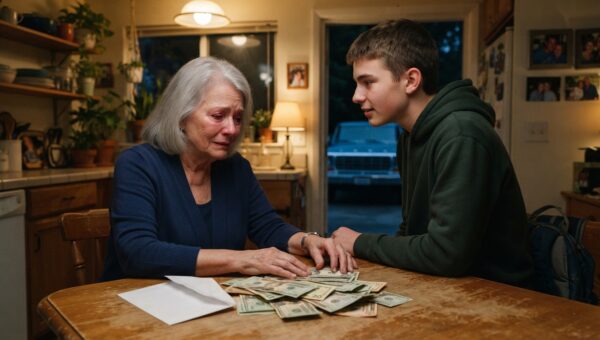
Nobody said a word. A fork clinked against a ceramic plate down at the end of the table and sounded like a hammer hitting an anvil. Melissa stopped writing mid-stroke. Her hand hovered over the paper. What did you say, she asked, her voice pitching up just a little bit too high. Grandpa reached into his shirt pocket and pulled out a standard white business envelope with the bank logo printed in dark blue ink. He laid it flat on the table, right on top of her little black notebook.
“I said you have viewing rights,” Grandpa repeated, his voice as calm as lake water on a still morning. “Which means you can see every time money leaves. It also means the bank keeps a record of every time someone tries to pull money out without my signature.”
Melissa’s face went from pale to a dull, mottled red. She grabbed the edge of her notebook like she wanted to slide it off the table and hide it in her purse. “I was only trying to help keep things straight for the family,” she stammered, her chin starting to shake. “With your memory and everything, everybody knows you get mixed up, “
“I get mixed up about where I left my reading glasses,” Grandpa said, leaning forward just an inch. “I do not get mixed up about four thousand dollars vanishing every month into an account bearing your daughter’s tuition name.”
Kyle dropped his spoon. It clattered against the side of the ceramic bowl and skidded across the tablecloth, leaving a streak of peach juice right over the linen. He looked from Melissa to Grandpa, his mouth half open. “Whose tuition?” Kyle asked. “Melissa, what is he talking about?”
Melissa stood up so fast her chair screeched against the hardwood floor. “This is ridiculous,” she snapped, grabbing her purse by the strap. “After all the hours I spend driving him around, listening to him complain about his joints, this is how I get thanked. I am leaving.” She grabbed her black ledger, tucked it under her arm like a shield, and marched out toward the front hall. The front door clicked shut three seconds later with enough force to rattle the windowpanes.
Nobody moved for a long minute. My aunt cleared her throat, looking down at her napkin as if the floral pattern held the secrets of the universe. Kyle sat back in his chair, rubbing the back of his neck and staring at the space where Melissa had just been sitting. He looked embarrassed, the red creeping up into his ears.
“Dad,” Kyle finally muttered, looking at Grandpa. “Is that true about the account?”
“Every dime,” Grandpa said quietly. He picked up his coffee cup and took a small sip. “Mr. Henderson down at First National has known me since I was running the hardware store in sixty-eight. He noticed the duplicate withdrawal slips back in March. He called me in. We didn’t need a quarterly report, Kyle. We needed an audit.”
The ride home that evening felt different. The air outside was cool and smelled of damp earth and coming rain, the kind of autumn evening that makes you want to pull your jacket tighter around your ribs. Grandpa didn’t say much in the car, just stared out the passenger window at the streetlights blinking on one by one along the highway. When we pulled into his driveway, he didn’t rush to get out. He sat there for a moment with his hands resting on the top of his cane.
“You knew for months, didn’t you?” I asked him, cutting the engine so the dashboard lights faded out into the dark.
Grandpa turned his head and looked at me, a small, knowing glint in his eye behind his wire-rimmed glasses. “When you’ve lived eighty-two years, you learn that people who shout the loudest about being responsible are usually the ones hiding their hands in your pocket,” he said. “I just wanted to see how far she would carry the book before she realized I had the ledger that mattered.”
The next morning, Grandpa and I went down to the bank together to finish closing out the remaining joint permissions. Mr. Henderson met us at his desk with a thick manila folder and a pot of strong black coffee that smelled like chicory. It took twenty minutes to sign the papers, void the old authorizations, and set up a direct alert system that went straight to Grandpa’s phone and my own. By the time we walked back out through the heavy glass doors into the bright morning sun, the weight on his shoulders looked like it had dropped clean off.
Melissa didn’t come to Sunday dinner the following week, and nobody asked where she was. The conversation around the table was lighter, easier, full of talk about the local football team and whether the early frost was going to kill the tomato plants still clinging to life in the back garden. Grandpa ate a whole pork chop and two pieces of corn bread, laughing when my aunt dropped the gravy boat on the linoleum.
It took a little time for the rest of the family to adjust, but boundaries have a way of holding firm once you pound the stakes in deep enough. Grandpa didn’t need Melissa to take him anywhere anymore. Two days after the bank visit, a sleek black sedan pulled into his gravel drive, sent by the reliable senior rideshare service we set up on his new tablet. He tested it once to make sure he could manage the screen without his glasses, nodding with satisfaction as the driver stepped out to open the rear door for him.
That evening, after the sun had dipped below the ridge and the neighborhood grew quiet, I watched him from the kitchen doorway. He walked into the mudroom, took the heavy set of car keys he hadn’t used in two years off the old key ring, and placed them back onto the wall hook where they belonged. Next to them sat his white ceramic mug of black coffee and a small, fresh biscuit he had saved from supper, left entirely unbroken.