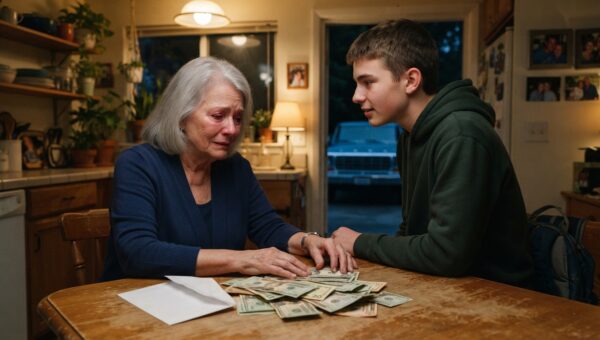
The kitchen smelled like lemon cleaner, cold gravy, and the burnt coffee Caleb had left sitting on the counter all morning. Sunlight came through the back window in a hard white square, bright enough to show every smear on the tile and every crumb his wife had watched me crawl around to collect. I was seventy-one years old, kneeling in my own kitchen.
Caleb stood behind me in polished boots that had never seen a day of real work, tapping one heel like I was taking too long. Marissa leaned in the hallway with her red nails wrapped around a champagne flute, smiling the way people smile when they think cruelty is private. “Missed a spot, Mother,” Caleb said.
I was scrubbing the kitchen floor on my hands and knees when my son deliberately stepped on my fingers with his heavy boots. “Watch where you’re crawling,” he grunted, while his wife giggled from the hallway. I slowly pulled my bruised hand away, stood up, and picked up my heavy cast-iron skillet.
The silence in the room stretched out thin and tight, snapping the quiet morning clean in half. Caleb did not step back right away. He kept that heavy, superior slouch of a man who figured fifty-four hundred square feet of brick house and a three-car garage belonged to whoever yelled the loudest.
But the skillet stayed heavy and steady in my right palm, seasoned black from forty years of cornbread and fried pork chops, and I did not drop my eyes to the floor this time.
“Put that down, Mom,” Caleb said, his voice dropping an octave as his heel stopped tapping against the linoleum. “You’re going to scratch the enamel.”
I didn’t answer him right away. I walked the two steps over to the gas stove and set the heavy iron down on the front burner with a loud, metallic clatter that made Marissa jump. The champagne in her glass sloshed over the rim and hit the baseboard with a tiny splash.
“You’ve been tracking mud across my clean floors for six months, Caleb,” I said, and my voice sounded different to my own ears. It didn’t shake like it usually did when we argued about the grocery bills. It sounded dry, like autumn corn husks rubbing together in the wind. “And I am done cleaning it up.”
Marissa set her flute down on the hall table, her face tightening up into that sharp, pinched look she always got when she didn’t get her way immediately. “Oh, here we go with the waterworks again,” she muttered, crossing her arms over her silk blouse. “Caleb, tell your mother to stop being dramatic before I get a migraine. We have brunch reservations at twelve.”
The truth was, I hadn’t cried in this house since the day Arthur died in the upstairs hallway back in October of two thousand nineteen. Arthur had built this house with his own hands, plank by plank, measuring every stud and driving every nail while I held the flashing and handed him the tin snips. We lived here for forty-two years without missing a single mortgage payment, even through the bad drought of ’88 when the bank threatened to take the south forty. When Arthur passed away from his heart, my grief felt like a heavy woolen blanket soaked in river water that I had to drag behind me everywhere I went.
Caleb had shown up three days after the funeral with a leather binder under his arm and a sympathetic look pasted over his smooth face. He told me that keeping up a big house on a widow’s pension and social security was asking for trouble. He told me about property taxes going up three percent every spring and municipal sewer liens that could catch an old woman sleeping. He promised me that if I signed the house over into a family trust, his name would only be there to protect me from the county, and I would always have my own room, my own kitchen, and my quiet life right here where I belonged.
I was tired. My joints ached every time the wind shifted off the river, and the thought of dealing with plumbers and roofers made my head swim. So I signed the papers across the dining room table while the notary public tapped her silver ballpoint pen against the wood. I thought I was securing my peace. Instead, I had handed the keys to a stranger who happened to share my DNA.
“Mom, don’t start,” Caleb said, stepping into the kitchen and puffing out his chest the way his father never had to do. “We own this property now. You know we do. We talked about this when Arthur died. You signed the quitclaim deed right over in front of Mrs. Gable at the municipal annex.”
“I signed a care agreement, Caleb,” I said, holding my ground by the stove. “A life-estate and maintenance covenant. Right there in black and white.”
Marissa let out a sharp, ugly laugh from the hallway. “Oh, please. Show us the paper then. Go ahead and dig through your sewing basket. Your name isn’t on the county registry anymore, Elena. We checked online yesterday while you were at the grocery store. The parcel is clear, free, and entirely in Caleb’s name.”
The wall of text in my head was spinning now, all those months of small humiliations stacking up like dry firewood waiting for a match. They had moved Marissa’s mother’s antique armoire into the guest room without asking, throwing out Arthur’s old oak workbench to make room for Caleb’s golf clubs and electric smoker. They ate the good beef tenderloin I bought with my own pension check and left me the gristle on paper plates while they talked about booking a cruise to Cozumel with the equity they planned to pull out of the second mortgage. They treated me like an aging tenant who overstayed her welcome, an invisible piece of furniture they had inherited along with the copper gutters and the central air.
“You think I’m stupid because I use a push mower,” I said, my voice dropping down low into the quiet kitchen.
“Nobody said you’re stupid, Mom,” Caleb sighed, rubbing the back of his neck with an air of profound annoyance. “You’re just old. You’re seventy-one years old. People your age belong in a nice little one-bedroom apartment down by the river where someone else changes the lightbulbs and mows the grass. We’re doing you a favor by keeping you here where we can keep an eye on your blood pressure.”
“My blood pressure was fine until you brought her into my house,” I said, pointing a finger straight at Marissa.
Marissa rolled her eyes so hard I thought they might get stuck. “Caleb, I am not standing here listening to this senile old woman insult me in my own foyer. Either you get her under control or we’re calling Dr. Vance to see about an evaluation. You know the county has those assisted living units on Route 4 where they take people who can’t manage their own households.”
The word evaluation hung in the bright, dusty air between us like a bad smell. That was their backup plan, wasn’t it? If the nagging and the boot steps didn’t break me down, a quiet word to the family doctor about memory lapses would do the trick. They figured they could sign me away into some sterile room with linoleum floors and yellow walls, then sell the brick house to developers for three hundred thousand dollars and buy themselves a new Mercedes.
I didn’t yell. I didn’t reach for the skillet again. I just walked past them without looking at either of their faces, my rubber-soled slippers squeaking softly against the tile floor I had scrubbed three times that morning.
I went down the short hallway to the small linen closet behind the bathroom where Arthur used to keep his old hunting gear. Behind the stack of spare flannel sheets and the mothballed winter coats sat a gray metal lockbox with a dented corner. I didn’t need a key because Arthur never locked it; he just liked the way it looked sitting on the shelf next to his tackle box.
I lifted the lid and pulled out the yellow manila folder labeled *Property Protection and Contingency Terms, August 2019*.
When I walked back into the kitchen, Caleb was pouring himself a fresh cup of coffee from the pot I had brewed at five o’clock that morning. He didn’t look up until I dropped the heavy manila folder right onto the laminate counter, scattering a few stray coffee grounds across the formica.
“What’s this?” Caleb asked, frowning down at the cardboard tab.
“Read page four, paragraph nine, Caleb,” I said.
He didn’t move for a long second, his thumb hooked into the ceramic mug handle. Then, seeing the look on my face, he set the mug down and pulled out the staple-bound pages. His eyes scanned the legal phrasing, moving from the top margin down toward the bottom where the notary stamp sat purple and crisp against the cream paper.
I watched the color drain out of his face right down to his collarbone. The smooth, easy arrogance he wore like an expensive cologne started to flake away, leaving behind the small, pinched expression of a boy who had just been caught stealing from the collection plate.
“This… this is just a draft,” Caleb stammered, his voice rising half an octave. “Mrs. Gable said the quitclaim was absolute.”
“Mrs. Gable retired two weeks after we signed that paper, Caleb,” I said quietly, leaning both hands flat against the cool counter edge. “And before she left, she filed the supplementary rider that states clearly if the primary resident, that’s me, is subjected to harassment, physical intimidation, or breach of the care covenant, the entire transfer becomes null and void, returning full title and unencumbered ownership back to the original grantor.”
Marissa pushed her way into the kitchen, her red nails digging into Caleb’s shoulder. “What is he talking about? Let me see that.” She snatched the paper from his hand, her eyes darting across the legal text. The silence in the kitchen got very heavy then, heavier than the cast-iron skillet, heavier than forty years of grief. Her mouth opened slightly, but no sound came out. She looked up at me like she was seeing a ghost, or worse, like she was seeing someone who had just caught her with her hand in the till.
“You lied to us,” Marissa whispered, her voice shaking with sudden, cold panic. “You set us up.”
“I didn’t set you up, Marissa,” I said. “I just remembered how to protect my home. Arthur taught me how to read a contract before he let me sign my name to a single acre of this valley. He always said a man who forgets his obligations deserves to lose his plow.”
Caleb grabbed the edge of the counter, his knuckles turning white. “Mom, be reasonable. We can’t move out. We just bought new living room furniture on credit using this address as collateral. We don’t have anywhere to go.”
“That sounds like your problem, not mine,” I said. “You have until sundown to load those golf clubs and your wife’s champagne flutes into that truck out in the drive. If you aren’t off this property by six o’clock, I’ll be calling Sheriff Holloway to enforce the eviction clause on page four.”
Marissa started crying then, real, ugly tears of frustrated rage, but Caleb didn’t say another word. He just stared at the paper in his hand like it had bitten him, his shoulders slumping under the weight of an unearned life finally coming to an end.
They packed their bags in the afternoon heat, the heavy slam of car doors echoing down the quiet gravel drive while I watched through the front window with my arms crossed over my apron. By six-thirty, the driveway was empty except for the white square of sunlight fading slowly across the asphalt.
The kitchen floor was clean and dry, reflecting the warm amber light of the late afternoon sun without a single streak or smudge across the tiles. I walked over to the stove, picked up the heavy cast-iron skillet, and slid it back into its dark, quiet home on the front burner where it belonged. Then I sat down at the wooden table by the window, poured myself a fresh cup of hot coffee, and listened to the absolute silence of my own house settling down around me for the evening.