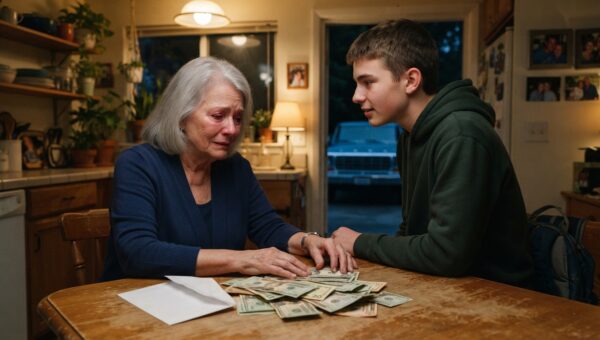
My sister’s fingers dug into my bruised flesh as she violently slammed me against the wall, shattering glass across the hardwood floor. The sound was sharp enough to make my ears ring, but I didn’t make a sound. For three years, Rachel has waged a cruel, silent war to steal our oblivious mother’s estate. She threatens to starve me and hide my medication if I don’t surrender the house deed, entirely unaware that the papers are already signed.
Rachel thinks my silence is a weakness. She thinks no one is watching her abuse. But as she turns away with a triumphant smirk, our mother’s quiet nurse pulls out a hidden leather notebook, meticulously documenting every single sin.
I don’t even know why I remember the exact timestamp on the microwave display behind her shoulder. It read 4:14 in the afternoon. Rachel had come over under the usual pretense of bringing groceries, though the bags mostly contained items she knew I couldn’t eat or didn’t like, a petty little game she played twice a week. She liked to check the pantry and the refrigerator, counting the cans of soup like an auditor inspecting a failing warehouse. I stayed by the counter because I knew what came next. She always started with the pantry and ended with the paperwork.
“You’re making this much harder than it has to be,” Rachel said, her voice dropping into that low, flat register she used whenever she wanted to sound reasonable while tearing someone apart. “Mom doesn’t even know what year it is, and you’re squatting in a house that’s going to cost a fortune in probate fees.
Just sign the transfer over to me. It saves us all legal bills.”
I looked down at the linoleum where a shard of the broken jelly jar caught the afternoon light. My arm throbbed where she had grabbed me, the skin already turning a mottled purple beneath the sleeve of my cardigan. I learned early on that arguing back only made her grip tighter and her threats louder. If I raised my voice, she would threaten to call Adult Protective Services and claim I was the one neglecting our mother. She was thorough in her cruelty, building a paper trail of fake concerns and exaggerated worries with our family doctor and the local senior center.
For months, I absorbed it all. I took the insults about my inability to hold down a regular job after my knee surgery. I took the whispered warnings that she would have me put into a county-run facility where nobody would visit me on Sundays.
Every time she came over, she tightened the screws a little more, convinced that our mother’s declining memory left the field entirely open for her. She forgot one crucial thing. Memory doesn’t vanish all at once like a blown fuse. It flickers. And during those bright, sharp flickers, my mother was paying much closer attention than either of us realized.
Six months before that afternoon in the kitchen, the house had been quiet. It was a Tuesday morning, raining hard enough to turn the gutters over into the flower beds. Evelyn, our mother, had been sitting at the kitchen table with a cup of lukewarm tea, staring out at the wet lawn. I remember the smell of damp wool from the coat she refused to take off. Without any warning, her eyes cleared completely, losing that hazy, drifted look that usually settled over her by noon.
“Rachel thinks she’s clever,” Mother had said, her voice steady and dry as old paper.
She didn’t look at me when she spoke. She just stared right through the windowpane. “She’s been asking about the deed since the funeral. She thinks I’ve forgotten what she did to the savings account back in nineteen-ninety-eight. People don’t change, they just get older and louder about what they want.”
That was the afternoon she called Arthur Vance, the attorney who had handled our father’s estate two decades ago. Arthur didn’t come out in a suit; he wore a muddy windbreaker and carried a battered briefcase that smelled faintly of pipe tobacco and peppermint. He sat at that very same kitchen table and laid out the paperwork while Mother signed her name with a slow, deliberate hand that didn’t shake once. The deed was transferred directly to me that very afternoon, filed down at the county annex before the rain had even stopped.
Rachel never checked the county registry because she assumed public records worked at the speed of government gossip. She thought she had all the time in the world.
Clara had been hired around that same time, supposedly just to help with the heavy lifting of physical therapy and medication schedules twice a week. Clara didn’t talk much when she first started. She was a woman in her late forties with salt-and-pepper hair pulled back into a practical clip and eyes that missed very little. She took notes in a small, black leather notebook with a yellow ribbon bookmark, usually while sitting by the porch window waiting for the physical therapy bands to arrive.
At first, I thought Clara was just keeping track of blood pressure readings and salt intake. Then I noticed how she looked up every time Rachel’s silver sedan pulled into the gravel drive.
The next few weeks were quiet. Too quiet. Rachel started coming by three times a week instead of two, her demands sharpening into actual ultimatums. She would stand in the hallway by the grandfather clock, tapping her car keys against her palm while she laid out her timeline for selling the furniture.
“I’ve already talked to the realtor,” Rachel told me one Thursday morning while Mother was napping upstairs. “We can list by August if you get your things out of the guest room. I’m not running a charity ward here.”
“The house isn’t yours to list, Rachel,” I said, keeping my voice level.
She laughed, a short, dry sound that had no humor in it. “Keep telling yourself that. When Mom goes into care, the court gives me power of attorney by default. You won’t even have a key to the mailbox.”
She didn’t know that Clara was sitting out on the screened-in porch with the door cracked an inch wide. I saw the tip of Clara’s pen moving across the paper through the glass panel. Clara had been watching the way Rachel leaned over me, the way she blocked the doorway so I couldn’t walk past, the exact phrasing of every threat to cut off my prescriptions.
The escalation didn’t happen all at once. It was a slow poison that built up in the corners of the house until the air felt heavy just walking down the hall. Rachel started hiding the refill bottles of my arthritis medication in her purse, claiming I was taking too many and needed to ration them. She thought I wouldn’t notice, but I kept a separate stash in an old tea tin behind the flour canister. Every time she took a bottle, Clara noted the date, the time, and the exact words Rachel used when I asked for them back.
“She’s building an administrative record,” Arthur Vance had told me over the landline one evening, his voice crackling through the heavy beige handset. “Let her keep digging. Every time she threatens you with withholding medical supplies or physical intimidation, it moves out of a family dispute and into something the courts take very seriously indeed. Just hold your ground.”
Holding my ground meant standing in that kitchen while the broken jelly jar crunched under my sneakers. It meant letting Rachel believe she had total control right up until the moment the trap closed.
The breaking point came on a Friday afternoon when the mail carrier dropped off the quarterly property tax assessment. Rachel intercepted it at the mailbox before I could reach the porch. She tore the envelope open right there on the top step, her eyes scanning the official county seal and the bold black text naming the current legal owner.
She stood frozen for three full seconds on the doormat. Then she pushed the front door open so hard it hit the coat rack with a loud thud.
“What is this?” she demanded, marching into the kitchen and thrusting the paper toward my face. Her voice was shaking, not with sadness, but with the raw, sudden panic of someone realizing they had run across a frozen lake only to hear the ice crack beneath their boots. “Why does this say your name as primary grantee? Explain this right now.”
I didn’t move away from the sink. I just kept rinsing the sponge under the tap, letting the water run over my fingers. “Arthur Vance handled it six months ago. Mother signed it while she was still lucid. You missed it by about half a year, Rach.”
That was when she lost whatever thin control she had left. She lunged forward, grabbing the front of my shirt and shoving me back against the pantry door with enough force to knock the spice jars rattling off the top shelf. That was the moment the glass jar on the counter caught her elbow and sent green grape preserves and shards flying across the floor.
“You lied to me,” she hissed, her face inches from mine, her breath smelling of mint and cold coffee. “You manipulated a sick old woman. I’m going to have you both declared incompetent by Monday morning. I’ll throw you out on the street with whatever fits in a plastic bag.”
She didn’t hear the back door open. She didn’t hear Clara’s sensible walking shoes step onto the linoleum behind her.
“That won’t be necessary, Rachel,” Clara said. Her voice was entirely calm, almost conversational, the way a nurse speaks when charting a routine temperature.
Rachel spun around, her face flushed red, ready to unleash whatever sharp dismissal she had prepared for the help. “Mind your own business. This is a family matter.”
Clara didn’t flinch. She reached into the deep pocket of her blue uniform tunic and pulled out the worn black leather notebook with the yellow ribbon. She didn’t open it yet. She just held it in her hand like a small weight she was measuring.
“I have seventeen entries here,” Clara said, stepping forward until she was standing right between Rachel and the mess on the floor. “Each one includes the date, the exact time, the names of any witnesses present, and verbatim quotes of every threat you’ve made regarding medication withholding and physical coercion over the last four months. I also have the signed affidavits from Dr. Miller regarding Mrs. Evelyn’s cognitive capacity during her legal appointments.”
Rachel stared at the notebook, her mouth slightly open, the triumphant smirk completely wiped off her features. For the first time since she started her campaign, she looked small. She looked like someone who had spent years cheating at a game only to realize the dealer had been keeping a second set of books the whole time.
“You can’t do this,” Rachel whispered, taking a half-step back toward the hallway. “This is private property. You’re just hired help.”
“I’m a mandatory reporter,” Clara replied, her voice dropping into that steady, professional rhythm that brooked no argument. “And Arthur Vance is currently sitting in the front parlor with two deputies from the county sheriff’s department who are reviewing the property transfer files right now. You can walk out the front door on your own, or you can wait for them to come back here and ask about the assault on your sister.”
Rachel didn’t say another word. She looked from Clara to me, then down at the broken glass at her feet as if she were only just noticing it. She didn’t try to pick up her purse from the counter. She just turned around, walked down the hall with stiff, jerky strides, and pulled the front door shut behind her with a sharp click that echoed through the quiet house.
Nobody ran after her. Nobody shouted.
Upstairs, the floorboards creaked softly as Mother walked to the landing, her footsteps light and steady the way they used to be on Sunday mornings before all the noise started.
Clara stood by the kitchen table for a long moment, watching the driveway through the small window above the sink. Then she closed the worn leather notebook with a crisp, final snap, sliding it across the polished wooden table toward the attorney’s briefcase as the front door clicked shut behind Rachel for the last time.