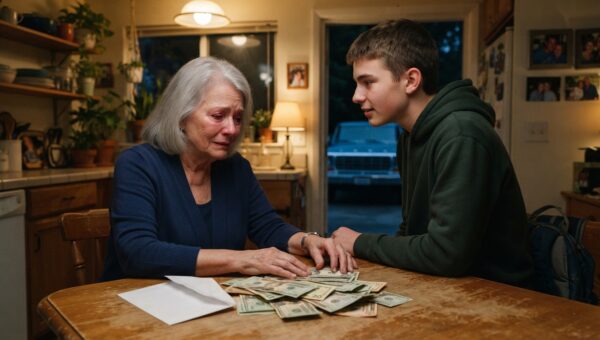
David sat at my kitchen table and asked me to put my house up as collateral for his loan. The house his father and I paid off in 1994, burning the final slip in a metal bucket on the back porch while the crickets were loud in the dry weeds. He is forty-six now. His contracting business is eighty thousand dollars underwater, and the bank needs a co-signer with real equity.
“Mom, if you don’t, we lose the house and the kids change schools,” he said.
Three grandbabies. Twelve, nine, and six. I raised him to stand on his two feet, and he did, right up until the work dried up and the material costs doubled. I live on nineteen hundred dollars a month from social security and my old survivor benefit. This house is the only asset I have left in the world. Sign the bank papers, and if he fails, I am seventy-two years old with nothing to my name. Don’t sign, and I watch those kids pack their toys into cardboard boxes. I sat there at the laminate table. I kept folding the same cotton dish towel over and over until the threads frayed under my thumbs. David wouldn’t look up from his coffee mug. He just stared at the little brown ring left by the ceramic.
“I’d never ask if there was any other way,” he muttered.
The silence in the kitchen felt heavy, like the air right before a summer cloudburst over the valley.
I didn’t reach for the pen. I laid the folded towel down right next to the bank’s manila folder. My father always told me that a man who asks you to sign your name in the dark is inviting you to stumble into a ditch he dug himself. David stood up after a minute, his chair scraping hard against the linoleum. He left the paperwork right there on the table, face up with all the zeros staring at me. He walked out to his white pickup without saying goodbye, and the gravel crunched loud under his tires as he backed out toward the highway.
I stayed at the table until the light turned the color of old brass. Nineteen hundred dollars a month does not leave room for mistakes. In 1994, when the mortgage was finally dead, Arthur and I sat on that porch and drank warm beer because we didn’t have ice.
We didn’t own much, but what we owned was clear of banks and liens. I walked over to the sideboard and pulled out my ledger book where I keep track of the electric bill, the propane, and the car insurance. The numbers looked small and honest compared to the massive debt David had piled up on those bank pages.
Two days later, Sarah showed up at my front door before noon. She didn’t look like herself. Her hair was pulled back with a yellow pencil, and her eyes had that red, swollen look that comes from crying behind closed bedroom doors so the children won’t hear. She sat in the same chair David had occupied, but she didn’t look down. She looked right at me with a hard, tired frustration.
“He didn’t tell you the half of it, did he?” she asked.
“He told me about the eighty thousand,” I said, pouring her a cup of lukewarm decaf from the pot on the counter.
“It isn’t eighty thousand from bad jobs, Mom,” Sarah said, and her voice shook when she used that name, the way she always did when she was holding herself together by a thread. “It is eighty thousand because he has been floating three dead-end commercial builds for two years just to keep his guys paid.
He drained our household savings back in March. I found out when the grocery card declined at the register.”
The kitchen felt very small then. I looked at Sarah, and I realized David had built a wall of pride right through the middle of his own home, keeping his wife in the dark just like he tried to keep me in the dark with a stack of bank forms.
“He’s terrified,” I told her quietly.
“Terror doesn’t pay the lumber yard,” she said, setting her mug down hard enough to rattle the rim. “If you sign that house over as collateral, you aren’t saving us. You’re just pulling the chair out from under yourself so we can all drown together.”
I didn’t argue with her. She was right, and deep down, I knew it from the moment David slid those papers across the laminate.
The next morning, I drove out to the industrial park on the edge of town where David keeps his equipment yard. It is a gravel lot fenced in with rusted chain-link and stacked high with spare lumber bundles, old scaffolding, and three heavy commercial flatbeds that haven’t moved since the first frost. David was standing by the tailgate of his truck, arguing into his phone with a plumbing supplier. When he saw my old Buick pull up beside the office trailer, he hung up the phone and jammed it into his pocket like a kid caught doing something he shouldn’t.
“Mom, you shouldn’t drive out here. It’s dusty,” he said, wiping his grease-stained hands on a blue rag.
“Get your books, David,” I said, keeping the engine running so the air conditioning could blow on my knees.
“My what?”
“The ledgers. The real ones. Not the summary you brought to my kitchen table for the bank.”
He stared at me for a long beat, his jaw tight the way his father’s used to get when the tractor engine seized up in the middle of a ten-acre field. He looked small standing there among the rusted trailers and the piles of discarded drywall. For a second, I almost put the car in drive and went home to bake bread and forget I ever saw the papers. But I didn’t. I cut the engine and stepped out into the grit and the smell of diesel.
“Bring them into the trailer,” I said. “And bring Sarah’s phone number, too, because she’s coming over this afternoon whether you like it or not.”
We sat around that scratched plastic table in the back of the office trailer with a box of cold soda cans and two yellow legal pads. It took us four hours to go through every invoice, every tax lien, and every past-due materials account. The eighty thousand dollars wasn’t just a sudden market slump. It was penalty interest from high-interest equipment loans David took out in secret because he was too proud to tell his crew he couldn’t afford new tires for the dump trucks. He had been robbing Peter to pay Paul since the winter of the previous year, burying his head in the sand while the interest piled up like snow against a barn door.
“I can’t let the kids lose their school,” David whispered, and his voice finally broke, the last of his big contractor bluster washing out of him until he sounded like the little boy who scraped his knee falling off the hayloft. “They have their friends there. Sarah loves that neighborhood. If we move now, everything we built is just gone.”
“Nobody is packing boxes today,” I said, sliding the yellow pad across the table toward him. “But you aren’t mortgaging my roof to pay for trucks you aren’t even using.”
We called Arthur’s old bowling partner, Dennis, who had spent thirty years as a corporate accountant before retiring down by the reservoir. Dennis didn’t charge us for an hour of his time. He came over to my kitchen table on a Thursday evening with a pocket calculator and a sharp eye for corporate nonsense. He looked at David’s numbers, shook his head once, and laid out a map that didn’t involve my deed at all.
“You don’t need a co-signer, David. You need an auctioneer,” Dennis said, tapping his pen against the laminate. “You’re sitting on three commercial flatbeds and a spare bobcat that are costing you six hundred dollars a month just sitting in that yard depreciating. Sell the iron. Cut the two guys who haven’t pulled their weight since August. Go down to a two-man crew and take on residential remodels where the cash flow is weekly instead of thirty days out.”
David sat back in his chair, staring at Dennis like he had just suggested cutting off his right arm.
“That means I’m not a commercial general contractor anymore,” David said.
“Son, right now you aren’t a contractor at all, you’re a tenant of the bank,” Dennis told him, blunt as an iron wedge. “You can keep your pride or you can keep your kids in that school. Pick one.”
The meeting with the commercial loan officer at the bank took place on a Tuesday morning under fluorescent lights that hummed like an angry hornet nest. David didn’t look at the floor this time. He sat up straight in his suit jacket, the one he wore to weddings and funerals, and laid out Dennis’s liquidation plan right on the loan officer’s walnut desk. He offered to sell the surplus commercial vehicles immediately to pay down twenty-five thousand of the principal, and presented a restructured payment schedule based on residential framing and deck work.
I sat in the plastic chair by the door, my purse held tight in my lap, ready to stand up if they asked for my signature. The loan officer, a young man with a neat red tie and sleeves rolled up to his elbows, looked over the asset sale agreement twice. He looked at David, then he looked over at me sitting quietly by the water cooler.
“Your mother isn’t signing as guarantor?” the officer asked.
“My mother’s house stays out of this,” David said, and his voice didn’t waver even a little bit. “This is on the business, and the business assets are covering the gap.”
The officer tapped his pen against the blotter, considered the columns of figures, and finally reached for his red stamp.
“We’ll approve the restructuring on a six-month probationary review,” the man said. “Get those trucks off your yard by Friday or the deal is off.”
The drive back home was quiet, the kind of quiet that feels like a clean floor after a long winter of mud. We didn’t talk much about the bank or the trucks. When we pulled into my driveway, David walked me up the porch steps and carried my bag of groceries inside without being asked. He stood by the screen door for a moment, looking out over the tomato plants I had put in behind the rain barrel.
“Thanks, Mom,” he said, and his hand rested on the wooden door frame for a second before he turned back toward his truck.
“Tell Sarah to bring the kids over for Sunday pot roast,” I told his back. “I want to hear how the spelling tests went.”
He gave a little wave, got into his truck, and drove down the road without kicking up quite as much dust as he did the day he brought the papers.
Now the house is quiet again. The afternoon sun is hitting the smooth laminate of the kitchen table in a long, bright shaft, lighting up the dust motes dancing in the air. Right there in the middle of the table, beneath a clean, neatly folded white dish towel, sits the blue folder with the deed to this house, safe and untouched. Outside on the back porch, the old metal burn bucket is still sitting by the woodpile, rusting a little around the bottom where the rain catches it. I poured myself a fresh cup of instant coffee and carried it over to the window, watching the sparrows fight over the birdbath in the yard. My name is on the title, and the roof overhead is paid for in full, brick by brick and bone by bone, just like Arthur and I promised each other thirty years ago.