I came home unannounced to surprise my parents in the house and on the land I bought them after years of sacrifice, and the first thing I saw made my blood run cold. The first thing I saw when I pulled into the driveway after six years of working myself raw in Houston was not the white house with the red roof I paid for so my parents could finally grow old without fear.
It was not the front porch my mother used to talk about, the one where she said she wanted to sit in the evenings with a cup of coffee, a thin blanket over her knees, and the sunset warming her face. It was not the little field behind the house I bought so my father could grow what he wanted instead of breaking his back for someone else’s table.
Instead, the car tires crunched over dry gravel that sprayed against the side of a rusted-out single-wide trailer. The paint was peeling off the warped plywood skirting in long, gray strips. An old plastic lawn chair with a cracked seat sat by the door next to a rusted oil drum being used as a trash can. The whole place smelled faintly of stagnant ditch water and rotted pine needles. My hands were still gripping the steering wheel so tight my knuckles looked like chalk.
I sat there in the cab of my truck with the engine idling, waiting for my brain to catch up with my eyes, trying to convince myself I had punched the wrong address into the GPS.
The monthly wire receipts in my glove box said otherwise. I had sent thirty-eight thousand dollars just this past spring for the final masonry work on the chimney and the wrap-around porch railings. For six years, every single paycheck from the heavy equipment yard in Houston had been split right down the middle. Half for my tiny rented room near the ship channel, and half wired straight back home to my mother. She had always thanked me in those long, rambling letters she wrote on lined yellow paper, talking about how the hydrangeas were taking root by the well and how my father was finally sleeping through the night without his ribs aching from coal dust.
A screen door banged shut across the porch. My mother stepped out into the harsh afternoon sun, squinting through her bifocals. She looked older than she had six years ago. Her hair was thinner, pulled back into a messy knot with a yellow pencil holding it together, and her apron had a grease stain right near the pocket. When she saw my truck sitting there by the rusted oil drum, she froze. The basket of laundry she was carrying slipped an inch in her grip, the plastic handle digging into her forearm.
She didn’t run down the steps to hug me. She didn’t drop the basket and start crying tears of joy like I had imagined every single night during the double shifts on the loading docks. She just stood there on the warped wood of that sagging porch, her face draining of color until she looked almost gray in the glaring sun.
“Well,” she said, and her voice sounded thin and dry. “You’re early.”
I turned off the ignition, the sudden silence inside the cab deafening me, and pushed the door open. My boots hit the dirt with a heavy thud. I didn’t say hello. I just looked around the small, neglected patch of scrub brush that passed for a yard, noticing the weeds choking out what little grass tried to grow near the rusted well pump.
“Where is it, Mama?” I asked. My voice didn’t sound like mine. It sounded flat and hollow, like someone talking from the bottom of an empty well.
“Where is what, honey?” she asked, shifting the laundry basket to her other hip. Her fingers were trembling. I watched the way her wedding band loose-fitted her knuckle, a little detail I shouldn’t have noticed, but my eyes locked onto it.
“The white house,” I said, taking two slow steps toward the porch. “The red roof. The field for Daddy’s garden. I sent the checks every month, Mama. Every single month for seventy-two months. I missed Christmas with the crew down in Baytown so I could pick up holiday overtime for the foundation pour.”
She took a step back, her heel catching on the edge of the screen door frame. “It’s a long story, Raymond. Things got complicated after the lumber prices went up.”
“Lumber prices didn’t buy a rusted-out scrap heap in the middle of nowhere,” I said.
Before she could answer, the side door swung open wider, and my brother Donald stepped out into the light. He looked greasy, wearing a stained tank top and a pair of gym shorts that had seen better days. He had a beer bottle in his hand, condensation dripping down his knuckles. He took one look at me standing by my truck and gave a little half-smile, the kind of crooked grin he used to give right before our father caught him sneaking out the back window with the car keys.
“Hey there, big shot,” Donald said, taking a sip of his lukewarm beer. “Thought you weren’t coming home till Thanksgiving.”
That was when the pieces started clicking together in my head with a sickening, heavy weight. I didn’t yell. I didn’t throw my keys or slam the truck door. I just walked past my mother, stepping right over the threshold into the dark, cramped living room that smelled of old carpet and cheap tobacco.
The house was tiny. Two small bedrooms, a kitchen with grease-caked burners, and linoleum peeling up near the sink. There was no custom cabinetry. There was no stone fireplace. There was just a sagging floral couch with springs poking through the cushions and a television set balanced on an empty milk crate.
“Where’s the rest of it?” I asked, turning back to face them as they followed me inside. Donald stayed by the door, leaning his shoulder against the cheap paneling like he owned the place. My mother stood in the middle of the room wringing the edge of her apron until her knuckles were white.
“Your brother had some trouble with the county down in Jackson,” she whispered, her chin dropping to her chest. “They were going to take the shop, Raymond. They were going to put a lien on everything he built. He needed a bridge loan. Just a temporary thing.”
“Temporary,” I repeated the word out loud, tasting the bitterness of it on the back of my tongue. “For six years?”
“He’s your brother,” she said, and that old family line sounded like glass breaking on a hardwood floor. “What was I supposed to do? Let him lose his livelihood while you were sitting pretty down in Texas with your air-conditioned job?”
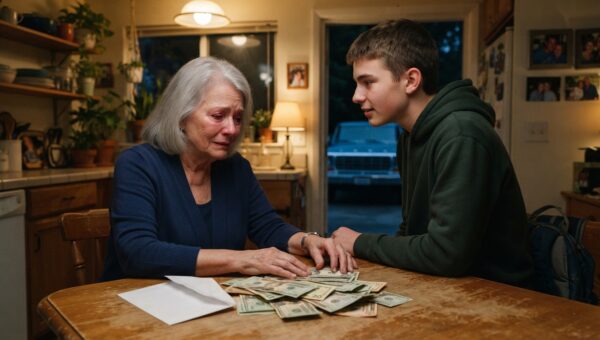
I reached into the inside pocket of my jacket and pulled out the manila folder I kept with me, the one containing every certified bank wire receipt, every deposit slip, and the official county property tax records I had pulled up on my phone at a truck stop forty miles back down the interstate. I didn’t throw them at her. I just laid them out one by one on the scarred laminate kitchen table.
“The property down the road sold for twelve thousand five hundred dollars three years ago,” I said, pointing my finger at the county deed I had printed out. “That’s what this scrap heap cost. Not the eighty thousand I wired for the construction. Not the thirty thousand for the clear title. Twelve grand. And the rest of it?”
Donald rolled his eyes and took another swig of his beer. “Oh, stop whining. You make good money down south. It’s not like you’re hurting for groceries.”
“You took my life, Donald,” I said, and my voice finally cracked. Not with tears, but with a cold, jagged anger that had been freezing in my chest for an hour. “Every double shift. Every Sunday I spent crawling around inside those hot tanks down at the refinery while my hands blistered and my back locked up so bad I couldn’t climb out of the truck at night. I sent every dime of it here because I thought my mother was sitting on a porch watching the sunset.”
“I did sit on the porch,” my mother cried out, her voice breaking as the tears finally spilled over her glasses. “In the evenings, after the dishes were done. I sat out there on these very steps with my coffee, just like I told you. It ain’t a bad place once you get used to the quiet.”
She didn’t get it. Or maybe she just refused to look at what she had done. To her, a porch was just a piece of wood outside a door, and my labor was just a bottomless well she could keep dropping her bucket into whenever Donald ran his car into a ditch or got himself sued by another local supplier.
“You lied to me in every letter,” I said. “You sent me pictures of some other house down in the valley and told me it was ours.”
“We wanted you to be proud,” she whispered, her hands shaking so hard she had to grab the back of a kitchen chair to steady herself. “We didn’t want you feeling like you wasted your time out there all alone.”
I stood there in the middle of that cramped, stinking room for a long time, listening to the hum of the old refrigerator and the sound of Donald burping softly near the door. The silence between us wasn’t quiet anymore. It was heavy, filled with the wreckage of six years that I could never get back, six years of sweat and grit traded away for a lie.
“The wire transfers stop today,” I said quietly.
Donald stopped chewing on the inside of his cheek. His eyes narrowed. “What do you mean, they stop? He’s got court dates coming up next month. We still need, ”
“You’ll get nothing,” I said, looking right past him at the water-stained wall behind the sink. “And I’m calling the lawyer in town tomorrow morning to have my name stripped off this deed. You want this land? You want this trailer? You and Donald can figure out how to pay the taxes on it yourselves.”
“Raymond,” my mother choked out, taking a stumbling step toward me with her hands outstretched like she wanted to grab my sleeve. “You can’t do that to your own family. We’re all you’ve got.”
I didn’t step back, but I didn’t let her touch me either. I just looked at her face, really looked at it, seeing the stranger behind the gray hair and the grease-stained apron.
“No,” I said. “You stopped being my family the day you decided my life was worth less than his mistakes.”
I turned around and walked back out the screen door, letting it slam shut behind me with a sharp, echoing crack. The sun was dipping low behind the distant treeline, painting the sky in heavy streaks of orange and bruised purple, but there was no sunset porch here to watch it from. There was only the gravel driveway, the rusted oil drum, and the idling truck waiting to take me back south.
I walked down the two warped wooden steps, stopping right at the edge of the neglected dirt yard where the tall weeds brushed against my boots. I reached into my jacket pocket, pulled out the thick packet of false photographs my mother had mailed me over the years, and let them drop from my fingers into the dust. A light evening breeze caught one of the pictures, sliding it across the gravel before it came to rest against a rusted tin can. I didn’t bend down to pick it up. I just got back into my truck, put it in reverse, and drove away without looking in the rear-view mirror once.