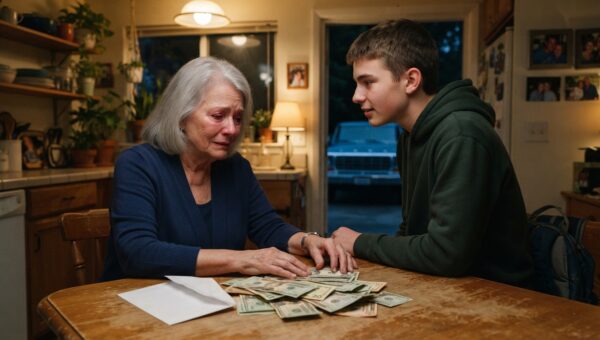
The push notification lit up my phone screen at 6:15 on a Friday morning, right while I was scrubbing the third-floor hallway tile at St. Jude’s Academy. It was a calendar alert for Easter Sunday dinner at Eleanor and Richard’s house. I did not want to go. I never wanted to go. But I looked down at eleven-year-old Audrey sitting on the bottom bleacher in the gymnasium with her textbook open on her knees, waiting for my shift to end so we could walk home together to our small apartment on Maple Street.
Daniel had been gone three years. When he was alive, his parents treated us like distant acquaintances they tolerated out of a sense of family PR. Once he passed away from that sudden heart attack at thirty-four, the polite distance turned into a heavy, locked iron gate. Daniel came from old money, trust funds, and country club memberships. I came from a trailer park two counties over where my dad fixed tractors until his lungs gave out. Daniel never cared about any of that. He loved the way I laughed when I spilled coffee on the stove. He loved my messy hair. But the moment his casket was lowered into the damp Dayton earth, Eleanor and Richard made it clear that their son’s generosity did not extend to the woman he left behind.
They cut off all support before the flowers on the grave even started to wilt. No phone calls to check on Audrey.
No offer to help with groceries. Just a cold letter from their family lawyer reminding me that Daniel’s separate estate was locked up tight. So I took whatever work I could find. I cleaned motel rooms until my knuckles cracked, worked the cash register at the 24-hour laundry mat, and eventually landed the head custodian job at St. Jude’s. It was hard physical labor. The bleach smelled sharp and chemical in my nose for hours after I clocked out. But it paid $41,200 a year, gave us health insurance, and most importantly, it meant Audrey could attend the academy on staff tuition remission.
Twice a year, Eleanor and Richard invited us to their estate for the holidays. It was never about love. It was about keeping up appearances so their social circle could admire how charitable they were to their poor widowed daughter-in-law. I went for Audrey. I wanted her to know her father’s side of the family, even if they were cold and hollow inside.
That Easter Sunday, the air in their dining room felt heavy enough to choke on. The silver candleholders on the lace runner caught the light of the crystal chandelier, throwing sharp little prisms across the walls. Eleanor sat at the head of the table in a cream-colored St. John knit suit, her blonde hair sprayed into an immovable helmet. Richard carved the ham with long, slow strokes, his face red from scotch and self-importance.
We sat near the far end of the mahogany table, Audrey and I. Audrey wore a simple navy blue dress I had bought her on clearance at Marshall’s, but she sat with her back straight, her napkin neatly folded across her lap. She looked so much like Daniel in the jawline that it made my chest ache every time I glanced sideways at her.
“More wine, Clara?” Eleanor asked, her voice dropping down into that smooth, glacial register she reserved for people she considered help.
She did not wait for an answer before motioning to the housekeeper.
“I’m fine, thank you,” I said softly, staring down at my water glass.
Richard set the carving knife down with a dull clatter against the porcelain platter. He wiped his hands on a linen napkin and looked down the length of the table, his eyes landing squarely on my shoes, which still had a faint smudge of floor wax near the heel from Saturday’s deep clean in the north wing.
“Still cleaning toilets, Clara?” Eleanor asked. She didn’t even try to keep the smirk out of her voice. It was sharp enough to cut glass. “I saw your uniform hanging in the utility closet when I dropped off some old linens at St. Jude’s last month. Honestly, darling. With all the retraining programs the county offers, you’d think you could find something a little more suitable for a woman with a child.”
A few cousins down the table exchanged muffled laughs. My face felt hot, burning straight up to my ears. I opened my mouth to say something bland, something safe, because I had practiced keeping the peace for three long years. But Richard cut in before I could even draw breath.
“Daniel had a brilliant future,” Richard said, shaking his head with a slow, theatrical sigh as if mourning a stock portfolio gone bad. “It’s painful to see what was left behind. Such wasted potential.”
The table went completely quiet. The only sound was the grandfather clock ticking in the hallway, heavy and rhythmic. My fingers curled around my water glass so tight my knuckles turned white. I thought about the four-thirty-am alarms. I thought about the burning in my lower back after eight hours on the buffer machine. I thought about the way Audrey and I shared a single plate of scrambled eggs some nights when the grocery money ran thin, and how she never complained once.
I opened my mouth to tell them we were doing just fine, but I never got the chance.
Audrey set her fork down against her plate. The metallic clink sounded loud in the silent room. She didn’t yell. She didn’t cry. She just straightened her shoulders, looked directly across the table at her grandfather, and cleared her throat.
“No,” she said firmly. Her eleven-year-old voice carried a strange, steady authority that made Eleanor freeze mid-reach for the butter dish. “Listen carefully, Grandma and Grandpa.”
Richard blinked, his gray eyebrows shooting up toward his hairline. “Excuse me, young lady?”
“You heard me,” Audrey said, her voice clear and level. “You talk about my dad like he was some kind of prize that got dropped in the dirt. But he loved Mom. He loved her because she actually works for a living instead of sitting around a big house waiting for someone else to carry the plate.”
The silence in the dining room became absolute. Uncle Greg stopped chewing his ham. Aunt Sarah dropped her fork.
“Audrey, honey, that’s enough,” I whispered, reaching out to touch her wrist.
“No, Mom, it’s not enough,” Audrey said, turning her head to look at me with so much fierce love in her eyes it nearly knocked the wind out of me. She turned back to her grandparents, her chin lifted high. “You think Mom is a servant because she wears gray scrubs and pushes a mop. But do you even know what happens at St. Jude’s when you’re not paying attention? Do you know who actually runs the place?”
Richard opened his mouth, but no sound came out.
“Mom is the head custodian,” Audrey said, her voice ringing off the high ceilings. “She manages twenty-four buildings, five maintenance workers, and the entire supply budget. She works sixty hours a week so we can pay our rent and keep the pantry full. And while she’s down in the hallways cleaning up after spoiled kids who throw their trash on the floor, do you know what else she does?”
Nobody moved. Eleanor’s hand was still hovering over the butter dish, trembling just a fraction of an inch.
“She checks my algebra homework every single night at the kitchen table while her feet are still throbbing from the shift,” Audrey continued, her eyes locked on her grandfather. “And last week, the headmaster posted the mid-term academic rankings for the seventh grade. Out of one hundred and forty-two kids in my class, including all your rich friends’ kids who pay forty thousand dollars a year in tuition, I am ranked number one.”
The color drained entirely from Richard’s face. He looked like someone had punched him square in the chest.
“I got a full academic scholarship for the upper school, Grandpa,” Audrey said quietly, leaning forward over her napkin. “Not because of your name. Not because of a trust fund. Because Mom taught me how to work hard, how to study until midnight, and how to hold my head up even when people who share my blood look down their noses at us.”
She picked up her cloth napkin, laid it neatly beside her untouched plate, and slid her chair back against the hardwood floor with a soft scrape.
“Thank you for the dinner invitation,” Audrey said, her tone as polite as a hotel concierge. “We’re going to go home now. Mom has to prep the gymnasium floors for the Monday morning assembly.”
She stood up, walked around the table, and grabbed my hand. Her small fingers were warm and strong. I stood up with her, my knees shaking slightly, but my back straighter than it had been in three years. I looked down the length of that long, expensive table at Eleanor and Richard. Neither of them could meet my eyes. Uncle Greg was staring intently at his water glass. Aunt Sarah looked like she wanted to disappear into her chair.
We walked out through the double doors of the dining room, past the crystal chandeliers and the polished antiques, stepping out onto the gravel driveway into the cool, sharp air of an April evening. The sun was dipping low behind the maples, painting the sky in deep streaks of gold and violet.
Audrey squeezed my hand as we walked toward the gate, leaving the sterile, silent opulence of the grandparents’ estate far behind for the warm, cluttered kitchen waiting for us on Maple Street. My hands smelled like bleach and laundry soap, but as I looked down at my daughter walking beside me, I knew they were the cleanest hands at the table.