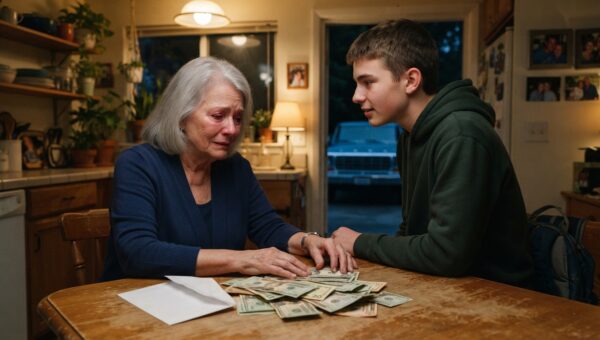
My daughter-in-law Brenda paid ninety dollars a visit for three days a week, and I hated the sound of her key turning in the deadbolt. Every Tuesday, Thursday, and Saturday at nine in the morning, the heavy brass lock would click, and I would feel like a trespasser in my own kitchen. I would be sitting at the scarred oak table with a mug of warm water, trying to look as busy and self-sufficient as possible.
Gene, my only boy, worked sixty hours a week down at the grain elevator and managed three rental houses on the side just to keep his own kids in braces and soccer cleats. He didn’t need his widowed mother sitting around waiting for him to check her blood pressure.
Brenda meant well, of course she did. She had three kids under twelve and a part-time job at the title company, yet she still found time to worry about my gray hair and my empty pantry. But ninety dollars a visit was an insult to my common sense. That was nearly three hundred dollars a week just to have someone sit across from me while I pushed a spoon through lukewarm beef broth. I could boil my own bones. I could stare at my own wallpaper without paying an hourly rate for the privilege.
The newest aide was a quiet woman named Etta. She had short, iron-gray hair parted on the side and wore sensible sneakers that didn’t squeak on the linoleum.
On her first two visits, we barely spoke fifty words. I gave her short answers, and she wrote neat little notes on her clipboard about my pill box and the laundry basket. She moved like a nurse who had spent thirty years on hard hospital floors, efficient and unbothered by silence. By the fourth visit, however, the quiet between us had grown heavy, like the humidity right before a July thunderstorm in Sedgwick County.
I was staring down at my midday mug when Etta walked in, shrugged off her canvas coat, and set her black leather bag by the refrigerator. She didn’t head straight for the sink or ask about my joints the way the others did. Instead, she pulled out a folding chair, sat down directly across from me, and laid her ballpoint pen flat across her notepad. The click of plastic hitting paper sounded louder than it should have in the quiet room.
“Ma’am, how long have you been hiding that you can’t swallow?” she asked.
The question hit me right behind the breastbone, sharp and sudden as a dry cough. I felt my shoulders tighten up against the ladder-back chair. I tried to pull my usual trick of offering a thin, dismissive smile, but my jaw felt locked in place. I had been living on strained broth and melted ice cream for eight months, telling Gene every Sunday over the phone that I just wasn’t hungry anymore, that older folks didn’t need heavy meals. A weight pressed down on my chest until breathing felt like pulling dry wool through a narrow pipe. I didn’t want to be a burden. He had enough on his plate without driving me to clinics and sitting in sterile waiting rooms while some young doctor told him his mother was falling apart.
“I am just getting older, Etta,” I said, my voice sounding thin and papery even to my own ears. “People lose their appetite. It is a natural part of things.”
Etta didn’t blink. She reached across the oilcloth table and took my hand in hers, her palm dry and calloused from years of lifting patients who couldn’t lift themselves. “This isn’t picky eating. Something is closing, and the longer we wait…”
She didn’t finish the sentence out loud because she didn’t need to. She saw the tremor in my fingers. She saw the way my throat muscles hitched every time I tried to force a swallow of air. She knew the clinical signs of a stricture better than I wanted to admit, having spent decades working the night shift down at Wesley Medical before her knees gave out and she moved to home care. Without asking for my permission, she picked up her phone from the table, unlocked the screen with a steady thumb, and dialed a number from my emergency list.
“Gene,” she said into the receiver the second someone picked up on the other end, her voice dropping into that calm, flat tone that professionals use when they are about to deliver bad news. “This is Etta. I am at your mother’s house. You need to leave work right now and come home.”
I sat frozen in the armchair, my hands gripping the armrests until my knuckles went stark white. I wanted to snatch the phone out of her hand and tell Gene it was a false alarm, that I had just swallowed wrong, that I was fine. But my tongue felt thick and dry, and my brain kind of stopped working for a second. The secret I had guarded for eight months, the quiet starvation I thought I was managing so cleverly behind closed curtains, was unraveling in the span of thirty seconds over a nineteen-dollar landline speaker.
“She isn’t eating,” Etta said, looking right into my eyes while Gene shouted something panicked on the other end of the line. “She hasn’t been for months. Her esophagus is restricted. You need to get her to an ear, nose, and throat specialist today. Not tomorrow. Today.”
She clicked the end button before Gene could ask another dozen frantic questions. The silence that settled back over the kitchen was different now. It wasn’t the comfortable silence of two strangers minding their own business; it was the sharp, ringing silence of a trap springing shut. Etta stood up, walked to the sink, rinsed her hands under the tap, and dried them on a dish towel without saying another word. She just waited by the door, quiet as a shadow, while I sat there trembling in my cardigan.
Twenty-two minutes later, the gravel in the driveway crunched under the tires of Gene’s old Ford pickup. The truck door slammed with a heavy, rattling thud that shook the front windows. Gene didn’t bother knocking; he threw the deadbolt open with his key, his face flushed and his work shirt half-tucked into his denim trousers. He looked past Etta like she was a stranger in a store and dropped down on one knee right beside my chair, his big, rough hands hovering over my knees as if he were afraid to break me.
“Mom,” he said, breathing hard like he had sprinted up the stairs from the shop floor. “What is going on? Etta said you can’t swallow. Why didn’t you call me?”
“I didn’t want to bother you, Gene,” I whispered, the shame of it finally rising up in my throat like bile. “You are working yourself to the bone. I thought it would pass.”
“Pass?” Gene’s voice cracked a little bit, and I saw the exhaustion in the deep lines around his eyes, lines I had pretended not to notice for months. “You look like a skeleton, Mom. Why would you hide something like this from me?”
“Because I am supposed to be taking care of things, not adding to your list,” I said, and for the first time in eight months, a real tear slipped down my cheek without me trying to stop it.
Gene didn’t yell at me. He just let out a long, shaky breath, looked up at Etta, and nodded once. “Thank you for calling.”
“That is what I am here for,” Etta said quietly, gathering her notepad and slipping her pen into her pocket. “I will leave you two to get ready. You have an appointment at four o’clock across town. I already called the clinic and told them you were coming.”
The next four hours were a blur of fluorescent lights, cold vinyl chairs, and white-coated doctors shining penlights down my throat. The specialist, a kind man named Dr. Vance with silver hair and kind eyes, confirmed what Etta had suspected from the start. A severe esophageal stricture had formed over the past year, narrowing the passage until nothing thicker than water could pass without getting stuck. Dr. Vance looked at my chart, then looked over at Gene standing anxiously by the door, and shook his head gently.
“Another month of this and you wouldn’t have been able to handle your own saliva, Mrs. Miller,” Dr. Vance said, and his words didn’t sound like a scolding, just a plain, hard fact. “We can fix this with a simple outpatient dilation procedure, but you are going to need someone to help you manage your nutrition for a few weeks afterward.”
Driving home, the cab of the truck smelled of stale coffee and the damp wool of Gene’s work jacket. Neither of us said much for the first three miles, the hum of the engine filling the space between us. I kept my hands folded in my lap, watching the flat Kansas fields blur past the passenger window in the late afternoon sun. I had spent eight months convincing myself that hiding my weakness was a kindness to my family, a way to spare them from the burden of my aging body. All I had really done was make them strangers to my pain.
“We are going to do things differently from now on,” Gene said softly as he turned the truck onto my street. He didn’t look at me, keeping his eyes on the asphalt, but his jaw was set. “Brenda is already planning on bringing dinner over three nights a week. Real food. Soft food to start, but actual meals.”
“You don’t have to spend the extra money on aides every week, Gene,” I murmured, testing the old argument just out of habit.
“Mom,” Gene said, pulling into the driveway and cutting the engine. The sudden silence of the truck was heavy and complete. “Etta costs ninety dollars a visit. You cost me nothing compared to what I would have lost if you had kept quiet another month. Let us help you.”
Two weeks after the procedure at the clinic, the kitchen table looked different. Etta was still coming three days a week, but the resentment I used to feel when I heard her key in the lock was entirely gone. Now, I actually had the kettle on by the time she walked through the door.
On a Tuesday afternoon, Brenda walked in carrying a covered ceramic casserole dish while Gene followed behind with a loaf of soft, buttered bread. They set the steaming bowl of nourishing potato soup right in the middle of the table, right alongside Etta’s black notepad and her ballpoint pen. The air in the room didn’t smell like thin broth and isolation anymore. It smelled like warm butter and garlic, rich and heavy and unmistakably alive.