My husband Elwood balanced our checkbook to the penny for 52 years. So when I found a thick folder in his workbench drawer after he passed, I couldn’t make it add up. Receipts from the hardware store in town. Layaway slips, strangers’ names, every December going back to 1986. Forty, fifty dollars each, all marked paid. He’d been quietly clearing other folks’ Christmas layaways for almost forty years and never breathed a word, not even to me.
I sat down on his cold stool in the garage. And then I remembered. Our first winter married, 1985, broke and too proud to ask for help. How we’d put a little red wagon on layaway for our girl and couldn’t make the last payment. How we walked in that week to give it up, and the clerk smiled and said it was already paid for by a friend.
The garage still smelled like him. It smelled of motor oil, WD-40, and the damp cedar shavings he kept in a coffee can by the lathe. Elwood spent every Saturday out here after he retired from the county road department, fixing lawnmowers for neighbors who couldn’t afford a mechanic. He never charged them full price. Sometimes he took a pie or a sack of sweet corn, but mostly he just did it because he had time on his hands and grease under his fingernails.
I had been going through his things for three days. Clara, our daughter, had gone back to her own house in Des Moines after the funeral, promising to call on Tuesday. The house felt too big and too quiet. Every floorboard creaked in places I had forgotten. I figured I needed to clear out the workbench so I could find his spare truck keys and the title to the old Ford. That was when I pulled the bottom drawer too far and it jammed against a stray bolt. When I jerked it loose, the folder slid out from the very back, wedged behind a box of rusted carriage bolts.
It was a standard manila folder, but the edges were curled from thirty years of humidity in an unheated garage. Written on the tab in Elwood’s neat, sloping mechanical print were the words Miller’s Hardware, 1986 to 2004. Inside were receipts, yellowed slips of paper, and pink carbon copies stapled together in little bundles for every single year.
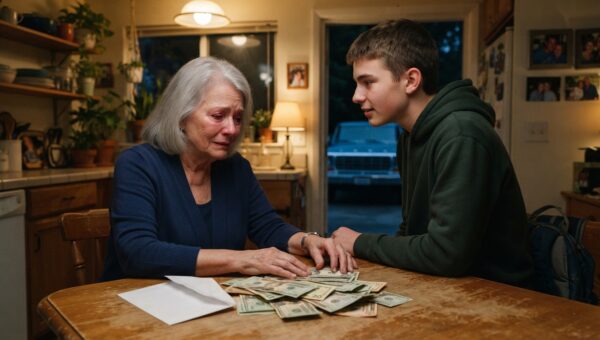
I carried the folder into the kitchen and sat at the oak table where we had eaten ten thousand meals. The sun was coming through the window, catching the dust motes dancing in the air. I opened the cover. The first paper was dated December fourteenth, 1986. A receipt from Miller’s Hardware for forty-two dollars and fifty cents, with a name scribbled in the margin that I did not recognize. Below it, in Elwood’s handwriting, were the words One red tricycle, paid in full.
I turned the page. December 1987. Fifty dollars. A winter coat and a pair of boots.
December 1988. Sixty-five dollars. Dollhouse accessories.
It went on like that, year after year, page after page, up until December of last year, just a few months before his heart gave out in the garden. I sat there with my glasses slipping down my nose, turning the onionskin pages until my fingers felt stiff.
Elwood had spent thousands of dollars over four decades. Our checkbook never showed it because he kept a separate cash tin behind the water heater, the one he used for side jobs and scrap metal money. He never bought himself a new coat. He patched his work boots with shoe goo three times before finally breaking down and buying a new pair at the farm store.
I kept thinking about how quiet he was. Elwood wasn’t a man for grand speeches. When Clara was born in the bitter cold of January 1985, he didn’t cry or shout. He just held her tiny hand with his big, grease-stained thumb and whispered, “Well, hello there, little bird.” That was the extent of his poetry.
The memory of that first winter came back to me so sharply I could feel the chill in my bones. We were living in the little rental on Maple Street with single-pane windows that frosted over every night. Elwood was making four dollars an hour at the grain elevator, and every cent went to coal and formula. Clara was just turning one, and we had scrimped for six months to put a bright red wagon on layaway at Miller’s Hardware down on Main Street. It was five dollars down and five dollars a week. We thought it was a fortune.
By the second week of December, the truck broke down, the radiator cracked, and we had nothing left. I remember walking down there with Clara bundled in her wool bunting, my heart feeling like a heavy stone in my chest. I had to tell Mr. Miller we couldn’t finish paying for it. I had to let the wagon go back on the shelf for someone else’s child.
I can still see old Mr. Miller standing behind the wooden counter with his green visor and his white shirt sleeves rolled up. I can hear the way his voice sounded over the rattle of the space heater in the corner.
“You’re here about the red wagon, Martha?” he asked, looking down at his ledger.
“I’m sorry, Mr. Miller,” I told him, fighting back the heat in my face. “We just can’t manage the last twelve dollars this week.”
He didn’t look disappointed. He just smiled that slow, knowing smile old men have. “No need to worry about that, young lady. A gentleman was in here an hour ago and cleared the whole account. Said it was already yours.”
I stood there holding Clara, blinking through the snow that had melted on my eyelashes. “Who was it?” I asked.
“He said he was just a friend,” Mr. Miller replied, tapping the receipt with a stubby pencil. “Now take your girl home where it’s warm.”
I never knew who paid that twelve dollars. For years, Elwood and I talked about it, wondering which neighbor or uncle had slipped us that mercy. Elwood always got a strange, distant look on his face whenever we spoke of it, but he never said a word to suggest it was anything more than a lucky break.
Now, sitting at the kitchen table thirty-nine years later with his hidden folder of receipts, the truth settled over me like a warm quilt on a freezing night. Elwood hadn’t just wondered about that stranger. He had taken that twelve-dollar act of grace and built an entire cathedral of kindness out of it, brick by quiet brick, year after year, without ever asking for a single pat on the back.
I closed the folder and walked out to the truck. The old Dodge still had his blue baseball cap hanging from the turn signal lever. I turned the key and drove down into town, past the grain elevator and the post office, right up to the curb in front of Miller’s Hardware.
The store had changed hands ten years ago when old Mr. Miller passed, but young Arthur Miller Jr. kept the place running just the way his daddy did. The bell over the door still gave that same brassy chime when I walked inside.
Arthur was behind the counter, wrestling with a box of galvanized nails. He looked up, wiped his hands on his apron, and smiled when he saw me.
“Morning, Martha,” he said, leaning against the counter. “How are you holding up?”
“I’m getting by, Arthur,” I said, laying the manila folder right between us on the scarred wooden wood. I opened it to the first page. “Did you know about this?”
Arthur looked down at the yellowed slips of paper. His smile softened into something quiet and respectful. He didn’t look surprised at all.
“Elwood started coming in right after my daddy died,” Arthur said softly, tracing the edge of an old 1992 receipt with his thumb. “He walked in here every December fifth, rain or shine. Put down three hundred dollars in cash. Told me to look at the ledger and find the families with little kids who were behind on their Christmas layaways. He made me promise on his grave I wouldn’t tell a soul.”
“For forty years?” I asked, my voice cracking just a little bit.
“Every single year,” Arthur said. “Sometimes he didn’t even have enough for his own truck parts, but he never missed December. He told me once that the hardest thing in the world is standing at a counter when you’ve got nothing in your pocket and a child waiting at home. He said he wanted to make sure nobody else had to feel that specific brand of cold.”
I stood there in the middle of the hardware store, surrounded by the smell of rope, iron, and cedar mulch, and I felt a great wave of tenderness wash over me. It wasn’t grief anymore. It was just the staggering realization that I had lived for half a century with a saint and never even knew his halo was made of greasy work gloves and old receipts.
“He was something else, weren’t he?” Arthur whispered.
“He was stubborn,” I said, and for the first time in a week, I actually laughed out loud.
I drove home slower than usual, keeping both hands on the wheel of the Dodge. When I got back to the house, I called Clara on the landline. She picked up on the second ring, her voice tight with worry.
“Mom? Is everything okay?” she asked.
“Everything is just fine, honey,” I told her, looking out the kitchen window toward the old red shed where Elwood kept his tools. “I found something of your dad’s. And I want to tell you about a red wagon from 1985.”
We talked for an hour. By the time we hung up, we had a plan. Elwood’s birthday is coming up in November, and Clara is coming home for the weekend. We aren’t going to have a memorial service or sit around drinking instant coffee. Instead, we are going to walk down to Miller’s Hardware with an envelope of our own, just like Elwood used to do.
The garage is quiet tonight. The sun has gone down behind the treeline, leaving a pale orange streak across the Iowa sky. Tomorrow morning, I’ll go out there and sweep the floor where Elwood stood for all those years, checking off his numbers, keeping his own secret ledger of love.