The roller made a dry, scraping sound against the old plaster that had been painted over four different times since 1974. I was three rooms deep into clearing out Mama’s house after the funeral, working my way down the dark hallway toward the kitchen where the smell of her stale Folgers coffee still seemed to cling to the yellowed wallpaper.
We had spent the entire weekend arguing about who was going to haul away the bins of cracked Tupperware and the mountains of expired canned goods in the pantry. My brother Dennis was already downstairs rattling the bulkhead doors, complaining that the old place wouldn’t fetch twenty thousand dollars on the open market even if we gutted the kitchen to the studs.
I gave the paint roller another push near the corner where the hallway narrows toward the linen closet. The wood paneling there had always looked slightly out of place, a dark walnut insert that didn’t match the pine trim around the bedroom doors, but Mama always said it was just a patch job from when the old furnace ductwork had been replaced back in the seventies.
The handle of the roller hit the panel with a dull, wooden thud that sounded wrong. Not solid brick or lath, but a hollow, resonant echo that made me stop dead with my arm half-raised.
I didn’t think much of it at first. I figured the wood had warped over the decades and left an air pocket behind the grain.
I set the paint tray down on a folded drop cloth and tapped the panel with the flat knuckles of my right hand. The sound went *tunk-tunk-tunk*, completely different from the solid thud three inches to the left.
I reached for the old flathead screwdriver sitting on the step stool and wedged the tip into the narrow gap between the walnut board and the baseboard trim. The old brass screws didn’t even put up a fight. They were rusted at the threads, but they backed out with a dry screech that made my teeth ache.
When the board finally popped loose, it didn’t fall inward. It stayed hinged on a concealed piano hinge I hadn’t noticed in the dim hallway light.
I dropped the screwdriver. The clatter on the hardwood floor sounded entirely too loud in the empty house.
Inside the cavity of the brickwork, tucked back into a recess that had been hand-chiseled out of the original foundation wall, sat a heavy steel box painted battleship gray. There was no keyhole on the front, just a circular dial with four numbers stamped into the brushed metal face.
My heart did a strange, heavy flip against my ribs. I sat back on my heels, the knees of my old jeans stiff with dried latex paint, and stared at the dial.
Mama had lived on a fixed pension for the last fifteen years of her life, and Dennis and I had spent half our adult Sundays arguing over whether we should chip in to help her pay for her prescription refills or her heating oil. She always waved us off with that sharp little flick of her wrist. “I don’t need your charity,” she’d say, her voice tight and thin as paper. “I know how to manage a dollar better than the lot of you combined.”
I remembered the worn-out soles of her sensible walking shoes lined up by the back door, and the way she saved every scrap of aluminum foil until it looked like crumpled silver lace. We thought she was just growing stubborn and poor in her old age.
I got up and walked down the hall to the small bedroom she used as a sewing room. Her framed portrait from her fiftieth birthday still sat on the maple dresser, the glass dusty and smudged around the corners.
With shaking fingers, I lifted the heavy frame and pried the cardboard backing loose from the rusted metal points. A yellowed grocery receipt fell out first, dated June 1988, followed by a folded strip of lined notebook paper.
On the back of the paper, written in Mama’s careful, left-handed cursive, were four numbers: thirty-two, twelve, four, eighteen.
I walked back down the hallway, the paper clutched in my sweaty palm, and knelt in front of the gray box. My fingers were stiff as I spun the dial left to thirty-two, right to twelve, left to four, and right to eighteen.
The heavy internal bolt gave a deep, metallic *clack* that vibrated right through the floorboards.
I pulled the steel door open. Inside wasn’t a stash of old savings bonds or bundles of mildewed twenties from some mattress-stuffing panic of the seventies. It was a single, heavy velvet pouch tied off with a faded gold cord.
I lifted the pouch out. It had some serious weight to it, shifting heavily in my palm like a bag of heavy lead sinkers.
I untied the knot and tipped the contents into my lap.
Fourteen small, dark leather cases tumbled out onto my dusty blue jeans, accompanied by a folded sheet of heavy cream letterhead. I opened the top case first. Inside the white satin lining sat a deep, pigeon-blood red stone the size of a robin’s egg, catching the single beam of sunlight from the hall window and throwing a sharp, fiery crimson gleam across the peeling wallpaper.
My hands started shaking so hard I almost dropped the case. I picked up the folded letterhead next and unfolded it on the floor.
It was a signed affidavit, notarized by a man named Arthur Vance at a downtown bank in the spring of 1991, thirty-three years ago.
“To whoever finds this,” Mama’s handwriting read, stark and unbending. “The banks broke my father in thirty-one, and they will break yours if you let them. Every penny I didn’t spend on Sunday roast or winter coats went into these stones through my brother-in-law’s old friend down in the city. They are certified, they are clean, and they are for the three of you when the ground gets too hard to dig. Do not let the banks have them.”
I sat there on the floor for a long time, the red stone glowing between my knees, listening to Dennis stomp around downstairs yelling my name about a box of old National Geographics.
Three days later, I was sitting across a cold mahogany desk in a quiet office on the third floor of a gemological lab in the city. The man examining the stones through a heavy silver loupe was old enough that his hands shook slightly whenever he set a sapphire down on the black velvet mat.
“These aren’t garden-variety department store stones,” he muttered, not looking up from his eyepiece. He adjusted the gooseneck lamp so the harsh white bulb pierced straight through a heavy, emerald-cut diamond resting near the edge of the tray. “Your mother bought these from the old Arthur Miller stock before he retired to Florida. You don’t see work like this anymore. The certification papers are all here in the packet.”
He reached for a small calculator, tapped a few keys with a yellowed fingernail, and slid a printed receipt across the blotter toward me.
“Wholesale replacement value today is roughly four hundred thousand dollars,” he said quietly, as if he were telling me the price of a basket of apples at the roadside stand. “Give or take ten thousand depending on the auction house.”
Four hundred thousand dollars.
I looked down at the slip of paper. The numbers didn’t attach themselves to anything real in my head. I thought of Mama’s pantry shelves lined with store-brand canned peas and the patched cardigan she wore until the wool wore as thin as gauze. She had walked two miles to the Piggly Wiggly every Tuesday to save twenty cents on a pound of butter while sitting on a fortune that could have bought half our county.
“Is everything all right?” the appraiser asked, peering at me over the top of his half-moon glasses. “You look like you’ve seen a ghost.”
“No,” I said, my voice sounding thin even to me. “Just remembering a coat.”
Two days after the appraisal, I called Dennis and our younger sister Sarah down to the family kitchen. I hadn’t told them anything over the phone, just that we needed to sign the final release forms for the estate lawyer before the weekend closed.
Sarah walked in first, smelling of damp wool and wet leaves, holding a cardboard box full of old kitchen towels she’d salvaged from the laundry room. Dennis followed her, wiping his muddy work boots on the porch mat and dropping his canvas jacket over the back of Mama’s old oak chair.
“If this is about the oil tank compliance certificate, I told you I’m not paying half,” Dennis said before he even sat down. “The county inspector is a crook. He wants twelve hundred just to sign his name.”
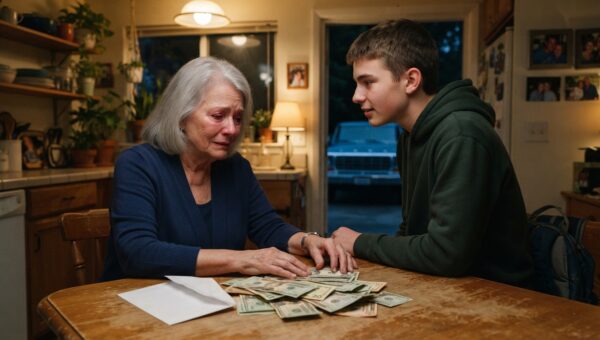
I didn’t say anything. I reached into my canvas tote bag, pulled out the heavy velvet pouch, and set it right in the middle of the worn oilcloth kitchen table.
The soft leather thud didn’t sound like money. It sounded like lead shot.
“What’s that?” Sarah asked, her hands hovering over the cardboard box. “Did you find some of Mama’s old sewing weights?”
I untied the gold cord and tipped the contents out across the scarred white pattern of the oilcloth. The red ruby, the blue sapphire, and the diamond caught the dim overhead light, casting small, sharp arcs of color across the sugar bowl and the salt shaker.
Dennis stopped midsentence. His jaw stayed open, his tongue resting against his lower teeth for three full seconds before he finally closed his mouth.
“Where did you get those?” Dennis whispered.
“The hallway wall,” I said. “Behind the paneling where the old ductwork used to go.”
Sarah reached out slowly, her fingers trembling as they brushed the edge of the heavy diamond ring setting. She looked up at me, her eyes wide and wet around the edges. “Mama lived on canned soup for twenty years, Tom. I bought her a winter coat at Sears three years ago and she yelled at me for spending forty dollars.”
“Read the paper,” I said, sliding the notarized affidavit across the table toward them.
Dennis picked it up. He read it once, his lips moving silently over the faded ink, and then he read it again. When he got to the bottom where Mama’s signature looked like a wire fence beaten down by a heavy snow, he laid the paper flat and pressed his palm against the center of it as if he were trying to flatten out a wrinkle in his own past.
“She didn’t trust them,” Dennis said, his voice dropping an octave. “After the bank in town went under back when we were little… she never forgot.”
“She didn’t spend a dime of it on herself,” Sarah said softly, a tear finally spilling over her lower lid and tracking down her cheek. “Not one single dime.”
Nobody talked for a long time after that. The old refrigerator in the corner gave its familiar, rhythmic click as the compressor kicked on, vibrating the floorboards just enough to make the small stones shift slightly on the oilcloth.
We didn’t argue about the money. We didn’t talk about debts or repairs or who deserved a bigger share because they drove Mama to the doctor more often.
We sat there around that kitchen table until the afternoon sun dipped below the neighbor’s barn roof, leaving the room in a long, gray shadow. We agreed to set up the formal safety trust just like the affidavit requested, keeping the fund intact as a shield against whatever the world decided to throw at our kids next.
The next morning, the hallway was quiet again.
The new plaster was dry, sanded smooth, and painted two coats of Swiss Coffee white so it matched the rest of the trim without a single shadow to show where the wall had been cut.
I picked up Mama’s fifty-year-old portrait from the floor where I’d left it, cleaned the smudge off the glass with the corner of my flannel shirt, and drove a single galvanized nail back into the drywall over the exact spot where the hidden safe had rested for thirty-three years.