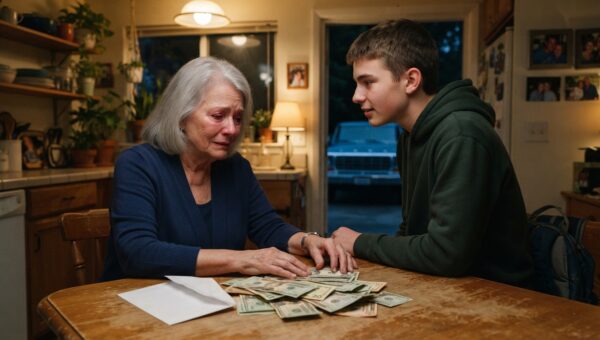
The kitchen smelled like lemon cleaner, cold gravy, and the burnt coffee Caleb had left sitting on the counter all morning. Sunlight came through the back window in a hard white square, bright enough to show every smear on the tile and every crumb his wife had watched me crawl around to collect. I was seventy-one years old, kneeling in my own house, scrubbing linoleum that I had laid down myself thirty years ago with Arthur.
Caleb stood behind me in polished boots that had never seen a day of real work, tapping one heel like I was taking too long. Marissa leaned in the hallway with her red nails wrapped around a champagne flute, smiling the way people smile when they think cruelty is private.
“Missed a spot, Mother,” Caleb said.
That was when his boot came down right across my knuckles. It wasn’t a gentle nudge or a clumsy accident. He planted his heel with enough weight to grind my fingers into the hard tile beneath them. “Watch where you’re crawling,” he grunted, not even looking down, while Marissa gave a little musical giggle from the shadows of the drywall archway. I didn’t cry out. My breath just hitched once, sharp and hot, and then my brain went very cold. I stayed still for three long seconds, feeling the rough leather of his sole against my skin, and then I slowly pulled my bruised hand away from the dirt.
I didn’t rush. Rushing is for people who are scared. I planted my left palm flat on the floor, found my balance on knees that ached every time it rained, and pushed myself up to a standing position. My joints made a dry, clicking sound in the quiet room. Caleb didn’t move his feet. He just crossed his arms in his expensive wool sweater, the one I had darned the elbow on just last Tuesday, and waited for me to apologize for being in his way. Marissa took another slow sip of her cheap sparkling wine, her eyes narrowed with that familiar, lazy boredom she always wore whenever she had to share oxygen with me.
Instead of reaching for the rag, my fingers wrapped around the cold, seasoned handle of the heavy cast-iron skillet resting on the back burner of the stove.
Arthur bought that skillet at a hardware store in Cairo back when we were first married and had twenty-two dollars to our name.
It had cooked ten thousand eggs and fried three thousand pork chops, and it weighed nearly eight pounds. As soon as my palm closed around the iron, the kitchen air seemed to change weight. The humming of the refrigerator sounded louder. Caleb stopped tapping his boot against the baseboard.
“What are you doing with that?” Caleb asked, his voice dropping half an octave as his eyes flicked down to my hand. “Put the grease down. Marissa wants to use the stove for her brunch things in ten minutes.”
I didn’t answer him right away. I lifted the skillet off the burner, letting its weight settle into my forearm, and turned around to face them both. My hand was already swelling where his heel had caught it, the skin turning a mottled, ugly purple across the middle joints, but my grip on the iron didn’t tremble at all. I looked past Caleb at Marissa, who had finally lowered her champagne glass an inch or two.
The smile on her face looked stiff now, like plaster drying too fast in the sun.
“You know,” I said, and my voice sounded strange even to me, flat and quiet like water under thin ice, “Arthur built these cabinets with his own two hands. Every single board. He measured twice so the grain would match right over the sink.”
Caleb shifted his weight, his polished boots squeaking slightly against the floor I had just scrubbed. “Mother, what is this about? If you’re tired, hire someone. Oh, wait, you spent your savings on our roof repairs. Too bad.” He let out a short, wet laugh, looking at Marissa for approval. Marissa didn’t laugh back this time. She was staring at the skillet in my hand.
“You told me two years ago,” I said, taking one slow step toward them, “that signing the deed over was just a formality. A way to save on probate fees so the state couldn’t take the roof over my head if I had to go into a home. That’s what you said at this very kitchen table while we were eating Sunday pot roast.”
“We talked about this,” Caleb snapped, his face flushing a dull, angry red that crept up into his hairline. “You’re getting old. You forget things. It was a legal transfer. The house belongs to us now, and frankly, you’re a guest here. A guest who happens to do the floors.”
The silence that followed wasn’t the comfortable kind of silence that Arthur and I used to share while we sat on the back porch reading the paper together. It was heavy and sharp, full of the sound of the refrigerator motor kicking on and off. I remember the exact texture of the linoleum beneath my slippers, worn smooth by decades of walking back and forth between the pantry and the stove. I had cooked thirty-four Thanksgiving dinners in this exact room. I had carried Caleb out of this back door when he broke his collarbone falling out of the pear tree, and I had washed his bloody shirts in the utility sink just ten feet away from where he was standing now, telling me I was in his way.
“You think you own this,” I said softly.
“The county assessor’s office thinks so too,” Caleb said, though his voice had lost its edge, replaced by that nervous, whistling breath he always made when he got caught lying in middle school. “The deed is recorded. It has your signature right there in black ink. You signed it, Mother. You can’t just un-sign a piece of paper because you’re having a moody morning.”
“I signed it because you swore on your father’s memory that you would never sell the land and that I’d always have my room at the end of the hall,” I said. I raised the skillet just enough for the light from the window to catch the dull, black seasoning on the rim. “You said it was to protect me. But you didn’t protect anything, Caleb. You spent the equity on a new truck within six months, and Marissa turned my sewing room into a walk-in closet for shoes she wears twice a year.”
Marissa finally set her champagne glass down on the edge of the counter with a sharp, glass-on-formica clink that made us both jump. “This is ridiculous,” she hissed, her voice thin and sharp like wire being pulled through a tight hole. “Caleb, tell her to put that dirty pan away. She’s losing her mind. She’s literally threatening us with cookware in our own kitchen.”
“It’s not your kitchen, Marissa,” I said, and I didn’t raise my voice at all. “And it’s not yours either, Caleb.”
I walked right up to them. Caleb didn’t step back, but his shoulders went up toward his ears like he was bracing for a blow that wasn’t coming. He was taller than me by half a foot, and his shoulders were thick from the gym memberships I had paid for during his first year of marriage, but he looked smaller than he had when he was six years old and crying over a skinned knee. He looked like what he really was: a man who had never earned a single thing in his life and was terrified that someone was finally going to ask for the receipt.
“You have twenty-four hours,” I said.
Caleb let out a short, barking laugh that didn’t reach his eyes. “Twenty-four hours for what? Are you kicking us out? With what authority, exactly? You don’t own the door we’re standing behind.”
“The deed is in your name,” I said, holding his gaze until his eyes flickered away toward the pantry door. “That’s true. But the mortgage release hasn’t been filed with the county clerk yet. Arthur never filed the final satisfaction piece because he wanted to keep it in the safety deposit box downtown until we both turned seventy-five. I found the pink slip in his lockbox yesterday morning when I went down to check on the birth certificates.”
Caleb’s mouth stayed open for a second. “That’s… that’s impossible. That was years ago.”
“Arthur was cautious,” I said quietly. “He knew you, Caleb. He used to watch you trade your baseball cards for broken watches when you were twelve and say you had the soul of a horse trader. He told me before he went into the hospital that if you ever tried to turn this house into a hotel for your pride, the key would still be in my pocket.”
Marissa grabbed Caleb’s sleeve, her red nails digging hard into the wool of his sweater. “What is she talking about, Caleb? Is the house paid off or not?”
Caleb didn’t answer her. He was staring at my hand, the one holding the cast-iron skillet, and then down at my fingers where his boot had left a dark, angry bruise right across the knuckle. For the first time since they moved in two years ago, bringing their suitcases and their expensive coffee machines and their loud opinions about my housekeeping, he looked like he realized he had crossed a line that couldn’t be uncrossed with a polite smile and a handshake.
“You can call your lawyer,” I said, setting the skillet down on the wood table with a heavy, final thud that made the salt shaker jump. “Or you can call whoever gave you that loan on the truck. But by this time tomorrow evening, I want your boots off my porch and your clothes out of my spare room. If you aren’t gone by sundown, I’ll let the sheriff explain to you what happens when someone tries to evict a widow from homestead property she never legally surrendered the life estate on.”
“You can’t do this,” Caleb muttered, but the defiance was gone out of him now. He looked old, too, in a different way, the way men look when they realize the safety net they thought was made of steel was actually just spiderwebs. “Where are we supposed to go? We don’t have the deposit for an apartment in town.”
“That sounds like something you should have thought about before you stepped on my hand,” I told him.
I turned my back on them and walked over to the sink, turning the handle until the cold water ran clear and strong down the drain. I picked up my scrub brush from the edge of the basin, dipped it into the soapy water, and dropped back down onto my knees on the tile. The linoleum was still damp where I had left off. Behind me, there was a long, heavy silence, followed by the sound of Marissa’s heels clicking fast against the floorboards as she turned and hurried down the hall toward the bedroom to start packing her things. Caleb lingered for a moment longer, his boots shifting weight twice, before he finally turned around and followed her without another word.
The house stayed very quiet after that. By six o’clock, the driveway was empty except for my old Buick and the tire tracks they left behind in the gravel. I finished scrubbing the last four feet of the floor, rinsed the rag out in clean water until there wasn’t a trace of lemon soap left in the bucket, and hung it over the edge of the porch to dry in the evening air.
Now the kitchen is dark except for the small amber light on the stove clock. The heavy cast-iron skillet is sitting right where it belongs on the front burner, clean and dry and seasoned until it shines like dark glass in the twilight. I am sitting at the kitchen table with a white ceramic mug of hot tea between my two hands, watching the shadows lengthen across the yard without a single pair of muddy boots in sight.