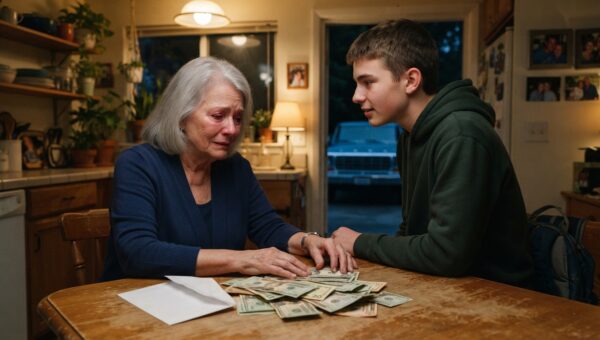
The kettle on the back burner of my small apartment kitchen was whistling a thin, reedy note that I couldn’t ignore anymore, but I kept my hands planted flat on the linoleum counter anyway. My fingers still smelled faintly of lemon oil and industrial bleach, the same scent that had lived in the skin of my palms for fifteen straight years.
It was a funny sort of finality, washing out empty coffee mugs in a place that no longer belonged to my week. Arthur Sterling was gone, the house was sold to some developers from Stamford, and my keys were sitting in a neat little pile right beside the toaster. I kept thinking about the heavy envelope resting on the small table by my entryway, the one Evelyn had shoved into my hands with all the grace of a woman dropping trash into a bin.
Fifteen years is a long time to watch a family slowly turn into strangers. When I first started cleaning the Sterling place out in Fairfield County, the stone floors of that kitchen actually echoed with people who talked to each other. Arthur’s wife Martha was still alive back then, a tiny woman with terrible arthritis who used to sit at the island and peel apples while I scrubbed the baseboards.
She’d always make extra coffee, pouring half a cup into a saucer for the old tabby cat that slept by the pantry. Arthur would come in from the gardens around noon, his boots covered in dark Connecticut mud, and kiss the top of her head without breaking his stride. Back then, the house felt lived-in and warm, even with all the heavy mahogany and the fancy oil paintings hanging in the parlor.
Martha passed away during my fourth winter there, and the air inside those high-ceilinged rooms shifted right away. The kids, Evelyn and Richard, stopped coming out from the city for Sunday dinners and started coming out only to check on the will. I watched them circle their father like a pair of sleek, expensive crows, counting up square footage and eyeing the silver tea sets while the old man sat quietly in his leather wingback chair. Arthur didn’t say much about it, but you could see the light just kind of drain right out of his eyes.
He spent his mornings reading old history books in the sunroom and his afternoons walking the perimeter fences where the property bordered the town woods. I always made sure to leave his tea on the small side table just the way he liked it, dark with one cube of sugar, and he’d nod without looking up. That was our routine for ten solid years.
By the time Arthur’s health really started failing around year fourteen, Evelyn was practically running the schedule. She’d leave Post-it notes on the marble counter detailing which rooms needed deep cleans and which antiques weren’t to be touched under any circumstances. Richard showed up twice that whole year, both times to argue in the hallway about nursing home costs versus estate preservation. Arthur barely knew who they were half the time, his mind drifting back to when Martha was still planting bulbs in the spring garden.
But he always knew me. Whenever I came in to change the sheets on his hospital bed or sweep up the lint by his dresser, his hand would twitch against the quilt. He’d look at me with those watery blue eyes and whisper, “You’re still here, Martha.” I never corrected him. It didn’t seem right to break whatever peace he had left.
The final day on the job didn’t feel like a celebration or even a sad goodbye. It felt like an eviction without the courtesy of a notice. The moving vans were already lined up in the circular gravel driveway when I pulled in at 7:00 in the morning, their massive diesel engines shaking the leaded glass windows in the foyer. Evelyn was standing right by the front door holding a clipboard and looking at her wristwatch like I was a delivery driver running late. She didn’t offer to hang up my coat, and she didn’t ask how my knees were holding up after all these years on the hardwood. She just watched me wipe my boots twice on the scraper before stepping inside for the last time.
“We’re clearing out the pantry today, so don’t bother with the kitchen,” Evelyn said, her voice clipped and sharp as a pair of kitchen shears. She didn’t look up from her clipboard once. “Just do the upstairs guest baths and make sure the master suite is presentable for the appraisers coming at noon. And honestly, don’t leave any of your cleaning rags behind this time. We want the place spotless.”
I didn’t say a word back to her. I just walked down the familiar hallway with my caddy of supplies, my shoulders already aching before I even picked up a sponge. The house felt hollow, stripped of its rugs and smaller lamps, echoing with the boots of strangers who were already measuring the walls for new paint. I spent four hours scrubbing porcelain that had never seen a speck of dirt, moving methodically from room to room while the auctioneers downstairs shouted numbers back and forth. By one o’clock, I was finished. I walked down the grand staircase with my empty caddy tucked under my arm, ready to slip out the side door without making a fuss.
Evelyn intercepted me right by the foyer archway, her expression tight and impatient. She reached into her oversized leather handbag and pulled out a bulky, square-shaped envelope that looked like it had been sitting at the bottom of a drawer for a decade. She held it out at arm’s length, dropping it into my hands with a quick, dismissive flick of her wrist. “A little something, for all your years with us,” she said, and turned right back around before I could even get the words thank you out of my mouth. The heavy wooden front door clicked shut behind her with a solid, final sound, leaving me standing alone on the porch with the afternoon wind catching the hem of my jacket.
I walked down the long gravel drive toward the bus stop, my fingers wrapping around the envelope out of pure habit. It felt heavy, much heavier than a holiday card or a fifty-dollar bill in a greeting fold. It had a strange, stiff bulk to it that didn’t feel like paper money at all. When I climbed onto the town bus, the vehicle was mostly empty except for a school kid listening to music through headphones in the back row. I sat down on the worn vinyl seat, my knees throbbing from the morning’s scrubbing, and pulled the flap of the envelope open. Inside was a short note written in Arthur’s shaky, sprawling hand on heavy cream stationery, and tucked right behind it was a folded packet of municipal documents with a blue county seal stamped across the top.
I unfolded the letter first, my eyes scanning the familiar ink strokes that I used to see on grocery lists and instructions for the gardener. Dear Martha, it started, using my name instead of the housekeeper label Evelyn always pinned to me. If you are reading this, the vultures have finally cleared the house out and my children have divided up what was never really theirs to begin with. You stayed when everyone else was counting the days until my funeral. You brought me tea when the house was too quiet, and you never looked at me like I was just an item on an inventory list. I bought the old stone gardener’s cottage down on the southeast acre back in nineteen-eighty-two, before we ever built the big house. It was never part of the main deed. I had the town separate the parcel eighteen months ago while my lawyer was still answering my calls. The title is yours now, free and clear of probate, mortgage, and my children’s greedy hands. Go live somewhere quiet where nobody can tell you when to leave.
My hands started shaking so badly I almost dropped the paper onto the sticky floor of the bus. I pulled out the second document, unfolding the stiff blue-backed pages with clumsy fingers. Property ID 44-802-C, the municipal header read, accompanied by a detailed plot map outlining a small, historic stone cottage tucked right against the edge of the town forest where the property lines met the creek. It wasn’t a joke. It wasn’t some cruel oversight by an exhausted old man. Arthur Sterling had legally detached his old stone workshop and living quarters from the estate, filing the conveyance directly with the town clerk’s office a year and a half before his heart finally gave out.
The next three days were a blur of town hall visits, legal consultations, and a cold, sinking fear that somehow Evelyn would find a loophole to snatch it all back. I sat across the desk from a weary-eyed real estate attorney named Mr. Henderson in downtown Fairfield, watching him flip through the county records with a pair of half-moon glasses perched on his nose. He didn’t smile, but he didn’t hand the papers back either. He just whistled low through his teeth, leaned back in his leather chair, and told me the paperwork was airtight. “Arthur Sterling filed this himself in person back in October,” Mr. Henderson said, tapping the corner of the stamped deed against his blotter. “Your name is right here on the municipal registry as the sole fee-simple owner of parcel four-eighty-two. His kids don’t have a legal leg to stand on.”
The confrontation happened on a rainy Tuesday afternoon just two weeks after the estate sale placards were hammered into the front lawn. I had already moved my few boxes of belongings into the small stone cottage down the gravel lane, using an old handcart to wheel my blankets and pots down through the tree line. The cottage was quiet, smelling of old cedar and damp fieldstone, with small-paned windows looking out over a wild patch of fern and briar. I was standing by the kitchen sink wiping down the counter when I heard the harsh crunch of car tires spinning loose gravel outside the front door.
A sleek black sedan had bounced down the private service road, stopping right in front of my porch with its headlights blazing through the drizzle. Evelyn stepped out first, her expensive boots sinking immediately into the mud, followed closely by Richard carrying a rolled-up set of architectural blueprints under his arm. They didn’t look like grieving heirs; they looked like two people who had just discovered a massive hole in their inheritance ledger. Evelyn marched straight up the stone steps, hammered her fist against the wooden door three times, and yanked it open without waiting for an invitation.
“What in God’s name do you think you’re doing here?” Evelyn shouted, her face flushed red with genuine fury as she stepped into the small kitchen, bringing the smell of wet pavement and expensive perfume with her. “The entire estate was sold to the development group yesterday morning. This cottage is included in the master tract boundary. You are trespassing on private property, and I am calling the local sheriff right this second to have you hauled off the grounds.”
Richard pushed past her into the tiny room, his eyes darting angrily around my boxes and the small kettle sitting on the hot plate. “You can’t just squat in the utility quarters, Mrs. Miller,” he said, his voice rising in that sharp, entitled pitch I knew so well from the main house hallways. “This land is worth nearly half a million dollars to the buyers. We have the closing documents right here in the car. Pack your things and get off the property before we call the police and have you arrested for breaking and entering.”
I didn’t yell back. I didn’t drop my sponge or let my hands shake. I simply walked over to the wooden kitchen table where Mr. Henderson’s official packet lay neatly beside Arthur’s original letter. I picked up the attorney-stamped title and held it out toward them, my feet planted firmly on the wide oak floorboards that Arthur himself had laid fifty years ago.
“You can call whoever you like,” I said, my voice steady and quiet in the small room. “Your father separated this parcel eighteen months ago. The deed is registered down at the town hall in my name, and your buyers don’t own a single square inch of this stone.”
Evelyn stopped dead in her tracks, her hand hovering over her cell phone as her eyes darted across the official municipal seal stamped in blue ink at the top of the page. She snatched the paper right out of my hand, her eyes scanning the legal description frantically while Richard peered over her shoulder. The color drained right out of her face, leaving her staring at the text like she was reading a death sentence. Arthur had outsmarted them completely from the grave, bypassing their probate division with a simple stroke of a pen and a quiet trip to the county clerk’s office.
“This… this is impossible,” Richard stammered, his face twisting in ugly disbelief as he reached for a page that wasn’t there. “Dad wasn’t even in his right mind last year. He didn’t know what he was signing.”
“He knew,” I said softly, turning my back on them to pick up my tea mug from the counter. “He knew a lot better than either of you ever gave him credit for.”
They didn’t stay much longer after that. Evelyn let out a sharp, choked sound of pure humiliation, turned on her heel, and marched back down the steps toward the sedan without looking back once. Richard glared at me for a long second, his jaw clenched so tight I thought his teeth might crack, before following his sister back to the car. The gravel crunched loudly as they spun their tires in reverse, tearing up the mud along the edge of the lawn before speeding back up the lane toward the main house and out of my life forever.
The silence that settled back over the stone cottage once their engine noise faded away was the sweetest thing I had ever heard in my life. I walked over to the heavy oak front door, pulled it shut against the damp afternoon air, and slid the solid iron deadbolt into its groove. Turning the brass key in the lock, I listened to the heavy, satisfying click of metal sliding home, and watched the late afternoon sun stretch unhurried across my own wooden floorboards.