The iced tea glass left a wet circle on the varnished cedar table that matched the exact shape of my old mixing bowl at home. I remember looking at that ring of condensation while the cicadas in the live oaks outside the country club patio kept up their dry, rhythmic clicking. It was loud enough that you almost had to lean in to hear across the white tablecloths, which suited me just fine.
I had spent two years leaning back, keeping my mouth shut, and watching my son Dale pretend he was a self-made man while his wife, Brenda, ordered custom drapery and talked about their summer trips to Sanibel Island as if money grew on the scrub oaks behind their subdivision.
Dale was my only boy. After his father passed away in the VA hospital down in Temple, leaving me a small life insurance policy and a house that needed a new roof every four years, I figured out how to live on very little. I mended my own gardening gloves, kept the thermostat at sixty-eight in January and seventy-eight in July, and learned that ground chuck was just as good as ribeye if you cooked it slow with onions. I thought I had done okay. I thought I had raised a boy who knew the value of a dollar and the weight of a handshake.
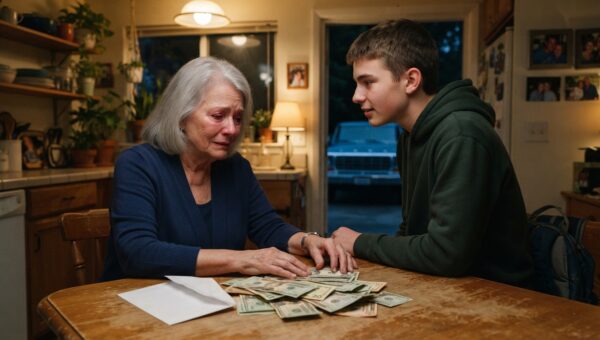
Then came the spring of two years ago. Dale showed up on my front porch at 7:15 in the morning before I even had my second cup of coffee brewed, his face the color of damp paste. He sat at my kitchen table and told me the bank had already sent the third certified letter about their mortgage. He didn’t say it all at once. He let it out in pieces like water leaking through a rotted floorboard. They had borrowed against the equity to pay for Brenda’s landscaping business that never turned a profit, and now the foreclosure notices were piling up in the garage behind the recycling bins.
“We can’t lose the house, Mom,” he had said, staring at his fingernails like they were the most interesting things in the world. “Brenda would lose her mind. The girls are settled in the school district. It would kill her.”
He didn’t mention what it would do to him. He was too proud for that, and too weak to fix it himself. So I did what mothers do when they run out of good choices. I didn’t yell. I didn’t lecture him about credit cards or lifestyle inflation or keeping up with the neighbors. I just called my cousin Arthur, who had spent forty years at the bank in Lampasas, and we set up a wire transfer. Every single month for twenty-four months, on the fourteenth day without fail, $2,450 left my dwindling retirement account and went straight to First National to cover their mortgage, their car notes, and the property taxes they kept forgetting to set money aside for.
I didn’t want their gratitude. I certainly didn’t want them looking at me with that pitying tilt of the head Brenda always used when she dropped off a plate of store-bought cookies and told me I should get out more.
I just wanted my son to have a roof over his head and his daughters to stay in their bedrooms with the pink walls. I wore my five-year-old walking shoes to the grocery store and put off replacing the water heater so the wire could clear every month. I figured I could live frugally if it bought them peace.
Then came the family reunion at the club. Brenda had insisted on hosting the Saturday lunch, even though we all knew she wasn’t paying for the venue or the catered brisket. She stood up at the head of the long table halfway through the meal, her silver charm bracelet jangling against her water glass as she tapped it three times with a butter knife. The sun was right in my eyes, reflecting off the water hazard behind the ninth green, and my feet were starting to swell in my church shoes.
“I just want to propose a toast to our favorite people,” Brenda said, her voice carrying across the patio with that bright, practiced ring she used when she was trying to impress my sister-in-law Martha. “Especially to the folks who make days like this possible. And a special shout-out to Martha, who brought those wonderful deviled eggs, and well, to Clara, who always manages to come empty-handed, bless her heart, but still brings her lovely, quiet self to keep us company.”
Everyone laughed. It wasn’t a mean laugh, exactly. It was the easy, careless laughter of people who had never looked at a bank statement and wondered which utility they were going to turn off to pay for groceries. My brother Wayne chuckled around a mouthful of potato salad. Martha smiled politely into her napkin.
I looked down the table at Dale. He didn’t laugh. He didn’t look up either. He just stared straight down at his white porcelain plate, his jaw working slowly as he moved a piece of smoked turkey around in the barbecue sauce. He knew. He knew every single dollar that kept that roof over his head didn’t come from his commission checks or Brenda’s boutique investments. He knew I hadn’t come empty-handed. He had been cashing the receipts for twenty-four months. And he sat there and let her make a joke of me in front of thirty people because it was easier than admitting his wife spent money we didn’t have.
Nobody said anything for a second and honestly that felt worse than the laughter. The wind rustled the napkins on the empty seats at the end of the table.
I didn’t rush. I smoothed down the front of my navy blue skirt, the one I bought on clearance at JCPenney back before Dale’s troubles started, and I slowly pushed my chair back from the table. The metal legs made a sharp screech against the concrete patio that cut right through the chatter.
I stood up and reached for my glass of iced water. My hand didn’t shake. Two years of worry will either break you or turn your blood to cold iron, and by that afternoon, I was all iron.
“Empty-anded,” I said, and my voice sounded clearer than hers did. “That’s an interesting way to put it, Brenda.”
Brenda’s smile hitched for just a second, her hand freezing halfway back to her water glass. “Oh, Clara, I was just teasing. You know how you are, you never bring a dish to pass.”
“No, I don’t,” I said, and I let my eyes sweep slowly across the table until they landed on Wayne, then Martha, and finally on the top of Dale’s head. “Because for the last twenty-four months, my hands have been pretty busy holding up your mortgage.”
The patio went dead quiet. Even the cicadas seemed to back off for a second.
“What did you say?” Brenda’s voice went up about an octave, the bright charm dropping off her face like cheap paint in a rainstorm.
“I said twenty-four months,” I repeated, speaking slowly and plainly, the way I used to talk to Dale when he was six and trying to explain why he tracked mud across the kitchen floor. “First National Bank, account ending in 4892. $2,450 on the fourteenth of every single month. That’s for the house. Then another $415 for your Subaru note, Brenda, because your credit rating was too low to finance it on your own after that little trip to Austin three summers ago. And let’s not forget the property taxes for twenty-three, which I wired directly from my husband’s life insurance payout because the county was about to slap a lien on the garden you love to post pictures of on Facebook.”
Dale finally looked up. His face was the color of a wet cardboard box. “Mom. Please. Not here.”
“Oh, we’re right here, Dale,” I said, looking right into his eyes. “Where we should have been two years ago when you sat at my kitchen table and cried about losing the guest room.”
I reached into my old leather folio bag resting on the chair beside me and pulled out a thick manila folder. I didn’t throw it. I just laid it down gently beside Brenda’s silver water pitcher, right on top of her linen napkin.
“Those are the stamped bank ledgers for every single transfer,” I told the table. The silence was so heavy you could hear the ice melting in the glasses. “Every receipt, every confirmation number, every dollar of the sixty-eight thousand four hundred dollars I’ve spent keeping you out of foreclosure while you buy new patio furniture and talk about my lack of contribution.”
Brenda reached out like she wanted to touch the folder, then pulled her hand back as if it was hot. Her mouth opened, but nothing came out except a little puff of air. Her chest was rising and falling fast under her linen blouse, and the color had completely drained out of her cheeks, leaving her looking old and sharp-edged.
“Mom, stop it,” Dale muttered, his voice cracking on the last word as he half-rose from his chair, his palms flat on the wood. “Just stop it right now.”
“I am stopping it, Dale,” I said softly. “As of three minutes ago, when I called Arthur from the parking lot before lunch started, the November wire has been cancelled. Permanently.”
Dale’s chair tipped back two inches before he caught it. “You what?”
“You heard me,” I said. “The well is dry. You’re thirty-eight years old, and you’ve got a wife who thinks she’s too good to remember where her house payments come from. You can figure out how to talk to the bank yourselves on Monday morning. I hear they’re very understanding if you explain that your feelings got hurt at a family barbecue.”
I picked up my small black handbag from the back of the chair and slipped the strap over my shoulder. I didn’t look at Martha. I didn’t look at Wayne, whose mouth was still hanging open over his half-eaten roll. I just looked at my son one last time, seeing all the choices he had made and all the ones he was going to have to face by Tuesday.
“You have a lovely home, Brenda,” I said, turning away from the table. “I hope you enjoy it while you’re still allowed in the driveway.”
I walked across the stamped concrete of the patio, my heels clicking a steady, even rhythm against the stone. Nobody called my name. Nobody stood up to follow me. The only sound behind me was the distant hum of a golf cart somewhere out on the tenth fairway and the thin, ragged sound of Brenda starting to cry.
When I reached my old Buick in the gravel lot, the afternoon sun was hitting the windshield just enough to make the steering wheel hot to the touch. I pulled the door open, climbed in behind the wheel, and pulled the heavy metal door shut until it gave a solid, satisfying click. My hands were steady as I put the key in the ignition. I didn’t look back at the clubhouse once as I turned the ignition, backed out of the space, and drove down the long, tree-lined driveway with my head held high and my pockets entirely empty.