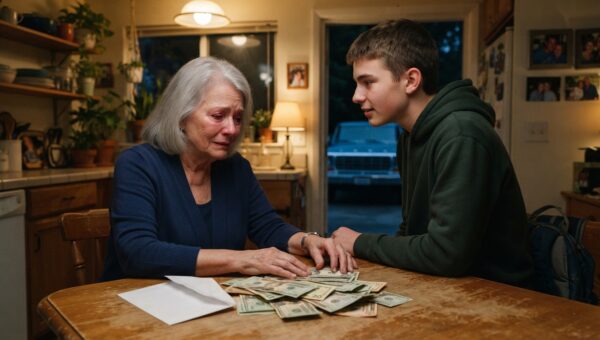
I got the numbers wrong at first, thinking I could just wire another three thousand dollars from Kandahar and fix whatever hole Chad had dug himself into this time. I figured family was family, and when you wear the uniform, you learn a special kind of stubborn patience that lets you swallow a lot of bitter pills just to keep the home front steady.
My father Frank always made sure I knew my duty. He raised me after Mom passed to be the reliable one, the girl who didn’t complain when her college fund went toward Chad’s truck repairs or when she spent her high school weekends working double shifts at the diner to cover the property taxes on our little house in Dayton. I sent home nearly forty thousand dollars over twenty-four months of deployment, trusting Frank to manage the bills while I was sleeping in a dust-choked bunk six thousand miles away. I thought I was building a future for all of us. I was actually funding my brother’s underground poker debts and my father’s pathetic attempts to buy Chad’s affection.
The flight from Bagram landed at Wright-Patterson three hours ahead of schedule, and the taxi smelled faintly of damp floor mats and stale peppermint as it wound through the familiar brick-paved streets of our neighborhood.
I didn’t call ahead because I wanted to surprise them with my early discharge papers and a three-week block of uninterrupted leave where I didn’t have to look at a map grid or listen to incoming mortar warnings. But when the cab pulled up to the curb on Maple Lane, my stomach didn’t drop; it just turned into a cold stone. There was a bright red Sold sign stabbed straight through the hydrangeas I had planted the weekend before I shipped out. The lawn was half-mowed, and two empty beer cans sat rolling in the dry brown grass near the driveway.
Frank was leaning back in the old wooden rocker on the front porch, wearing his faded bowling shirt with the grease stain near the pocket, while Chad sat on the porch rail strumming a cheap acoustic guitar that hadn’t been in tune since 2018. They looked comfortable. They looked like men who had just finished dividing up the spoils of a war they never had to fight.
I stepped out of the taxi, hoisted my heavy canvas duffel bag over my shoulder, and walked up the gravel path, waiting for the familiar warmth of homecoming to hit me. It didn’t. Instead, Frank took a slow pull from his can, squinted against the Ohio glare, and didn’t even stand up to greet his only daughter coming home from a combat zone.
I hadn’t even dropped my duffel bag before Frank smirked and said, “I sold the nest, kiddo. Chad needs to pay off some debts, and you’re the big sister. You make the sacrifice.” He said it like he was telling me he bought a new brand of coffee, casual and breezy, as if my entire life savings and every sleepless night in the desert were just loose change in his pocket. Then I watched Chad wipe spilled beer off the porch boards with the jacket I’d kept stiff with my fallen corporal’s blood.
Corporal Miller had taken the shrapnel that was meant for our platoon sergeant back outside Jalalabad, and when we packed his gear, I asked his mother if I could keep his field jacket because he had shared his last protein bar with me during a thirty-hour patrol. That jacket smelled like copper, dust, and a boy from rural Tennessee who loved baseball cards more than he loved the army. Chad didn’t even look down as he dragged the sacred wool across a puddle of stale Bud Light to clean up a ring from his can.
I didn’t yell. I didn’t drop my bag and start swinging the way Chad probably expected me to so he could play the victim of a volatile veteran. My time in military intelligence taught me that anger is just noise unless you harness it into a clean, hard line of logic. I just stared at the dark stain near the cuff of Miller’s jacket where the blood had oxidized into a dull, permanent rust. My throat felt dry, but my hands were completely steady when I set my duffel bag down on the bottom step. Frank took another sip of his beer, misreading my silence for defeat the way he always did whenever I backed down in high school to keep the peace.
“Don’t look at us like that,” Frank muttered, waving his hand toward the Sold sign. “The market was hot, and Chad was about to have some very unpleasant people visiting his apartment downtown. You’ve got your army pension, or whatever it is you get. You can rent a nice little place across town. This house was too big for me anyway.” He spoke with that familiar, weak cowardice that had defined our entire household, hiding behind my brother’s selfish wreckage while pretending he was the patriarch making hard choices. Chad laughed, a nervous, high-pitched sound, and tossed the damp jacket over the porch railing like it was a greasy shop rag. “Come on, sis, don’t be like that. We’ll throw you a housewarming party once we find a nice storage unit for your junk.”
I walked past them without saying a word, my boots clicking hard against the wooden steps, and pushed open the front door that hadn’t been locked since 1994. The house smelled of old dust, stale grease, and the cheap lemon furniture polish Frank used to hide the smell of his stale cigarettes. I carried my duffel bag straight down the narrow hallway to my old bedroom, locking the wooden door behind me with a solid, definitive click. My small metal deployment trunk sat right where I left it under the bed, untouched by their careless hands. I opened the combination lock, lifted the lid, and pulled out my laptop, my encrypted external drive, and the heavy manila folder containing the certified power of attorney documents I had foolishly signed before deployment thinking my father was an honest man.
I didn’t cry. I didn’t punch the wall. I sat down at the old oak desk where I used to do my high school algebra homework and plugged my drive into the USB port. Through my secure military portal, I accessed the county property registry and the digitized title deeds for Maple Lane. It took me less than twelve minutes to find what I was looking for. Frank hadn’t just sold the house; he had executed a fraudulent quitclaim deed using an expired military power of attorney form that had legally lapsed the moment my deployment orders were amended last November. He had forged my signature on the transfer affidavit, notarized by a lazy clerk down at the county annex who hadn’t checked a military ID since the Bush administration. The buyer was a local cash-buying LLC registered to a known predatory investor downtown who specialized in snapping up distressed property from families of deployed soldiers.
The next morning, I was sitting across the polished walnut desk of Sarah Vance, a sharp-eyed civilian attorney who specialized in veteran property fraud down on Main Street. I didn’t cry when I laid out the bank statements, the forged deed, and the text messages Chad had sent me three months ago bragging about his new sports car before he deleted them. Sarah adjusted her glasses, looked at the signature on the county transfer document, and gave me a long, evaluating look. “This isn’t just a civil dispute,” she said quietly, tapping her pen against the wood. “This is felony wire fraud and forgery committed against an active-duty service member under the Servicemembers Civil Relief Act. If we file an emergency injunction right now, we can freeze the escrow account before the closing clears on Friday afternoon.”
I spent the next forty-eight hours operating with the cold precision of a midnight patrol briefing. I didn’t answer Frank’s phone calls or respond to Chad’s panicky texts asking why their bank accounts were suddenly flagged for investigation. By Thursday evening, Sarah and I had secured a federal judge’s temporary restraining order halting the sale and slapping a lis pendens notice directly onto the property title. The buyer’s real estate agent called Frank in a blind panic while I was sitting quietly in my car parked across the street from the house, watching the yellow Bug light flicker through the living room window. I saw Frank jump out of his armchair, dropping his beer can on the rug, while Chad stared at his phone with his mouth hanging open like a hooked fish.
On Friday morning, exactly seventy-two hours after I stepped off that taxi, I walked back up the front path of Maple Lane with three copies of the court-stamped injunction and two Dayton police officers standing quietly behind me on the sidewalk. Frank flung the front door open before I even reached the top step, his face mottled red and his voice shaking with righteous, terrified fury. “What the hell is the meaning of this?” he shouted, pointing a trembling finger at my chest. “The police are outside! You’re dragging your own family through the dirt over a piece of paper?” Chad hovered behind him, his eyes darting wildly toward the squad cars idling by the curb with their headlights off.
I didn’t raise my voice. I didn’t scream or let loose any of the rage that had been burning a hole in my chest since I saw Miller’s jacket used as a floor rag. I pulled the legal packet from my portfolio and handed it directly to my father, letting the crisp, stamped seal catch the morning light. “You signed a document that didn’t belong to you, Frank,” I said, using his first name for the first time in my life. “The sale is frozen. The buyer is walking away because your title is fraudulent, and Chad’s creditors are going to find out exactly where his bank deposits came from.” Chad let out a small, pathetic whimper and tried to push past his father, muttering something about a mistake, but Frank just stared down at the court stamp with a look of absolute, crushing realization.
He finally understood that I wasn’t the girl who stayed behind to work the diner shifts anymore. He realized that the quiet, dutiful daughter he thought he could sell off to save his favorite son had learned how to read every line of the fine print while he wasn’t looking. Frank reached out a trembling hand toward my arm, his voice dropping into that wheedling, pathetic tone he always used when he needed me to bail him out of a mess. “We’re family, honey,” he whispered, his eyes welling up with cowardly tears. “We can fix this at the kitchen table. We didn’t mean no real harm.” I stepped back out of his reach, leaving him standing alone in the doorway with his mouth working silently against empty air.
I walked past them into the hallway one last time, ignoring the mess of pizza boxes and empty bottles piled on the living room rug, and made my way straight to the porch railing. Folded neatly over the wood was Corporal Miller’s field jacket. I picked it up, shook off the bits of dried mud Chad had tracked across the shoulders, and cradled it against my chest where the fabric was still stiff with the memory of a boy who knew what honor actually meant. I walked down the steps past my father and my brother without giving them another glance, stepping out of the shadows of that house into the clear, sharp Dayton air. I carried the jacket out to my waiting car, placed it carefully in the passenger seat, and drove away from Maple Lane while Frank stood frozen on the porch, finally learning what it cost to trade away the only person who ever protected him.