The green ledger book stayed tucked behind the tax forms in the bottom drawer of my mahogany desk for nineteen years, and the binding was stiff enough that it still made a dry cracking sound every time I opened it.
Back in 2007, Martha and I bought that blank book at the stationary shop down on Main Street when Chloe got engaged to a boy named Marcus from the Bible college.
We deposited five hundred dollars that very Friday, and every month after that I added another chunk of my paycheck until the total sat right at thirty thousand dollars. It was supposed to pay for the white lace dress, the rented hall out by the reservoir, and the catering plates with the silver rims.
Instead, Chloe packed her suitcase into the trunk of her beat-up Honda Civic on a rainy Tuesday morning in June, and she did not look back at the porch once.
The schism in our church community happened six months before that, but the real break happened right across our dining room table. I told Chloe that marrying outside the fellowship was walking away from everything her mother and I had built, and she just stood there with her hand on the brass doorknob, her jaw tight in that stubborn way she got from my side of the family.
“If I stay here, Dad, I’m going to hate you,” she said, and then the latch clicked shut.
Martha died twelve years later in the autumn of 2019, right as the sugar maples were turning that dull rust color. During her last week in the hospice bed, when the morphine had her drifting in and out of the room, she reached out her thin, bruised hand and caught my sleeve.
“Will you call her this year?” she whispered, her voice barely scratching past the oxygen tube.
“I can’t do that, Martha,” I told her, smoothing the hospital blanket over her shins. “She made her choice.”
Martha closed her eyes then, and she didn’t ask again before her heart stopped three days later on a rainy Thursday morning at 4:12 a.m. After the funeral, the house on Elm Street felt three times larger than it actually was, and the only sound was the refrigerator compressor kicking on every twenty minutes.
I kept myself busy by painting the baseboards, fixing the loose gutter over the side porch, and alphabetizing the cans in the pantry. I thought discipline was the same thing as strength.
Then the mail carrier dropped a thick manila envelope into the box last Tuesday.
I didn’t recognize the return address because it was from a suburb three counties over that I had never visited, but the handwriting on the front made my fingers go cold. It wasn’t Chloe’s neat cursive from high school, but it was close enough to it that I knew who sent it before I even slid my thumb under the paper flap.
Inside was a single 4x 6 photograph printed on glossy drugstore paper and a short note written on lined notebook paper. The photo showed three kids sitting on a wooden porch swing painted white, and the little girl in the middle, maybe eight years old with her hair pulled back into two crooked braids, had Martha’s exact bone structure across the cheekbones.
The note was short. “Dad, Mom passed away three years ago. I thought you might want to see your grandchildren. Their names are Leo, Maya, and Clara. We live at 414 Maple Street if you ever decide you’re tired of being alone.”
I sat at that desk for three hours with the photograph held under the glare of the brass lamp. My eyes kept tracing the small girl’s chin, the way she tilted her head to the left just like Martha used to do when she was thinking over a complicated recipe. The silence in the house felt heavy, pressing down on my eardrums until I could hear my own pulse thumping in my throat.
I pulled open the bottom drawer and dragged out the green ledger book.
The pages were yellowing at the edges, and the ink columns I had drawn with a straight-edge ruler back when George W. Bush was in office looked neat and foolish. Thirty thousand dollars sitting in a certificate of deposit that had rolled over so many times the bank manager probably didn’t even remember who I was. I opened the front cover and looked at the figures I had penned with such pride, believing I was securing my daughter’s future by withholding it over a point of doctrine.
Three weeks later.
The drive took two hours and fourteen minutes down Route 9, past the old paper mill that had rusted half-away since the county lost the state contract. My Buick’s transmission whined every time I climbed a hill, and my palms stuck to the vinyl steering wheel because I hadn’t turned the air conditioning on yet to save gas. Every mile marker felt like I was driving deeper into territory I had no right to claim.
When I pulled up to 414 Maple Street at 3:15 in the afternoon, the house looked smaller than I had pictured it, with faded yellow siding and a patch of crabgrass where a lawn should have been. And right there on the front porch was the white wooden swing from the photograph, swaying slightly in the breeze off the field behind the yard.
I sat in the idling car for five full minutes, staring at the steering wheel and wondering if I should just put the car in reverse and drive back to my empty kitchen. My chest felt tight, the way it did when I found out Martha wasn’t coming home from the hospital.
I killed the engine, and the sudden quiet was louder than the motor.
I walked up the three wooden steps, and every board creaked under my heavy work boots just like the ones at home. Before I could even raise my hand to knock on the scuffed blue wood of the front door, it swung open.
Chloe stood there with a dish towel in her hands, her hair pulled back in a clip with a few gray strands falling around her ears. She looked older, softer around the eyes than she had twenty years ago, but the way she stood with one hand braced against the doorframe was entirely my mother’s posture.
Nobody said anything for a second, and honestly that felt worse than shouting.
“You came,” she said finally, her voice steady but her lower lip trembling just a fraction.
“I got the letter, Chloe,” I managed to get out, my throat feeling like it was lined with dry sand. “I’m sorry it took me this long to drive out here.”
She didn’t move out of the doorway, but she didn’t close it either. “The kids are out back by the garden,” she said softly, stepping back to let the screen door hang open. “Leo is eighteen now. He’s got your height.”
I stepped past her into the small hallway that smelled faintly of cinnamon apples and old laundry, the kind of honest domestic smell that Elm Street hadn’t known since Martha passed. Chloe led me through the narrow kitchen where a basket of red potatoes sat on the counter next to a stack of school notebooks.
Through the back window, I saw the boy, tall and broad-shouldered with sandy hair, hauling a bag of mulch toward a raised garden bed, while the little girl with Martha’s eyes was kneeling in the dirt with a plastic trowel.
We sat down at the chipped Formica kitchen table across from each other, the same way we used to sit when she was bringing home report cards with straight As.
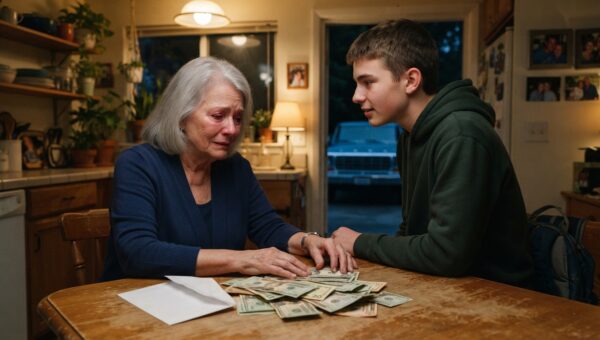
“I brought something with me,” I said, reaching into my breast pocket and pulling out the worn green bank book along with the cashier’s check I had drawn that very morning from the credit union. I laid them both flat on the laminate surface between us.
Chloe looked down at the faded cardboard cover of the ledger, then up at my face. She didn’t touch it.
“What is this, Dad?” she asked.
“It’s the wedding fund,” I told her, my voice cracking before I could finish the sentence. “I kept it in the drawer all these years. It’s thirty thousand dollars. It was supposed to be for your wedding, but seeing as that ship sailed a while back, I figured… I figured it ought to go toward getting Leo and Clara through whatever college they decide on. Or a trade school. Whatever they need.”
Chloe stared at the check for a long time, and I watched her shoulders rise and fall as she let out a slow, ragged breath. When she looked back up at me, there was no anger in her face, just an exhausted kind of peace that made me feel small and foolish for every Sunday I had sat by myself in that big, quiet house.
“We managed just fine without it, Dad,” she said quietly, her finger tracing the edge of the green book. “But the kids are going to need help with their schooling. Thank you.”
“I was a stubborn old fool,” I said, and the words tasted bitter coming out of my mouth, but once I said them I realized I should have spoken them a decade ago. “I let pride run my house until there wasn’t anybody left in it.”
“Yeah, you were,” Chloe said, and for the first time in twenty years, a small, tired smile touched the corner of her mouth. “You definitely got that part right.”
An hour later, the sun was dipping low behind the line of pine trees at the edge of the property, casting long orange shadows across the grass. Leo came in to wash his hands at the kitchen sink, nodding awkwardly when his mother introduced me as his grandfather, and Clara showed me a smooth river stone she had found under the tomato plants.
When dusk settled over the neighborhood, Chloe went inside to start dinner, leaving the back door open to the screen.
I walked out to the front porch and sat down on the wooden swing, the rough grain pressing through my trousers. Clara climbed up beside me after a minute, her small shoulder warm against mine, swinging her legs back and forth while the evening breeze rustled the oak leaves above us.
I looked down at the dark road stretching out past the mailbox, and for the first time since Martha died, the empty spaces in my life didn’t feel quite so permanent.