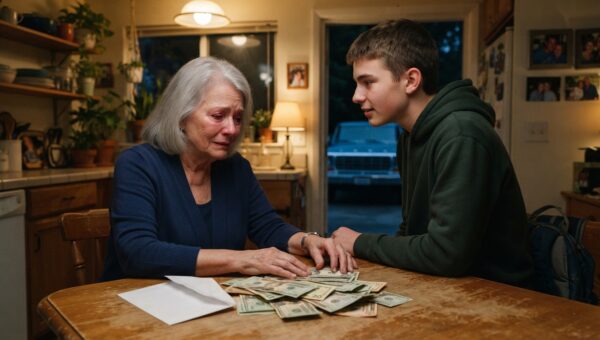
Thirty-four thousand two hundred and ten dollars. That was the exact total stamped in blue ink on the final line of the passbook before the water ruined the paper.
I didn’t think much about the number back when I started the account in 1996, working the evening shift at the textile mill while Chloe was still small enough to sleep in a wicker basket under the cutting table.
Back then, every dollar I put away was just a promise to myself that she wouldn’t have to count quarters at the grocery store the way I did after her father left. I worked forty hours a week at the plant, and then I cleaned offices on Saturdays until my lower back felt like it was full of broken glass.
Chloe grew up believing money came from the wall because I never let her see the overdraft notices or the winter nights we sat in the kitchen with the oven door open to stay warm. She went to the state college, she got a degree in marketing, and she found a man named Derek who wore expensive cuff links and talked about equity the way other men talked about baseball. By the time they announced their wedding at the country club across the county line, I figured the passbook was the best way to hand over thirty years of quiet labor.
It was the deed-backed collateral for the house they were moving into that very weekend, a home I had co-signed and quietly funded so they wouldn’t start life under a mountain of bank debt.
The reception was all white linen and ice sculptures that cost more than my first car. When my turn came to give a blessing, I walked up to the head table with the little blue book in my hand, its corners slightly frayed from thirty years of being tucked behind the tax forms in my cedar desk.
“I wanted you to have this, sweetheart,” I said, laying it right beside her champagne glass. “It’s everything I could manage for you since you were little.”
Chloe took it with two fingers like it might soil her manicure, flipped the cover open, and gave a short, dry laugh that didn’t reach her eyes. She didn’t even read the figures on the back page.
“What is this, a savings bond from 1980?” she asked, looking over at Derek with an amused tilt of her chin.
Derek leaned back in his velvet-lined chair, swirling his scotch and water while he looked down his nose at me. He had a way of smiling that made you feel like you were standing outside in the rain without a coat.
“Your mom’s gift looks like loose change for the memories,” Derek said loud enough for the entire bridal party to hear.
Several people at the nearest table chuckled, and Chloe didn’t bother to stop them. Instead, she turned her wrist and tossed the blue book in a clean, casual arc straight into the decorative fountain bubbling behind the sweetheart table. The small splash was almost lost under the sound of the string quartet playing in the corner. The passbook hit the water, spun twice against a concrete cherub, and began to soak through.
I didn’t yell. I didn’t throw my wine or start a screaming match that would give the guests something to whisper about over Sunday brunch. I just smoothed down the front of my sensible navy dress, stepped right past the ferns and the decorative stones, and waded two inches into the fountain water. My sensible loafers squelched against the rubber liner as I bent down, fished the soggy book out of the chlorinated water, and tucked it carefully into my handbag.
“Have a wonderful evening,” I told them, and walked out the side doors without looking back.
The next morning was quiet, the kind of Sunday morning where the dew sits heavy on the grass and the air smells like cut hay. I didn’t make coffee at home. Instead, I drove straight down to Maple Street to Uncle Arthur’s office above the hardware store. Arthur had been the notary for our side of the county for forty years, and he knew every legal quirk in the township property deeds better than the judges did.
Arthur was sitting at his old oak desk with a cup of chicory coffee when I unlocked the front door and walked in. He looked up over his wire-rimmed glasses, taking in my damp shoes and the thick plastic bag I had placed on his blotter.
“You look like you’ve had quite a weekend, Martha,” Arthur said, reaching for his pipe.
“I need to see the default clause on the Cedar Lane property trust,” I said, my voice sounding steadier than my hands felt. “The one we drew up when Chloe and Derek signed for the mortgage.”
Arthur paused, his match hovering over the bowl of the pipe. He knew every line of that document by heart. We had set it up three months prior, specifically to protect my life savings from Derek’s loose business ventures while still giving the kids a roof over their heads. It contained a strict good-faith covenant: any public defacement, rejection, or contractual breach regarding the primary collateral passbook by the named beneficiaries would trigger an immediate reversion of the deed back to the original trust holder.
“You’re certain about this, Martha?” Arthur asked, his gaze dropping to the plastic bag containing the water-damaged booklet. “Once we file this notice with the county recorder, there’s no going back for them. They’ll have twenty-four hours to cure the title or vacate.”
“File it,” I said. “Derek thinks thirty years of work is loose change. Let’s see how he likes paying market rent on a four-bedroom colonial by tomorrow afternoon.”
By ten o’clock that morning, Arthur and I drove out to Cedar Lane in his old Ford pickup. The neighborhood was one of those new developments where every house looked like it had been stamped out of the same plastic mold, all gray siding and oversized double garages. A brand-new BMW SUV was parked in the driveway, still sporting temporary paper dealer plates.
I walked up the front steps while Arthur stayed by the truck with the official county seals in his leather briefcase. I didn’t bother knocking politely; I used the heavy brass knocker until the sound echoed down the quiet street.
After a minute, the front door swung open. Derek stood there in a silk bathrobe, holding a mug of steaming coffee with a half-annoyed look on his face. When he saw it was me, his expression shifted into something between a sneer and a smirk.
“Well, look who it is,” Derek said, leaning against the doorframe and blocking the entryway. “Come to apologize for yesterday’s little embarrassment? Because Chloe is still sleeping off the champagne, and honestly, we’re not really in the mood for a lecture about old times.”
I didn’t step back. I reached into my handbag, pulled out the damp passbook, and laid it flat on the small foyer table right beside his coffee cup. The blue ink on the cover was smeared, but the serial number was as clear as day.
“You told the room my gift was loose change,” I said, my voice dropping into that flat, level tone I used to use when the mill machinery jammed up and needed a cool head to clear it. “You might want to check the title paperwork on this house before you finish your coffee.”
Derek let out a short, barking laugh, though his eyes flicked down to the passbook with a sudden, sharp wariness. “What are you talking about, Martha? The house is in our names. We signed the papers at the closing table last month.”
“You signed as occupancy trustees under a conditional thirty-year trust,” Arthur called out from the walkway, stepping up onto the porch with a manila folder in his hand. “And clause fourteen states that any public disposal of the master collateral document voids the co-signer guarantee and reverts sole deed ownership back to the primary depositor.”
Derek’s face didn’t go white like it does in the movies; it just went tight, the little muscles around his jaw bunching up until his skin looked stretched. He reached for the doorknob like he wanted to slam it in our faces, but Arthur was already holding the county-stamped notice right against the glass of the storm door.
“The bank has already been notified of the default, son,” Arthur said mildly. “Your mortgage approval was contingent on Martha’s underlying credit reserve. Without that passbook active in good standing, the loan was recalled at 8:00 a.m. today.”
Chloe appeared behind Derek then, wrapped in a silk robe that matched his, her hair still tangled from sleep. She looked between the two of us, her eyes wide and confused as she took in Arthur’s briefcase and my dry, steady posture.
“Mom? What is going on?” she asked, her voice small and sharp in the quiet hallway. “Why are you here? Derek, what is she talking about?”
“She’s talking about a stunt, Chloe,” Derek snapped, his voice rising as panic finally broke through his arrogance. “Your mother thinks she can play games with our home just because of some petty little drama at the reception yesterday!”
“It wasn’t a game, Derek,” I said, looking straight past him at my daughter. “I spent thirty years putting every extra dollar into that book so you two wouldn’t have to struggle the way I did. You called it loose change in front of two hundred people. So I figured you didn’t need my help keeping a roof over your heads.”
Chloe stared at the wet passbook sitting on the little wooden table. She reached out a trembling hand, her fingers hovering over the soggy blue cover as if she finally remembered the nights I used to come home from the mill with grease under my fingernails and flour on my apron.
“Mom,” she whispered, her voice cracking. “You… you paid for this whole place? The mortgage… it was you?”
“It was,” I said. “And now it isn’t.”
Arthur tapped the folder against his palm, signaling that our business on the porch was finished. I turned around, stepping off the welcome mat and back down the concrete walkway toward the truck. The morning sun was bright and sharp, catching the chrome on Arthur’s side mirror and warming the back of my neck.
Behind me, the front door stayed open, but I didn’t look back to see who was standing in the frame. I slid the dry, perfectly intact spare copy of the key back into my pocket, closed the truck door with a solid, satisfying thud, and let Arthur drive me home to a house that was already paid for, quiet, and entirely my own.