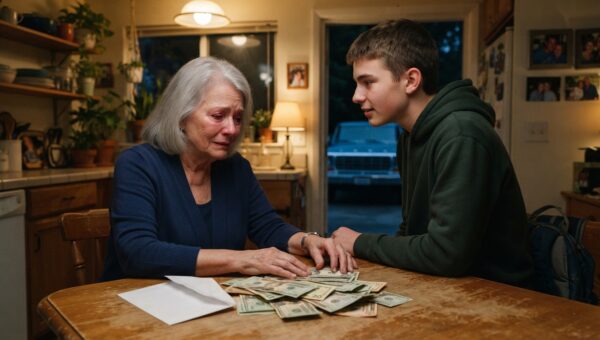
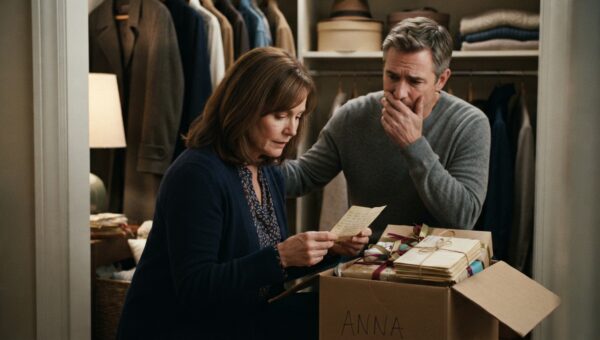
The laundry basket sat by the washing machine with three loads piled high because I never could seem to get ahead of the weekends. Richard left his heavy wool winter coat draped over the back of the kitchen chair instead of hanging it in the hall closet where it belonged. I picked it up to check the sleeves for lint and ran my fingers through the deep side pockets the way I always did before throwing anything into the wash.
Wallet, a crumpled grocery receipt from the hardware store, three stale mints wrapped in crinkly cellophane, and a small brass key that had no business being there.
It was not a house key, and it certainly wasn’t anything that unlocked his downtown architectural office. The little metal head was stamped with a postal branch on Monroe, which sat twenty minutes across the county line and in a direction neither of us ever traveled for groceries or errands. I turned the small piece of brass over in my palm for a long minute while the kitchen refrigerator hummed its familiar two-note tune in the background. I didn’t call him. I didn’t text him to ask why he had a post office box in a neighboring town. I just slipped the key into the pocket of my own cardigan and told myself it was probably nothing at all.
By Thursday morning the silence in the house had grown heavy enough to press against my eardrums.
The rain was coming down in gray, miserable sheets that plastered the dead leaves against the front porch steps, and the wipers on my sedan squeaked a ragged rhythm all the way down Route 9. The Monroe post office smelled of damp floor wax and old radiator heat when I pushed through the heavy glass doors at 9:15 in the morning. The clerk behind the high counter looked half-asleep until I slid the small brass key across the scuffed laminate and told her I needed access to Box 1147.
She didn’t ask for identification because small-town postal workers around here tend to mind their own business unless you give them a reason not to, or maybe she just didn’t care enough to check. I walked down the narrow, dimly lit corridor where the metal boxes lined the wall like tiny, silent teeth. The key turned in the brass tumbler with a dry, metallic click that echoed off the linoleum floor.
Inside the metal drawer sat a thick bundle wrapped in heavy rubber bands, bulky enough that it had clearly been pushed to the back to stay hidden from casual glances.
I took the bundle back to my car, sitting in the driver’s seat with the engine running and the defroster blowing tepid air against the windshield while the rain drummed a steady tattoo on the roof. Eleven birthday cards spanning nearly a decade, each one carefully signed in a neat, feminine script. Three school photographs showing a little girl with straight dark hair growing taller year by year, her smile unmistakably Richard’s. A crayon drawing of a blue house with crooked windows signed at the bottom in wavering block letters that spelled out Emma, followed by a return address on Birch Lane.
The address hit me somewhere behind my ribs before my brain even had time to process the letters.
Birch Lane was three blocks over from the hardware store where Richard claimed he went every other Tuesday evening to look at specialty lumber for his side drafting projects. Only Richard had never built a single custom shelf or repaired a single piece of molding in our entire house since the day we moved in twenty-four years ago. I sat there in the parking lot staring at the photographs until the condensation clouded the side windows and I had to wipe a circle with my sleeve just to see the street sign across the wet asphalt.
The realization settled over me in cold, flat pieces that didn’t leave any room for doubt or rationalization. Sarah was the woman’s name, though I had only known her as the quiet blonde who ran the register at the community center bake sales and occasionally chatted with Richard near the entrance while I was busy setting up the folding tables. Richard always mentioned her casually, calling her a friendly neighbor from across town who happened to be on his Tuesday night bowling league roster. He never brought home a single trophy, his bowling shoes stayed buried in the back of the hall closet with an inch of dust on the toes, and he always smelled faintly of cedarwood and laundry detergent when he came home late from those games.
The latest birthday card in the stack was pale blue with silver lettering on the front, dated just three weeks prior. I opened the envelope with fingers that felt stiff and clumsy against the paper, pulling out the folded card to read the neat, rounded handwriting inside. It wasn’t just a polite note from an old acquaintance or a passing client. The words spelled out a domestic reality that had been running parallel to my own life for nearly ten years without a single missed beat or a single cracked pane of glass.
The birthday card in her handwriting says, Daddy, I like it best when you stay for breakfast on the weekends too, and don’t forget to bring those extra drawing pads from your office like you promised. I stared at those words for a long time while the heater in the car clicked off and the cabin began to cool down around me. Nine years of sharing a bed, sharing Sunday morning coffee, sharing twenty-four years of quiet dinners while another household shared his mornings and his weekends with a little girl who called him Daddy.
The drive back home took twice as long because the traffic on the bypass had backed up behind a stalled gravel truck near the overpass. Every red taillight in front of me seemed to pulse in time with a dull, heavy ache behind my forehead that didn’t go away no matter how many times I blinked against the glare. I walked through the front door at precisely 11:45, taking off my wet boots and placing them neatly on the rubber mat by the back door just like I always did. The house was empty, smelling faintly of the lemon furniture polish I had used on Monday before any of this ugly reality had a name or a shape.
I didn’t cry, which felt strange and unnatural even to myself, as if my tear ducts had simply frozen shut from the sheer magnitude of the arithmetic. Eleven birthday cards multiplied by nine years of quiet deception meant hundreds of Tuesdays and dozens of fabricated late-night meetings that were actually spent sitting across a kitchen table on Birch Lane. I spent the rest of the afternoon moving through the rooms with a slow, mechanical precision that felt almost surgical. I didn’t tear down his clothes or throw his belongings out onto the lawn because that sort of display belongs in the movies, not in the quiet, dusty reality of a house where twenty-four years of a life had just dissolved into ash.
Instead, I cleared off the center of the dark oak dining table and laid the physical evidence out in a single straight line under the brass chandelier. The Monroe post office key rested right in the middle, flanked by the school photographs of Emma and the stack of birthday cards with their careful, steady handwriting. The last card was propped up against the salt cellar so anyone walking through the front door would see it immediately without having to look for it. Then I sat down in the wingback chair by the front window and waited for the clock on the mantelpiece to tick its way toward six o’clock.
The headlights cut across the living room wall at 6:14, sweeping in a long, slow arc as Richard’s sedan pulled into the gravel drive and crunched to a halt near the side porch. I heard the engine die, the soft thud of the car door shutting against the damp evening air, and the familiar sound of his keys jingling in his hand as he walked up the two wooden steps. He unlocked the front door with his usual brisk efficiency, pushing it open while shaking the drizzle off his umbrella and unbuttoning his collar in one smooth motion.
“It’s miserable out there on the bypass,” Richard said, stepping into the hallway and tossing his briefcase onto the small walnut bench by the coat rack. “I had to stay late to finish those site plans for the municipal building, and traffic was backed up all the way past the grain elevator.”
He stopped talking the moment he stepped around the partition and saw the dining room table illuminated by the single overhead light. The color drained out of his face so fast it looked as if someone had pulled a shade down behind his skin. He didn’t rush forward, and he didn’t try to clear his throat or offer another practiced excuse about late-night council meetings or bowling scores. He just stood there with his hand still resting on the edge of the hallway doorframe, his eyes fixed on the small brass key sitting right in the center of the polished wood.
“Where did you find that?” Richard asked, his voice dropping into a flat, thin whisper that didn’t sound like him at all.
I didn’t stand up from my chair, keeping my hands folded quietly in my lap where the fabric of my sweater felt warm against my palms. “You left your winter coat on the kitchen chair, Richard, and I was checking the pockets before I did the wash.”
He took one slow step toward the table, his hand reaching out instinctively toward the stack of cards before he stopped himself and let his arm drop back down to his side with a dull, heavy thud against his trousers. “It’s not what you think. It’s complicated, and there are things about that arrangement you don’t understand.”
“No,” I said, and my voice sounded clearer and steadier than I would have ever expected after a day like that. “It’s actually very simple, and I understand every single part of it now.”
He opened his mouth to say something else, some rehearsed line about responsibilities or mistakes or how much he still cared about our life together, but the words seemed to die in his throat before they could take any real shape. He looked at the photographs of Emma, then down at the small brass key that had unlocked ten years of lies in a twenty-minute drive across the county line. The silence in the room stretched out long and thin, heavy enough to crush whatever was left of twenty-four years between us into something small and worthless.
“I called the attorney’s office before you got home,” I told him, keeping my eyes locked straight on his face so he couldn’t look away from what he had built. “The joint accounts are already frozen until the auditor can sort through the deposits, and your overnight bag is sitting by the side door where you left your wet umbrella.”
He didn’t argue, and he didn’t raise his voice or try to bargain for another week under the same roof. Men who build their lives on quiet, methodical lies rarely know how to fight back when the floor finally gives way beneath them. He just stood there for another long moment, his shoulders slumping under the weight of an exposed life that could no longer be tucked away in a metal box two towns over. Then he turned around in the narrow hallway without another word, picked up his leather briefcase from the bench, and walked back out through the front door into the cold autumn rain.
I sat alone in the quiet house for a long time after the taillights of his car faded down the gravel drive and the front porch light cast a pale, empty glow against the empty screen door. The heavy brass key stayed right where I left it in the center of the polished oak table, catching the light from the overhead fixture and reflecting nothing back at all.