“You can’t fight a company that big, Daddy, so just let it go.”
Those were the exact words Nadine said to me over the kitchen table when the first denial letter supposedly arrived in the mail. My ears have been ringing high and sharp since I turned seventy, and half the time people sound like they are talking through a heavy wool blanket.
Nadine always took the calls from the clinic. She answered the door when the postman came. For forty-four years, ever since her mother passed away in that cold November room, Nadine made my coffee, filled my prescriptions, and kept our small brick house running without a single dropped stitch. I trusted her voice because my own had grown too weak to argue with insurance clerks.
Dr. Evans had been clear enough during my checkup on the tenth of the month. My heart was getting stiff like old harness leather, and the rhythm was skipping beats whenever I climbed the basement stairs. He told me the procedure had to happen within thirty days or the scarring would be too thick to fix. When Nadine called me into the living room that evening to tell me the claim was tossed out because of some technical clause in my retirement policy, I just sat there in my armchair and rubbed my knees.
I figured that was just how things ended when you got old. The world just quietly closed its doors on you one by one.
The house always smelled like whatever soup she had simmering on the back burner. That week it was potato and leek, thick with cream and black pepper because she knew my hands ached whenever the damp weather rolled in from the river. She would ladle it into my favorite heavy ceramic bowl and set it down with a soft click, wiping the rim with a damp cloth before she sat across from me. I used to think that was what devotion looked like. Just a steady pair of hands taking care of the small things so you didn’t have to worry about them anymore.
On the twenty-second day of the thirty-day window, I went back to St. Jude’s alone for a routine blood draw. My regular morning slot was booked, so I had to sit in the waiting room behind the billing desk while the young receptionist hunted for my file in the old metal cabinet.
A different clerk named Sarah was covering the front because the regular girl was out sick with a chest cold. Sarah was sharp-eyed and moved fast, her fingers clacking against the plastic keyboard like dry twigs snapping in the wind. She printed out three pages of billing history and shoved them across the counter to me without looking up.
“You’re all set for the supplemental payout phase, Mr. Keller,” she said, her voice cutting right through the ringing in my ears. “The balance was cleared out three weeks ago.”
I stared at the white paper she had laid between us. My jaw tightened so hard the old bicuspid on the left side started to ache. There were numbers printed in neat rows, followed by a bold total that made my breath catch in my chest. Thirty-one thousand six hundred dollars. The word approved was stamped right across the top in bright purple ink with a date from three weeks prior.
Not denied. Not pending. Paid in full by the secondary policy I had paid into every month since the mill shut down in ninety-eight.
“There must be some mistake,” I said, leaning over the counter so she could hear me clearly through the glass partition. “My daughter said it was thrown out.”
Sarah stopped typing and frowned, her fingers hovering over the keys. She pulled the paper back toward her, squinting at the routing numbers at the bottom before looking up at me with a slow, careful look in her eyes. “No mistake here, Mr. Keller. The funds were electronically transferred on the twelfth. It went straight into an individual account matching the claimant’s household address.”
I didn’t say anything else to her. I folded the paper four times until it was small enough to fit inside my shirt pocket right against my ribs, thanked her in a voice that sounded like it belonged to a stranger, and walked out to my Buick. The engine cranked on the third try, sounding tired and raspy in the gravel lot. I drove straight home, my hands gripping the steering wheel so tight my knuckles turned the color of lard.
When I walked through the back door, the kitchen was warm and smelled of boiling onions. Nadine was standing by the stove with a white linen dish towel in her hands, her back turned to me as she wiped down the stainless steel counter where she always prepped the vegetables. She didn’t look around when the screen door slammed, just kept right on scrubbing that same spot over and over in small, circular motions.
“You’re back early,” she said, her voice light and easy like it always was when she wanted to steer the mood of the room. “Did they take the blood okay?”
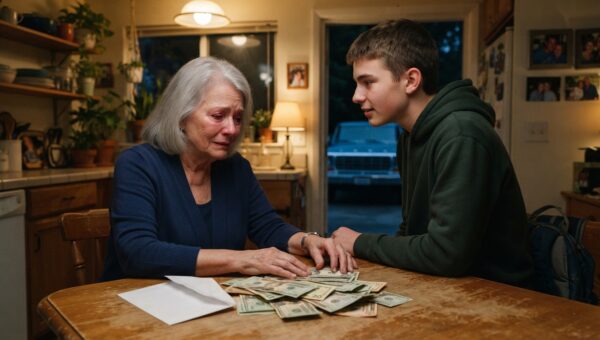
I walked over to the table and pulled the folded paper out of my pocket, laying it flat on the wood right where she usually set my coffee mug. The crease was deep and sharp. I didn’t raise my voice because I didn’t have the breath for shouting, but the silence in that little kitchen got heavy real fast.
“Sarah at the front desk printed this out for me today,” I said.
Nadine stopped moving the dish towel. Her shoulders stayed hunched forward for a long second before she turned around slowly, her hands still wrapped tight around the white cloth, twisting it back and forth between her fingers until her knuckles went white. She looked down at the paper on the table, then up at me, her mouth parting just a little bit like she was trying to catch a word that wouldn’t come out.
“Maybe the approval expired,” she said. Her voice was too quiet, too thin, like a frayed thread on an old sweater.
“Sarah checked it twice,” I told her, my own voice dropping into that flat, gravelly register I hadn’t used since my foreman days at the plant. “The money didn’t expire, Nadine. It moved.”
She didn’t answer right away. She just kept folding that dish towel, squaring the edges over and over with a frantic, jerky motion that didn’t look anything like her usual calm way of moving around the house. “You don’t understand how tight things got with the online store,” she muttered, staring hard at the counter instead of my face. “The supplier in Cincinnati changed the terms, and if I didn’t wire the balance by the end of the month, the whole inventory would have gone to auction. I was going to pay it back before the procedure date. I swear to God I was going to replace every cent.”
I stood there by the table and looked at her. Really looked at her. Not as my little girl who warmed my soup when my fingers hurt, but as a stranger who had looked at an old man with a bad heart and decided her boutique mattered more than whether he drew another breath. Forty-four years under the same roof, and it turned out she had been keeping a ledger of what I was worth dead or alive.
“You used my hearing against me,” I said, and the words tasted like iron in my mouth. “Every time Dr. Evans’ office called, you told them I was resting. You intercepted every letter that came through that front door.”
“That’s not fair,” she whispered, her voice finally cracking as she dropped the dish towel onto the counter. “I’ve taken care of you since Mom died. Who washes your shirts? Who makes sure your pills are sorted every Sunday morning? You wouldn’t even know how to schedule half these appointments without me.”
“Then I guess I’ll have to learn,” I said.
I didn’t yell. I didn’t throw her soup against the wall or smash the ceramic bowl she had set out for my lunch. I just turned around and walked out of the kitchen, leaving her standing there by the stove with her hands empty for the first time in as long as I could remember.
The next morning I was back at St. Jude’s before the parking lot even filled up. I sat across from Dr. Evans in his small, cluttered office while he looked over the bank records Sarah had helped me pull from the fraud division’s online portal. He didn’t say much while he read through the transfer slips showing the thirty-one thousand six hundred dollars landing in an account bearing Nadine’s name and her business tax ID. He just took off his wire-rimmed glasses, set them down on the desk, and rubbed the bridge of his nose where the pads had left two red dents.
“The window is down to seven days now, Arthur,” Dr. Evans said, his voice low and tired. “If we book the O.R. for Tuesday morning, we can still clear the blockage before the tissue hardens permanently. But the original funds have been frozen by the bank’s fraud investigators. It’s going to take weeks to claw that money back through probate and civil court.”
“Book it anyway,” I told him. “I’ve still got the truck and the title to the house clear. We’ll use the equity line at the credit union until the bank sorts out what she stole.”
He looked at me for a long time, nodding slowly like he was weighing whether I was going to collapse right there in his leather chair. “You’re a stubborn man, Arthur.”
“Mill work,” I said. “You learn how to stand up even when the floor is shifting under your boots.”
I went back to the house one last time that afternoon while Nadine was out at her post office box. I didn’t pack much. Just two flannel shirts, my good boots, the old radio my brother gave me when we came back from the service, and the framed photograph of Sarah from the day she graduated high school. It took me less than ten minutes to fill my old canvas duffel bag.
Before I pulled the front door shut behind me, I walked into the kitchen one last time. The white ceramic bowl of soup Nadine had ladled out for me before I left for the clinic was sitting dead center on the kitchen counter, untouched and starting to grow a thin skin across the top where the grease had cooled in the quiet air. I didn’t touch it. I just set my keys right beside it on the laminate surface, listening to the small, steady hum of the refrigerator fighting to keep things cold in a house that didn’t feel like home anymore.
I walked out to the truck, threw my bag into the passenger seat, and didn’t look in the rear-view mirror as I pulled down the gravel drive.