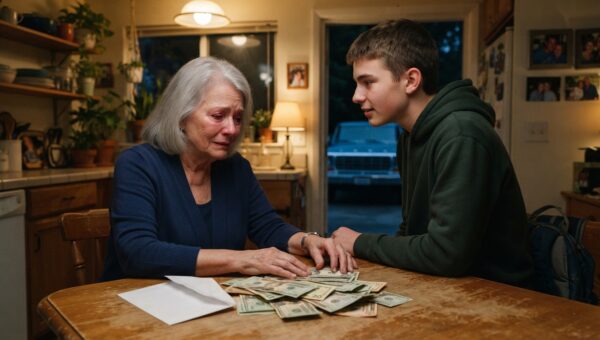
The courtroom smelled faintly of floor wax and stale coffee, a sterile municipal chill that always seemed to settle into the marrow of your bones. I sat at the defense table with my hands resting flat on the grain of the laminate wood, watching my mother perform her grief for the gallery. She held a lace-trimmed tissue delicately against the corner of her left eye, pressing it there with a rhythmic, practiced precision that would have won an award if the stakes had been lower.
Beside her, my brother-in-law, Arthur, adjusted his silk tie with damp fingers, his chest puffed out with the rehearsed confidence of a man who believed he had already won the game before the board was even set.
For five years, they had called me unstable, reclusive, and hopelessly adrift. Whenever I visited for Sunday dinner, my father would shake his head over the roast beef and ask when I was finally going to get a real job instead of staring at spreadsheets in my spare room. My sister would shoot me pitying looks across the table, whispering about how sad it was that I never quite recovered from my divorce, living alone in that modest two-bedroom condo while Arthur was busy developing commercial real estate and making real money. I let them believe whatever kept them comfortable. I let them think I was the family casualty, the erratic sibling who needed to be managed, because while they were busy keeping score at holiday dinners, I was quietly building a commercial lending firm from the ground up.
The petition sitting on the judge’s bench was a masterclass in calculated greed. They had filed for an emergency conservatorship, claiming I was mentally incompetent, deeply in debt, and entirely incapable of managing my own affairs. If the judge signed their order, my condo, my car, and my modest savings account would be transferred directly into a family trust administered by Arthur. It was a clean, brutal financial ambush designed to strip away my independence and use my assets to rescue Arthur’s over-leveraged commercial projects from imminent foreclosure. They had spent weeks gathering public records, scouring county databases, and manufacturing a paper trail of my supposed insolvency to present to the court.
Arthur took the stand first, smoothing back his thinning hair and speaking in a low, somber tone that dripped with manufactured concern. He told the judge about my reclusive habits, my obsessive work hours, and the crushing financial obligations he claimed were slowly destroying my life.
He spoke of my supposed debts with such vivid detail that even the bailiff looked over at me with a flicker of pity. My mother let out a soft, theatrical sob from the front row, leaning her head against my father’s shoulder as if the burden of my mental collapse was simply too much for her maternal heart to bear.
“We just want to protect her, Your Honor,” Arthur said, pressing a hand to his chest. “She is drowning in liabilities she doesn’t even understand. If the court doesn’t intervene immediately, her creditors are going to take everything she has left.”
When Arthur stepped down, the judge looked over his wire-rimmed glasses at my attorney, a sharp, silver-haired woman named Clara who hadn’t smiled once all morning. “Does the respondent have a response to the financial disclosures submitted in the petition?”
Clara stood up slowly, smoothing the front of her charcoal blazer. “We do, Your Honor.
And we would like to submit our own exhibits into the record before the court considers any ruling on the conservatorship.”
She didn’t raise her voice, but there was a quiet certainty in her posture that made Arthur shift uncomfortably in his chair. Clara reached across the defense table and popped open the brass latches of a thick manila folder. She didn’t hand up a few scattered printouts or a hastily gathered sheaf of bank statements. She slid a heavy stack of documents across the polished oak bench toward the clerk. Five years of clean tax returns. Corporate registration filings stamped by the state. And the private credit line agreement that the family had frantically pulled from public records, assuming it was the smoking gun of my financial ruin.
The judge pulled the top pages toward him, adjusting his glasses as his eyes scanned the dense rows of figures. The courtroom grew very quiet, save for the distant hum of the building’s air conditioner. I watched Arthur lean over and whisper something to my sister, his brow furrowing as he noticed Clara standing there with her hands folded, completely unbothered by the dramatic testimony we had just endured.
Clara stepped back and addressed the court. “The petitioners have made much of my client’s supposed debt, Your Honor. Specifically, they entered into evidence a high-value commercial credit line held by an entity called Vanguard Holdings, claiming it proves severe financial distress.”
My father cleared his throat nervously in the gallery, shifting his weight against the wooden pew.
The judge kept reading, his finger tracing a line down the middle of the corporate registry document. A slow, heavy silence settled over the bench. He looked up from the paper, his gaze shifting past Clara and landing squarely on Arthur, who suddenly looked very small in his tailored suit. The color began to drain rapidly from Arthur’s cheeks, leaving him a chalky, uneven gray.
“Sir,” the judge said, his voice cutting through the quiet room like a dry blade. “Are you aware that the petitioner is your largest creditor?”
My mother’s tissue stopped mid-dab. Her hand froze half an inch from her face, the crumpled white paper trembling slightly between her thumb and forefinger. She stared blankly at the bench, her mouth parted in a silent, unfinished gasp, as if the English language had suddenly broken down entirely.
Arthur tried to speak, but only a dry click came out of his throat. He swallowed hard, his eyes darting frantically toward my father, who was staring straight ahead in numb disbelief.
“Vanguard Holdings,” the judge continued, reading aloud from the corporate ledger now resting in his hands. “Sole equity holder, sole director, and senior lienholder. Miss Miller is not the debtor on this account, Mr. Hayes. You are. Her private lending firm holds the collateralized notes on your commercial properties, your development accounts, and your personal guarantees.”
The courtroom seemed to tilt slightly on its axis. In their desperate haste to paint me as a reckless failure, my family had pulled public documents concerning Vanguard Holdings without ever checking the corporate registry to see who actually owned the underlying debt. They saw my name on the loan paperwork and assumed I was the one drowning, never realizing that I was the one holding the anchor rope. Every single real estate venture Arthur had launched over the past three years had been quietly funded by my commercial lending firm after traditional banks had turned him away. They had walked into a court of law to steal my condo, and in doing so, they had officially handed me the keys to their entire financial collapse.
Clara didn’t miss a beat. “In light of these disclosures, Your Honor, we move for an immediate dismissal of the conservatorship petition with prejudice.”
“Granted,” the judge said without hesitation, his pen scratching a sharp line across the top of the petition.
Before Arthur could slump completely down into his chair, Clara offered her final motion of the morning. “Additionally, given that the financial statements attached to the initial petition were materially altered to conceal the true debtor-creditor relationship, we request a formal referral to the district attorney’s office for a criminal fraud investigation into the petitioners’ filings.”
The judge looked down at the forged exhibits attached to the family’s paperwork, his expression darkening. “Referral approved. Court is adjourned.”
The gavel came down with a sharp, final crack that echoed off the high plaster ceilings. The gallery erupted in a low, chaotic murmur, but I didn’t look back at them. I slowly closed my manila folder, secured the brass latches with a quiet click, and stood up from the table.
By the time I pushed through the heavy glass doors of the courthouse and stepped out onto the wide stone steps, the afternoon sun was bright and blinding against the concrete. I stood there for a long moment, breathing in the crisp air with a deep, steady calm I hadn’t felt in five years. Down at the curb, Arthur and my parents were scrambling awkwardly into the back of a idling taxi, my sister pulling her coat tightly around her shoulders as she avoided looking in my direction entirely. They slammed the cab door shut without a single word, leaving their financial fate and the entirety of their failing empire tied securely to the corporate ledger sitting inside my briefcase.