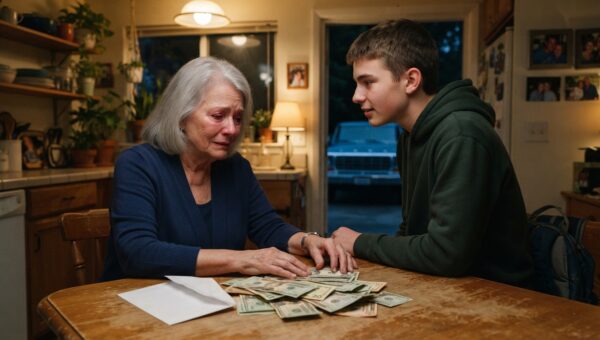
The linoleum under my kitchen table always felt a little too cold in the late afternoon, even when the autumn sun managed to cut through the heavy cotton curtains. I had just finished washing the supper skillet, wiping the grease from the rim with a damp rag, when Ethan cleared his throat. He was sixteen then, tall enough now that he had to duck his head slightly to clear the low oak lintel between the pantry and the stove.
He didn’t drop his schoolbag on the floor the way he usually did. Instead, he pulled out the chrome-trimmed laptop his uncle had given him for his birthday, set it flat on the laminate wood grain, and pushed it across the table toward me with both hands.
“Mom,” he said, and his voice cracked just a little on the first syllable. “I need to show you something.”
I stopped wiping the counter, the rag still bunched in my damp palm. Arthur was still thirty miles away at the district office, working late on quarterly inventory the way he always did on Tuesdays. For twenty years, the rhythm of our life had been as steady as the grandfather clock in the hall. Arthur went to work, Ethan went to track practice, and I kept the pantry stocked with flour and salt. There was no room in that tidy equation for a laptop pushed across the kitchen table like a subpoena.
“What is it, honey?” I asked, trying to keep my voice light, though my stomach gave a strange, sickening lurch against my ribs. “Did you break something in the lab again?”
“Just look,” he whispered.
He reached out with a thumb that still had a smudge of blue ink on the knuckle and tapped the trackpad. The screen flickered from a dark sleep mode to the bright, glaring white of a social media browser. At the top of the page was a profile picture of a woman with short, honey-brown hair and a wide, easy smile. She looked to be about thirty-one. The name above her photo was Claire. Below her picture was a grid of bright, sunlit squares that scrolled back through four years of history. Vacations in cabins by the lake. Birthdays with store-bought cakes covered in blue frosting. Christmasses with stockings hung from a mantelpiece I had never seen before in my life.
And in every single frame, smiling back at the camera with his arm slung casually around her waist, was Arthur.
I stared at the glowing rectangle until the letters began to blur into gray smudges. “Ethan,” I managed to say, my throat feeling like it was lined with dry dust. “Who is this?”
“I found it two years ago, Mom,” he said, and the confession rushed out of him in a ragged, breathless flood. “I was looking up an algebra link for extra credit, and her name popped up in a mutual group. I clicked on it. I saw him. I saw the kids.”
“Two years?” I repeated. The words felt too heavy for my tongue. “Ethan, you saw this two years ago and you didn’t tell me?”
“I didn’t want to lose Dad,” he cried, his voice breaking as he finally looked up at me, his eyes wide and wet. “I was fourteen.
I thought if I didn’t say anything, maybe it would go away. Maybe he would stop. Every time he went out of town for those hardware conventions, I thought about telling you, but the house was so normal when he came back. He asked about my grades. He kissed the top of your head. I was just so scared I’d break everything.”
My hand drifted down from the counter and landed flat on the cold table. The silence between us was heavier than anything I had ever felt in that house, thicker than the snowstorms that used to trap us for days. I didn’t scream at him. I couldn’t. I looked at my boy, who had been carrying a boulder on his thin shoulders since the eighth grade, and all I could do was reach across the laminate and close my hand tightly over his trembling fingers.
“You didn’t break anything, sweetie,” I told him, my own voice sounding thin and foreign to my ears. “Show me the rest.”
He swallowed hard, wiped his nose with his sleeve like a little boy, and scrolled back down to the bottom of the feed. The posts marched backward through time in reverse order of our own lives. There were pictures of Claire holding a newborn baby in a hospital wing with pale green walls. There were pictures of Arthur standing proudly beside a crib he must have built on a Saturday while I was busy at the garden club. Every milestone of our marriage, our twentieth anniversary trip to Savannah, the weekends we spent planting tomatoes by the back fence, had a parallel track running right alongside it, funded by the same man, signed with the same handwriting.
“Go to the very top,” I told him. “Show me today.”
Ethan’s finger trembled on the pad as he flicked the scroll wheel upward. The most recent post was timestamped three days ago. It was an outdoor photograph taken in front of a sprawling, split-level ranch house with manicured hedges and a freshly painted white trim. A bright red SOLD sign was staked deep into the green lawn near the mailbox. Arthur was standing right in the center of the frame, wearing a pair of khaki trousers and the heavy steel-link watch I had bought him for our fifteenth anniversary with the money from my mother’s estate. He was holding an infant in his left arm, looking down at the baby’s tiny cap with an expression of serene, domestic pride that I hadn’t seen directed at our own son in half a decade.
“Three days ago,” I whispered. “He bought a house three days ago.”
“Look at the window, Mom,” Ethan muttered, his voice dropping to a harsh rasp. “Look right behind his shoulder.”
I leaned closer, my glasses sliding down the bridge of my nose, and stared into the dark glass pane of the front window visible behind Arthur’s head. The glare of the afternoon sun had caught the glass, but the camera flash had illuminated the interior wall just past the foyer. Hanging on the pale blue drywall was a framed rectangular photograph. Even through the digital grain and the reflection of the porch light, I knew the exact dimensions of that frame. I knew the carved mahogany corners with the little thumb-nicks near the bottom left edge where Arthur had dropped it during our move from the old apartment.
It was our wedding portrait. The one taken in the parish hall twenty-two years ago, showing me in my mother’s lace veil with Arthur standing stiffly beside me in his rented gray suit. He hadn’t just built a second life across town. He had cloned our history down to the last framed memory, using the stability of our kitchen to finance the blueprint of his lie.
“He didn’t just cheat,” I said, and the realization didn’t make me cry; it made something inside me go completely, terrifyingly still. “He copied us.”
We sat in the fading kitchen light for nearly an hour. Ethan didn’t go to his room, and I didn’t start dinner. We opened the metal lockbox in the back of my closet where we kept our tax returns, and we laid the paperwork out alongside the glowing screen. For four years, Arthur had been claiming travel expenses for regional hardware conventions that never happened. For four years, he had diverted four hundred dollars every two weeks from our joint savings into a secondary credit line at the county credit union. Every time he kissed my cheek at the door and told me he had to check on the warehouse in Roanoke, he had been driving twenty minutes north to a subdivision with freshly paved streets and a mortgage in his name alone.
“What are we going to do?” Ethan asked, looking up at me as the digital clock on the microwave flipped to 6:15.
“We aren’t going to do anything tonight,” I said, my voice steady now, purged of every ounce of panic. “Your uncle Thomas is a lawyer in Charleston. I’m going to call him in the morning before your father gets up. But tonight, we act normal. Do you understand me, Ethan? We act completely normal.”
When Arthur’s sedan crunched down the gravel driveway at 7:02, the sound was exactly the same as it had been every evening for two decades. The engine hummed down, the driver’s side door clicked open with its familiar squeak, and the heavy oak front door swung wide to the smell of lemon polish and roasted potatoes.
“Helena?” he called out, tossing his leather briefcase onto the mahogany hall table with a tired sigh. “Smells good in here. Sorry I’m late. Traffic on the bypass was backed up all the way past the river bridge.”
I didn’t answer right away. I stayed by the stove, stirring a pot of green beans that we weren’t going to eat, watching the steam rise against the windowpane. Ethan was sitting quietly at the kitchen table, his homework open in front of him, though his pencil hadn’t moved in ten minutes.
Arthur walked into the kitchen rolling up his shirtsleeves, his tie loosened around his collar just enough to look like a hard-working husband coming home to his sanctuary. He leaned down and pressed a dry, familiar kiss to the back of my neck, right over the spot where my hair was pinned up.
“Rough day,” he muttered, reaching for the water pitcher on the counter. “Accountants are driving me crazy with the Q3 numbers.”
I turned around slowly, wiping my hands on my kitchen towel, and looked right into his eyes. They were the same hazel eyes I had trusted since I was twenty years old, clear and steady and entirely empty of anything resembling a conscience.
“Did you check on the Roanoke warehouse today, Arthur?” I asked.
He didn’t miss a beat. Not a single muscle in his face twitched. He poured his glass of water, took a long swallow, and smiled that easy, practiced smile that had fooled half the county for years. “Of course. Spent three hours down there going over the loading dock inventory. Why do you ask?”
I reached down beside my chair, picked up the three sheets of heavy printer paper where I had printed out Claire’s Facebook timeline and the SOLD house post, and laid them face-up on the center of the kitchen table right where Ethan’s laptop had been an hour ago.
“Because,” I said, and my voice didn’t shake once, “I think you forgot something important in the window of your new house.”
Arthur froze with the glass halfway to his mouth. The easy smile stayed pasted on his lips for a fraction of a second too long before it dissolved into something hard and gray. He looked down at the paper, then across at Ethan, who was sitting upright with his hands flat on the table, staring at his father with eyes that had finally grown up.
“Helena, let’s not do this in front of, ” Arthur started, his voice dropping into that smooth, managerial tone he used when he was trying to defuse a complaint from a supplier.
“Don’t you dare,” I said, and the word came out sharper than a razor, cutting him off completely. “Don’t you ever say his name like you’ve been protecting him. You packed your suitcase two years ago when you started that family across town, Arthur. You just forgot to take your clothes.”
He tried to argue then. He tried the old routines, the excuses about misunderstandings and complications and stress, his voice rising in that familiar, bullying cadence that used to make me back down in the early years of our marriage. But the words sounded thin and hollow in the small room, bouncing off the tile and the copper pans hanging by the stove like tin cans tied to a bumper.
“Get out,” I said quietly.
“Helena, be reasonable, you can’t just throw twenty years, “
“I said get out,” I repeated, louder this time, and I pointed straight toward the front door through the open archway. “Thomas has the bank statements and the mortgage filings. The locks are being changed at eight o’clock tomorrow morning. If you aren’t gone by the time I finish washing these dishes, I’ll let the sheriff explain the wire fraud to your partners in the morning.”
Arthur stared at me for a long, ugly moment, looking for the woman he had managed for two decades, the one who always kept the peace and swallowed her doubts to keep the roof over our heads. But she wasn’t there anymore. He must have seen it in my eyes, because the color drained right out of his cheeks, leaving him looking smaller than he ever had in his Sunday suit. He didn’t say another word. He turned on his heel, his heavy boots clicking against the hallway floor, and the front door slammed shut behind him with a dry, hollow thud that rattled the glass in the frame.
Neither of us moved for a long time after the engine of his sedan roared to life in the drive and faded away down the dark road. Ethan let out a long, ragged breath that sounded like he had been holding it for twenty-four months, and his shoulders slumped forward until his forehead touched the edge of the table. I walked around behind him, pulled his head against my hip, and stroked his hair the way I used to when he was small enough to hold all at once.
In the quiet living room down the hall, bathed in the pale amber glow of the porch light through the lace curtains, the original wedding portrait sat alone in its mahogany frame on the mantelpiece, perfectly dusted and gleaming quietly in the empty house.