The fluorescent lights in the transplant clinic at St. Jude General had a faint, rattling hum that sounded like a cheap electric razor left running in an empty drawer. I sat across the desk from Dr. Evans, holding a plastic cup of lukewarm water I didn’t want, while she turned a fresh manila folder around so I could see the intake summary.
My wife, Claire, had been crying on and off for two solid months since her brother, Caleb, collapsed in the middle of his garage on a Tuesday afternoon in September. We had all rushed to the hospital that day, frantic and terrified, because Caleb was only thirty-eight, a sharp-witted guy who always had a joke ready at family barbecues and a cold bottle of light beer in his hand.
The doctors back then told us his kidneys had simply quit, shutting down after what the family described as a severe bout of acute flu mixed with some bad medication reactions. Claire was inconsolable, and her parents looked ten years older overnight, their faces gray with shock as they hovered in the ICU waiting room.
Being O-positive and running five miles three times a week, I was the obvious person to step forward when the nephrologist mentioned live donation. I didn’t even hesitate for twenty seconds because Caleb was family, and in our house, family meant you didn’t ask questions when someone was going under.
Initial cross-matching tests came back faster than expected, showing I was a near-perfect candidate for the nephrectomy. The coordination team moved us from the general hospital over to the regional transplant wing for the deep psychological and physical clearances required for living donors.
That was how I wound up in room 412 with Dr. Evans on a rainy Thursday morning in November, going over five years of blood panels and lifestyle questionnaires. I figured it was just routine bureaucracy, the kind of boring paperwork you have to push through whenever you deal with large medical institutions.
“Mr. Davis,” Dr. Evans said, her voice entirely flat as she adjusted her wire-rimmed glasses and looked straight over the top of the folder. “Are you fully aware of the patient’s long-term history with alcohol?”
I gave a small, easy nod, thinking about the holidays and summer cookouts where Caleb always carried around a bottle of domestic beer and joked about his home-brewing attempts. “Sure.
Social drinking mostly. A couple of beers on the weekends watching games. Nothing out of the ordinary.”
Dr. Evans didn’t nod back, and that was the exact second the room felt like it had dropped twenty degrees. She slid a single printed lab summary across the table toward my side of the desk, her finger resting on a block of bold black text near the bottom of the page.
“That’s not what these charts say,” she said quietly.
I looked down at the paper, and my brain stalled out for a few seconds because the numbers listed under liver enzymes and past emergency room admissions didn’t match any weekend barbecue I had ever attended. There were four separate visits to county hospitals over the prior six years, all logged under acute alcoholic hepatitis and severe systemic dehydration.
“Wait,” I said, my voice sounding a little too loud in the small, quiet room. “This must be from a different patient file.
This is Caleb we’re talking about, not some stranger off the street.”
Dr. Evans pulled the folder back an inch and turned the pages deliberately, showing me dates, signatures, and admitting physician notes that named Caleb Robert Vance with complete clinical precision. “His primary care physician tried to intervene three separate times,” she said. “The kidney failure isn’t bad luck or a sudden flu. It’s the end stage of chronic, untreated substance abuse that has been actively managed and minimized by his immediate family for nearly a decade.”
The silence in the clinic room stretched out until all I could hear was the faint, steady tick of the wall clock near the door. Every family gathering, every casual explanation from Claire about why Caleb looked tired or why he had to miss Thanksgiving dinner two years ago, suddenly clicked into a very different, much uglier shape.
“They knew,” I whispered, the words coming out before I could stop them.
“The family was informed of his prognosis years ago,” Dr. Evans replied gently. “And when we started the donor evaluation process, we asked them to disclose his full medical history to you directly. Apparently, they chose not to.”
I stood up from the metal chair so fast the plastic legs scraped against the linoleum floor with a sharp screech. I didn’t say goodbye to the doctor, and I didn’t take the cup of water, walking straight out of the clinic doors into the cold parking lot where my sedan was parked under a gray, heavy sky.
The drive back to our subdivision took twenty minutes, and the whole way there my hands felt glued to the steering wheel, cold and stiff even with the truck heater blowing full blast. I kept replaying every conversation with Claire and her parents, remembering how eager her mother had been to fast-track my surgical dates and how quickly Claire brushed off my minor questions about Caleb’s diet and habits.
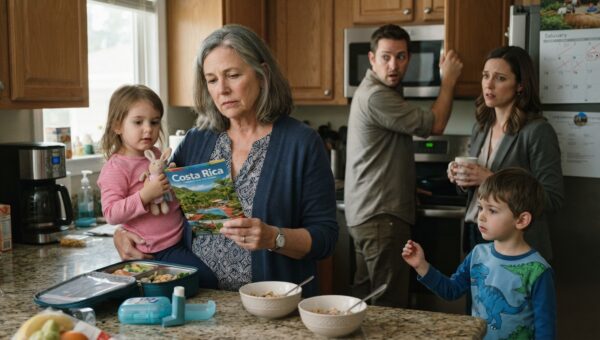
When I unlocked the front door, the house smelled faintly of cinnamon wax and the laundry soap Claire always used on the kitchen towels. Our three-year-old daughter, Lily, was sitting on the living room rug stacking wooden blocks while Claire stood by the counter pouring hot water into a ceramic mug.
Claire looked up as I walked in, her face dropping its usual strained smile when she saw the look in my eyes. “You’re back early,” she said, setting the kettle down. “How did the screening go? Did they schedule the pre-op date yet?”
I didn’t take off my jacket, just stood in the middle of the entryway staring at her across the kitchen island. “There is no pre-op date,” I said.
Claire froze, the ceramic mug half-filled with water. “What do you mean? Did something show up on your blood work? Are you okay?”
“I’m fine,” I said, my voice dropping lower than I intended. “My kidneys are fine. My liver is fine. The problem is in this house, and it’s been here for years.”
Claire set the kettle down with a sharp clatter that made Lily look up from her blocks for a second before going back to her toys. “Will, what are you talking about? Stop talking in circles and tell me what the doctors said.”
“They told me about the other hospital visits,” I said, taking two steps toward the counter so I was right across from her. “They told me about the alcoholic hepatitis, the ER admissions in the city, and the fact that your parents have been running interference for Caleb’s drinking since before we even got married.”
Claire’s face went completely still, all the color draining right out of her cheeks until she looked like she had just seen a ghost. “That’s… that’s ancient history,” she stammered, her hands gripping the edge of the granite counter until her knuckles turned white. “He had a rough patch after the company downsizing. Everyone has rough patches.”
“Four hospitalizations for organ damage isn’t a rough patch, Claire,” I said, and the anger I had been holding in my chest since the clinic finally broke loose. “That’s a decade of self-destruction. And you let me walk into a major surgical room without telling me a single word of it.”
“We wanted to save his life!” Claire shouted back, her voice cracking as tears spilled over her eyelashes. “What were we supposed to do, let him die because he made mistakes? He’s my brother!”
“You lied to me,” I said, and the flatness in my own voice scared me a little. “You and your parents looked me in the eye and let me volunteer my own body to fix a problem he caused himself, while you all sat there hiding the real reason his organs failed in the first place.”
Before Claire could answer, the front door swung open and her parents walked right into the kitchen without knocking, carrying a bag of groceries they must have picked up from the local market. Her father stopped dead in his tracks when he saw our faces, and her mother dropped her purse onto the hall bench with a loud thud.
“What’s going on?” her mother asked, looking between us with immediate defensiveness. “Why is everyone yelling? We could hear you from the driveway.”
“They told him,” Claire whispered, covering her face with both hands.
Her father stepped forward, puffing out his chest the way he always did when he wanted to project authority. “Look here, Will, whatever the clinic told you is being exaggerated by pencil-pushing administrators who don’t understand family loyalty. Caleb had a difficult time, yes, but he’s turned a corner. He needs this kidney.”
“He needs rehab,” I said, turning to face him directly. “And he needs honesty. Not an accomplice network that cleans up his messes and finds healthy donors to replace the parts he ruins.”
“He is your brother-in-law!” her father yelled, his face turning dark red. “You took vows to this family when you married Claire! You don’t get to back out now just because of some medical paperwork from five years ago!”
“I am not backing out of being a father to my daughter, and I am not backing out of my marriage,” I said, my voice dropping back down to a cold, hard whisper. “But I am not giving up my body part to a man who is still drinking behind closed doors while his entire family lies to protect his reputation.”
The kitchen went dead quiet again, save for the hum of the refrigerator in the corner. Claire dropped her hands from her face and looked at me with a mixture of terror and fury that I had never seen in the six years we had been married.
“If you walk away from this surgery,” Claire said, her voice shaking so hard the words barely came out, “you might as well pack your bags right now. Because I cannot live with a man who lets my brother die out of spite.”
That was the line, right there in the middle of the kitchen floor with our little girl playing quietly twenty feet away, where I realized the trap had finally closed all the way. They didn’t see a husband or a partner standing in front of them; they saw a spare parts kit, a walking resource to be managed, manipulated, and kept in the dark until the stitches were in.
“This isn’t spite, Claire,” I said, backing toward the front door while grabbing my jacket off the hook. “This is self-preservation. And I’m not doing it.”
I didn’t wait for her mother’s screaming or her father’s threats, turning the deadbolt and pulling the heavy wood door open to the gray afternoon air.
The driveway gravel crunched loudly under my shoes as I walked down the two concrete steps, stepping past my father-in-law’s idling sedan parked near the mailbox. The wind was picking up from the north, carrying that sharp, dry smell of coming winter down from the open fields beyond the subdivision.
I stopped at the edge of the porch, listening for a second to the quiet hum of traffic out on the county road before the front door clicked open behind me.
Little Lily came toddling out onto the porch holding her favorite wooden block, looking up at me with wide, uncomprehending eyes and reaching out her small hands. “Daddy, where are you going?” she asked, her voice high and sweet in the cold air.
I knelt down right there on the weathered cedar boards, scooped her up into my arms, and pulled her tight against my chest. Her small, warm weight pressed right where my own healthy heart was beating, steady and strong and entirely my own, refusing to be traded away for someone else’s unacknowledged sins.