My dad never sat with his back to a door. At a restaurant he would switch seats until he could see the room. At home it was that one chair in the corner, always. Forty years, and you just got used to it, you stop even noticing after a while. He was in the service young, over in Vietnam, and he came back different, and that was that.
You didn’t ask. Ask him about any of it and he would get up and go find something to do, clearing his throat or tapping his coffee mug against the counter. He passed this fall, seventy-eight. Heart gave out while he was out in the garage sweeping sawdust. My mom is gone already, so clearing out the house was entirely on me. I took my time with the kitchen, gave away the cans of soup, packed up the cast-iron pans, but I saved the basement for last.
That was his domain down there. Workbench, an old transistor radio tuned to local talk, a chair down there too, in the corner, same as upstairs. Man kept everything squared away in rows of mason jars and labeled coffee cans. It made me miss him, going through it, all that quiet down-home order he lived by. Down there against the concrete wall was a metal cabinet with a padlock on it.
And that stopped me cold, because nothing else in that whole house locked. Not the garden shed, not the back door, not even half the time the front door when he went out to check the mail. Just this one grey metal box. I stood there for a minute holding a box of old rags, wondering what on earth he kept in a basement corner that needed a heavy brass lock.
I knocked the lock off with a hammer and a screwdriver because I could not find a key anywhere in his desk drawers. The metal gave way with a sharp crack that echoed off the foundation walls. Opened it up. There was something standing inside, and when I lifted it out and got a real look, I had to sit down on the bottom step, because my brain kind of stopped working for a second. It was not guns.
It was not old medals or ribbons from the service, which he never talked about anyway. It was a polished teakwood box, heavy and smooth, surrounded by neat bundles of paper held together with rubber bands that had rotted and turned gummy with age.
I pulled the teakwood box out first. It had no latch, just a sliding lid that stuck a bit from the damp air in the cellar. When I worked it open, the smell of old cedar and dried paper came up out of it. Inside lay a collection of things that did not belong in an ordinary Ohio basement. There were photographs of a village I had never seen, rice paddies under a white sky, and a young woman with dark hair holding a baby. The edges of the pictures were worn soft from fingers touching them over and over. Beneath the photos were stacks of international postal receipts, yellowed and faded, dating all the way back to the early nineteen-eighties.
The names on the receipts were unfamiliar, tied to aid agencies and banks in Saigon and later Ho Chi Minh City.
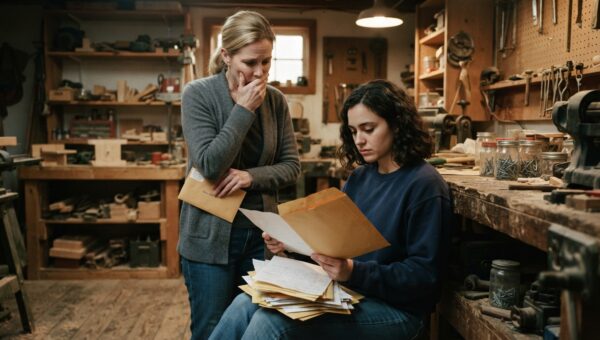
I sat there on the bottom step for a long time, turning a slip of blue airmail paper over in my fingers. The date on it was from 1985. Dad had been working at the grain elevator back then, making modest wages, but every single month he had sent money across the Pacific. I thought about how tight money had been for us when I was twelve, how he patched my winter boots with shoe goo instead of buying new ones, and here he was paying tuition and living expenses for strangers a world away. I didn’t know what to think. My dad was a quiet, practical man who didn’t spend money on himself, but I had always figured he just saved for retirement or worried about taxes like everyone else.
I kept digging through the box, finding letters written on thin onion-skin paper. They were in English, typed by someone named Father Thomas at a mission office, giving updates on a little girl named Linh. The letters spoke of school fees, new books, and a girl growing up into a bright student. One letter from the late nineties mentioned she was starting university. Dad never mentioned Vietnam once in my entire life, not a single story about his buddies or the jungle or the heat, but he had been keeping track of a girl’s report cards in a locked grey cabinet in his basement. I looked back at the open cabinet. Tucked into the very back corner was a small, folded piece of pale blue silk, smooth and entirely out of place among the business papers. It was a child’s tunic, exquisitely stitched with small flowers along the collar.
The house upstairs was dead silent except for the refrigerator humming in the kitchen. I carried the teakwood box up the stairs and set it on the kitchen table, right where Dad used to sit every morning with his black coffee and the local paper. I sat in his chair, the one facing the back door, and started opening the bundles of letters one by one. There was a ledger book, too, bound in black cardboard. Dad had written in it with his careful, block-letter drafting hand, logging every money order down to the exact cent, alongside notes about exchange rates and postal delays. The last entry in the ledger was dated just two weeks before his heart gave out.
Buried beneath the oldest letters was an official-looking document with a red seal, weathered at the folds. It was an incident report from an infantry unit in 1968, mentioning a sweep through a farming village that went wrong. It didn’t have many details, just dry military language about a crossfire and civilian casualties that shouldn’t have happened. Dad’s name was listed among the platoon members. He was nineteen years old when that happened. Nineteen years old, holding a rifle, standing in a place he didn’t understand, watching a world fall apart in twenty minutes. That was why he couldn’t sit with his back to a door. That was why he checked the locks twice every night before turning off the downstairs lights. The threat wasn’t something coming from the outside world now; it was the memory of a doorway he couldn’t guard back then.
The realization settled over me slow and heavy, like snow falling on dry ground. I had spent my whole life thinking my father was just cold, or distant, or worn down by ordinary hard work. I used to get mad when he wouldn’t come to my school plays or talk much at the dinner table. But looking at the ledger, I saw the real man. He was carrying a debt he could never pay off with words, so he paid it in quiet dollars sent across an ocean, month after month, year after year, without ever telling a soul. He didn’t do it for praise. He didn’t do it so someone would write a nice thing about him in the paper when he died. He did it because he had to live with himself in the dark.
Near the bottom of the box, under the receipts from the nineties, I found something modern. It was a glossy photograph printed on thick modern photo paper, showing a young woman in a graduation cap and gown holding a diploma in front of a brick building in Vietnam. On the back, written in neat black ink, were the words: Thank you, Grandfather. We made it. Below that was an email address scrawled in the same hand. My hands were shaking a little as I picked up my phone from the kitchen counter. I didn’t call anyone. I didn’t know who to call anyway. Instead, I sat there staring at the screen, typing out a message to the address on the back of the photograph, telling her that the man who had watched over her from half a world away had passed away quietly in his garage, but that his box was safe, and that I was his child.
The sun went down behind the trees across the street, turning the kitchen window dark and reflective. I didn’t turn on the overhead light. I just sat there in the quiet house with the teakwood box between us, feeling the strange, aching relief of finally understanding the man who raised me. The hypervigilance wasn’t a flaw in his character; it was the price he paid every single day to keep us safe from ghosts we couldn’t see. I walked back down to the basement later that evening, turned on the single bare bulb over the workbench, and sat down in his old corner chair. I didn’t face the workbench this time. I turned the chair around so I was looking out across the room toward the stairs, holding the small silk tunic in my lap, realizing that love sometimes speaks loudest in absolute, unbroken silence.