My dad never sat with his back to a door. At a restaurant he would switch seats till he could see the room. At home it was that one chair in the corner, always. Forty years, and you just got used to it. You stop even noticing after a while. He was in the service young, over in Vietnam, and he came back different, and that was that.
You didn’t ask. Ask him about any of it and he would get up and go find something to do in the garage or down in the garden. He passed this fall, seventy-eight. Heart. My mom is gone already, so clearing out the house was entirely on me. I saved the basement for last. That was his spot with his workbench, an old radio, and a chair down there too, in the corner, same as upstairs. The man kept everything squared away down to the last screw in the coffee cans. It made me miss him, going through it all, all that quiet calm. Then I saw the metal cabinet against the back wall.
It had a brass padlock on the latch. That stopped me dead in my tracks, because nothing else in that whole house locked. Not the tool shed, not the back gate, and half the time not even the front door when he was out checking the mail.
Just this one gray storage locker tucked behind the workbench. I stood there for a minute listening to the hum of the old refrigerator, wondering if there was a key on his ring. I had every key from his leather fob, thirty of them on a split ring, and none of them looked like they belonged to a padlock. I walked upstairs, dug through the kitchen junk drawer, and came back down with a claw hammer and a heavy flathead screwdriver. My hands felt a little unsteady. Dad was a private man, but he wasn’t a secretive one, not about anything that mattered. Or so I always thought.
I jammed the tip of the screwdriver into the brass hasp and hit the butt of the tool with the hammer. The first strike just echoed off the concrete foundation. The second one made the whole metal cabinet shudder. On the third hit, the rusted steel shackle popped with a dry crack that sounded like a pistol shot in that low-ceilinged room.
The padlock fell to the floor and rolled under the workbench. I pulled the heavy metal door open. It gave a long, rusty groan. Inside there was no old tax forms, no spare silver, no hunting rifles. There was a single, life-sized canvas duffel bag, stained dark around the bottom seam and weathered by sun and mud. And when I lifted it out and got a real look at the stenciled lettering on the side, I had to sit right down on the bottom basement step, because my brain kind of stopped working for a second.
The stencil read Vance, T. followed by a string of numbers I did not recognize. I sat there on the cold wood stair with the heavy canvas resting across my knees, smelling that old attic smell of canvas and dry wool and machine oil that had been sealed away for half a century. I didn’t want to open it, and at the same time I knew I couldn’t just slide it back into the dark.
My dad, Arthur, had carried a lot of things inside his head that he never let out into the light of day. I always figured it was just the usual ghost stories from a war nobody back home wanted to hear about. But looking at that name stenciled in faded black ink, I realized I did not know the first thing about the man who sat facing the restaurant door for forty years.
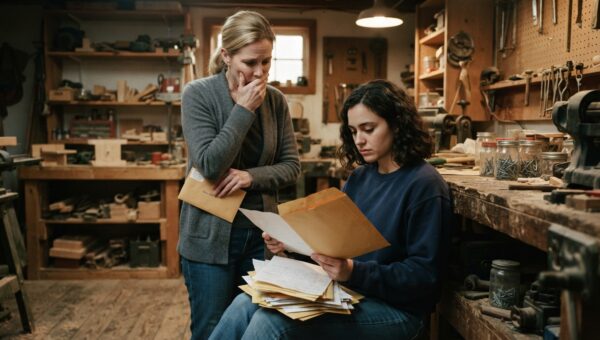
I unzipped the heavy brass zipper. It fought me the whole way, stiff with decades of dust, until it finally gave way with a long, tearing sound. Inside sat a wooden ammunition box with the latch unclipped. I lifted the lid, and the first thing I touched was a stack of letters tied together with a faded green bootlace. The top envelope was addressed to Mrs. Clara Vance in a small town outside of Youngstown, Ohio. The postmark was dated March 1968. It had never been opened. Below the letters was a handful of personal effects that made my chest tighten up. There were dog tags on a corroded chain, a leather wallet with the leather stiffened like jerky, and a pristine silver Zippo lighter with the initials T.V. scratched neatly into the metal beside an engraved date.
I picked up the Zippo. It felt heavy in my palm. I flicked the lid open with my thumb out of pure habit, though I knew there would be no fuel left in it. It made a sharp, clean snap that echoed off the cinder blocks. Underneath the Zippo was a heavy ledger book with black oilcloth covers, the kind they used to sell at the five-and-dime. I opened it to the first page, and there was my father’s handwriting, neat and blocky and unmistakable, filling lines from margin to margin. It wasn’t a diary of the war. It was an accounting. Every month, starting in November of 1974 and running all the way through last spring, there were entries with dates, amounts, and confirmation numbers. Money orders sent. Fifty dollars. Seventy-five dollars. One hundred dollars during the bad winters when the steel mills up north were laying people off by the thousands.
I turned the pages slowly, my thumb catching on the dry paper. Page after page of numbers, decades of them, tracking the address in Ohio. Clara Vance. And later, when the handwriting started getting a little shaky around the late nineties, another name below it: Margaret Vance, granddaughter. My dad worked forty-two years at the rail yard doing swing shifts, coming home smelling of creosote and cold iron, eating his dinner in near-silence while watching the front window. And every single month, before the light bills were even paid, he had been sending money to the family of the man whose name was stenciled on that canvas duffel bag.
I sat there on the basement steps for a long time, just looking down at the ledger while the furnace clicked on upstairs. It all came together in a slow, heavy wave that didn’t need any dramatic music or movie epics to make it real. My dad didn’t just survive whatever happened in the jungle back in sixty-eight. He came home with a debt he could never pay off to the man who took the hit instead of him. Thomas Vance. Private Vance. The man whose name was never mentioned at our dinner table, whose face was tucked away in a locked metal box in the dark while my father sat guarding the front door from ghosts that never stopped walking.
I took out my phone. My hands were shaking a little bit, which made typing hard. I typed the name Clara Vance and the Youngstown address into the search bar, scrolling past old census records and local newspaper archives until I found a small florist listing and a phone number for a Margaret Vance in the same county. I stared at the screen for three minutes before I finally pressed call. It rang four times before a woman’s voice answered, brisk and distracted, asking if this was about the sympathy arrangements for the spring gala.
“No,” I said, and my voice sounded rough, like I had been swallowing sand. “Is this Margaret Vance?”
“Yes, it is,” she said, her tone shifting to something more cautious. “Who is this?”
“My name is Thomas,” I told her, using my own first name for the first time that day. “My father was Arthur Vance’s old platoon mate. Well, not his mate. Arthur was my dad. But he kept your great-uncle Thomas’s duffel bag in his basement for fifty years.”
There was a long silence on the line. The kind of silence where you can hear the hum of distance over the wires, two people standing on opposite sides of a vast, unspoken gulf of time. When she spoke again, all the business-like snap was gone out of her voice. “My grandmother used to talk about a man named Arthur,” she whispered. “She said he was the only one who ever wrote after the telegram came. But then the letters stopped coming in the seventies, and she always wondered if he forgot.”
“He didn’t forget,” I said, looking down at the open ledger on my knees, at the columns of numbers stretching out across decades of steady, unglamorous labor. “He just didn’t know how to talk about it. But he kept track. Every single month, he kept track.”
“Oh,” she said softly, and I heard a sharp intake of breath. “Oh, goodness.”
We talked for twenty minutes. I told her about the Zippo lighter, about the letters, about the ledger and the way my dad used to sit with his back to the wall so he could see every angle of the room. I told her about the canvas bag and how it had been kept clean and dry in the dark, waiting for a day that took fifty years to arrive. By the time we hung up, we had agreed that I would box everything up and ship it out to Ohio by the end of the week, returning what was left of Private Thomas Vance to the bloodline that had lost him before I was even born.
I stood up from the basement steps, my knees popping in the quiet room. The metal cabinet stood wide open, its empty shelves gray and dull under the bare bulb hanging from the ceiling beam. The broken padlock sat on the concrete floor near my boot. I picked it up and dropped it into my pocket, heavy and cold against my thigh. I walked over to the workbench and picked up the polished silver Zippo, setting it down right in the center of the clean wood where my father used to spend his Saturdays sharpening mower blades and fixing old transistor radios. The house felt different now. The heavy, protective silence that had hung over every hallway since I was a kid didn’t feel like a wall anymore. It felt like an old coat left hanging by the door, heavy with rain, worn through at the elbows, but keeping out the cold until the very end.