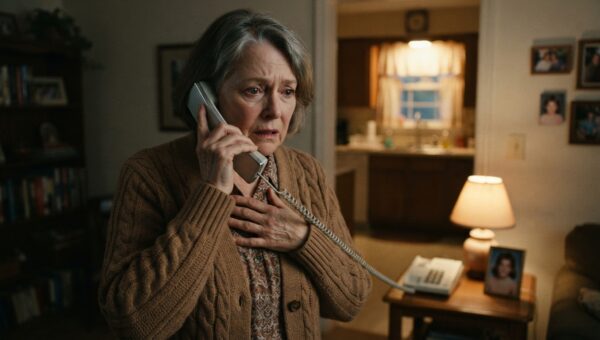
The phone on my kitchen counter started ringing at 4:12 on a Tuesday afternoon, and the tone of it had that sharp, jagged edge that always made my stomach tighten into a hard knot. I was standing by the sink rinsing a single coffee mug, the kind of quiet routine I had practiced a thousand times since the house went still.
When I picked up, I did not hear a greeting. I heard the ragged, hitching breath of my thirty-three-year-old daughter Chloe, a sound that immediately stripped away three decades of adult composure and took me right back to the worst night of my life.
Twenty years ago, Chloe was a thirteen-year-old girl with a bedroom door that stayed wide open until the exact night the world tipped sideways. We were arguing about something impossibly small, a ten o’clock weekend curfew that felt to her like a prison sentence and to me like the last fragile tether of keeping her safe in a loud, careless town. She looked right at me across the linoleum table and said something sharp, something engineered by a teenager who knew precisely where the armor was weak. And I snapped. I did not throw anything, and I did not hit her. I just let out a sound of pure, unadulterated frustration, a roar born from forty years of exhaustion.
She flinched. It lasted maybe half a second. Her small shoulders rose toward her ears, and she shrank back against the pantry door. I saw it. That half-second flinch seared itself behind my eyelids, and it has stayed right there every single day since.
I tried to fix it a hundred times after the echo of that noise died down. I held her in the hallway later that night. I said I was sorry until my throat was raw. “It’s okay, Mom,” she whispered into my shoulder, her voice small and entirely polite. But it was not okay. I knew it was not okay the very next afternoon when I walked past her room and found her white bedroom door clicked shut. For years, that door remained closed. She drifted through high school behind a silent barrier of her own making, speaking to me with courteous distance while I walked on eggshells in my own home, paying a lifetime penalty for one second of lost control.
Now, on the other end of the telephone line, adult Chloe was crying so hard she could barely string three words together. “Mom,” she choked out, her voice breaking on the syllable. “Mia pushed every button I had today. She just would not listen, and I felt it. I felt that same thing you felt. That snap right behind my ribs.” She paused, drawing in a shaky breath that rattled through the speaker. “I didn’t yell. I swear to God, Mom, I didn’t yell. But I wanted to so badly I could taste copper.”
I gripped the edge of the laminate counter until my knuckles turned white. The silence stretched between us across thirty miles of interstate and twenty years of unspoken history. My heart gave a heavy, aching thud against my ribs because I knew the exact terror she was swimming in right then. I knew what it felt like to look at the tiny human you love more than your own breath and realize how terrifyingly easy it is to become the monster you promised to outrun. “I know,” I said softly.
Chloe’s voice dropped to a ragged whisper that sounded so much like the thirteen-year-old girl behind that closed door. “How did you only do it once? How did you stop yourself after that first time, year after year, when it felt like my whole job was to tear you apart?”
I closed my eyes, letting out a long, slow breath that carried away the last remnants of my own stubborn pride. I had never told her the root of it. I had let her believe I was just naturally steady, some kind of saintly mother made of patience and brick. But listening to her sob on the kitchen floor of her own house, I knew I could not keep the ghost locked in the cellar anymore. If she was going to survive the heavy, beautiful burden of raising Mia, she needed to know that my restraint was not a gift. It was a scar.
“I didn’t do it because I was stronger than you, Chloe,” I said, my voice barely louder than the hum of the refrigerator. “I did it because of what my own mother left behind in me.”
The kitchen grew very quiet, save for the faint sound of traffic outside on Elm Street. I leaned my forehead against the cool glass of the window, letting the memory rise up through the floorboards like cold water. “You remember Grandma Clara,” I said, though Chloe barely did. “You remember her as the sweet old lady who sent cards with five-dollar bills folded inside. But you didn’t live in that house when I was twelve years old.”
I went back there, down the long, dark hallway of my childhood home where the wallpaper was peeling at the seams. My mother did not just yell; she took the air right out of the room. Every disagreement was a war of attrition, and every mistake I made felt like a personal insult to her dignity. I learned the exact pitch of her footsteps on the hardwood long before she reached my bedroom door. I learned how to make myself invisible, and I learned what a real, terrified flinch felt like before I was even old enough to ride a bicycle across town.
“The night I turned twelve,” I told Chloe, my voice trembling slightly as the old pain surfaced, “I made a promise to myself in the bathroom mirror while my mother was screaming downstairs over a broken dinner plate. I looked at my own face, and I swore to God that if I ever had a little girl of my own, I would never let her look at me the way I was looking at my reflection right then. I swore I would eat my own tongue before I let fear into my house.”
On the other end of the line, Chloe stopped crying. The silence shifted from jagged panic to something deep, hollow, and listening. “You did that?” she whispered.
“Every single day for twenty years,” I told her, my eyes stinging with hot, unbidden tears. “Whenever you talked back, whenever you slammed a drawer or pushed me to the absolute edge of my endurance, I wasn’t just parenting you. I was standing in front of that twelve-year-old girl in the mirror, keeping an oath I made when I was just a child myself. When I slipped with you at thirteen, when I let out that sound, it felt like the whole world had ended because I broke my promise. That’s why I never did it again. Not because it wasn’t hard, but because the alternative was unthinkable.”
Nobody said anything for a long moment, and honestly, that felt heavier than any words could have been. I could hear Chloe breathing softly through the phone, her mind racing as she reassembled twenty years of history through a completely different lens. The distant, cold mother who had apologized so desperately in the hallway was gone; in her place was a woman who had fought a silent, daily war just to keep her child safe from the ghosts of the past.
“You were fighting it the whole time,” Chloe finally said, her voice shaking with a profound, aching realization. “I thought you were just… perfect. I thought you didn’t feel the anger.”
“Oh, honey,” I whispered. “I felt it every single day. I just chose a different place to put it.”
“I’m coming over,” she said abruptly, before I could answer. “Don’t move. Just stay right there.”
The line clicked dead. I stood by the kitchen sink for a long time, looking out at the late afternoon sun cutting long shadows across the grass. The twenty years of heavy glass that had separated Chloe and me ever since that curfew argument did not shatter all at once; they just melted away, leaving the air clear and breathable for the first time in my life.
Forty minutes later, the front doorbell rang once, short and sharp. When I pulled the wooden door open, Chloe was standing on the porch with her car keys in one hand and little Mia clutching the hem of her jeans with the other. My daughter did not say a word. She just walked across the threshold and threw her arms around my neck so hard we both nearly stumbled against the coat rack, burying her face in my shoulder just like she used to do when she was small.
“I’m sorry,” she whispered into my ear, the old resentment finally burning off into ash. “I’m so sorry I closed the door.”
“I know, sweetheart,” I said, holding her tighter than I had in twenty years. “I know.”
Later that evening, after Mia had been tucked safely into bed down the hall, Chloe and I sat together at my kitchen table drinking lukewarm chamomile tea. The house was wrapped in a deep, comforting stillness that felt entirely different from the heavy silence of the past. As Chloe stood up to grab her jacket and head home for the night, she walked down the hallway toward the guest room where Mia had left her sweater. I watched from the kitchen doorway as Chloe paused by the open white door, her hand resting naturally on the brass knob for a second before she let go, leaving it propped wide open to let the warm light spill freely across the floorboards.