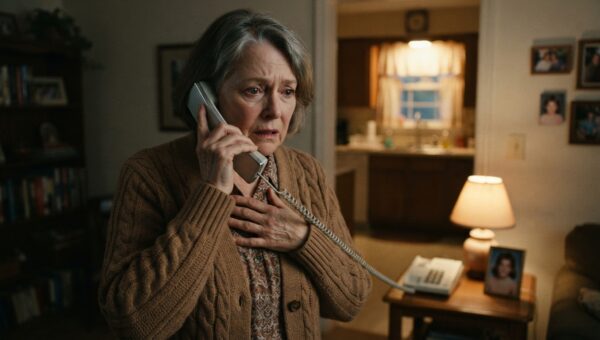
The telephone on my kitchen counter did not ring at 4:12 in the afternoon with any grand announcement, but rather with that sharp, thin jolt that always makes my stomach tighten. I picked it up before the second ring finished echoing off the tile. It was Clara, my thirty-three-year-old girl, and she wasn’t even halfway through her greeting before her voice cracked right down the middle.
“Mom,” she said, and I could hear the background squeak of her kitchen stool over the line. “Something happened today.”
My mind immediately vaulted backward across twenty years of careful, polished distance. I went straight to that Tuesday night when Clara was thirteen and we stood in the narrow hallway outside her bedroom arguing about some ridiculous curfew time. She had looked right at me with those sharp, teenage eyes and said something designed specifically to draw blood, something about how I didn’t know the first thing about her life. And I had snapped.
I didn’t use words back then. I just let out a sound. A low, ragged, wordless noise that clawed its way up from the bottom of my lungs because I was so bone-tired and terrified of losing her. Clara had flinched. It lasted maybe half a second, that little recoil of her shoulders, but it burned itself into the back of my eyelids for two decades.
“She pushed every button I have,” Clara was saying now, her voice trembling over the phone line, talking about my little six-year-old granddaughter. “And I felt it. That same thing you felt. That snap right behind my eyes.”
I stood frozen beside the coffee maker, holding the receiver so tight my knuckles turned the color of chalk.
“I didn’t yell,” Clara whispered, and I heard her take a ragged breath. “I walked out to the back porch and I just breathed until my chest stopped shaking. But I wanted to. I wanted to scream so bad I could taste it. How did you only do it once, Mom? How did you manage to hold it in all those years?”
The kitchen was quiet except for the hum of the refrigerator. For twenty years, that phone call was the bridge I had prayed for while pretending I didn’t need it. Ever since the night of the curfew argument, when I apologized immediately and held her until my arms ached, our house had possessed an invisible wall.
She had said it’s okay, Mom, but it wasn’t. The proof was right there on her bedroom hinges.
Before that argument, Clara’s door stayed propped open wide to the hallway noises, the television murmur, the smell of whatever was baking in the oven. After that night, the door clicked shut. It stayed closed through high school, through college visits, and right up until she packed her boxes for her own apartment. Even now, when I visited her house, I looked at her daughter’s open bedroom door and felt a phantom ache in my chest.
“Clara,” I said, my voice barely louder than a whisper. “I didn’t do it just because I was patient.”
“Then why?” she asked, and I could hear her wiping a tear away. “You never lost your temper again. Not once. While I was growing up, you were always just… steady.”
I looked down at the linoleum floor where the afternoon sun made a pale square near the pantry.
I had never told a living soul about the real reason. Not my sister, not my late husband, nobody. I had guarded that memory the way a miser guards a cracked coin, ashamed of where it came from, yet terrified of dropping it.
“Do you remember my mother?” I asked softly into the receiver.
“Grandma Helen?” Clara sounded confused. “A little. She passed away when I was four, right? She always smelled like peppermints and wool.”
“She smelled like peppermints when she was having a good day,” I corrected, shifting the phone to my other ear. “When she had a bad day, she smelled like vinegar and burnt toast, and the whole house went dead silent. You learned to walk on the balls of your feet before you could even tie your shoes. You watched her hands. If her knuckles turned white while she was holding a wooden spoon, you knew the sound was coming.”
The line was dead quiet for a long moment. Clara didn’t interrupt. She just breathed on the other end, listening to the shift in my tone.
“I learned how to flinch before I was five years old, Clara,” I said, and the words felt heavy, dragging up through the dirt of years I had tried to pave over. “I knew the exact pitch of my mother’s breath right before she lost her temper. I knew how to make myself small behind the living room armchair so I wouldn’t cast a shadow.”
I closed my eyes, and suddenly I wasn’t in my clean kitchen anymore. I was twelve years old again, standing in the cramped, damp-smelling bathroom of our old house on Maple Street. My mother had screamed at me that morning over a spilled glass of orange juice, a scream that made the water in the porcelain sink ripple, and I had locked myself in the bathroom to hide.
“When I was twelve,” I told my daughter, my voice cracking slightly, “I stood in front of that cracked bathroom mirror with my face all blotchy and red from crying. I looked at myself in the glass, and I made a promise. I swore to God and to that little girl in the mirror that if I ever had a child of my own, I would never, ever let them look at me with that cowering, sick kind of fear.”
“Mom,” Clara breathed.
“So when I yelled at you that night when you were thirteen,” I said, and the tears finally broke over my lower lashes, “it wasn’t just a bad moment. It felt like the whole world was ending. Because the moment I saw you flinch, I realized I had sounded exactly like my own mother. I had brought her ghost right into our hallway. That’s why I only did it once. Because every single day after that night, I was fighting a war against my own blood to make sure I never scared you like that again.”
The silence on the line stretched out, but it wasn’t the cold silence of the closed bedroom door anymore. It was thick and heavy with something else. I heard Clara take a shaky, ragged breath, and then she let out a small, wet laugh.
“You never told me,” she whispered. “All these years, I thought you were just… born good at this.”
“Lord, no,” I said, wiping my cheek with the back of my hand. “I just knew what the alternative looked like. And I couldn’t bear the thought of you growing up walking on tiptoes in your own home.”
“I closed my door,” Clara said suddenly, her voice dropping to a low, painful register. “After that night when I was thirteen. I kept it shut for years because I was mad, I guess. But mostly because I was scared if I opened it too wide, you’d see how angry I still was.”
“I know, honey,” I said. “I saw that door every single day.”
“Well,” she said, and I heard the chair scrape against the floor as she stood up. “My door is open right now. The kids are at preschool for another hour. If I get in the car right now, do you still have that raspberry pie in the fridge?”
I looked across the kitchen toward the hallway where the afternoon light was cutting clean across the hardwood floor.
“I’ve kept a slice right in the back,” I told her, my voice steadying at last. “You just drive safe, and take your time getting here.”