A dry sandwich smell stayed in the pages of that old library book, and forty-three years is a long time for a smell to keep its secret.
Back when I was twenty-nine, life in our house was measured in grocery coupons and bruised fruit. My husband worked the second shift at the mill, and I spent my days stretching eighteen dollars of flour and meat until it cried for mercy.
We had our daughter Maya in school then, her hair braided tight every morning so she would look neat among the other children whose mothers didn’t have grease under their fingernails.
I didn’t set out to be anybody’s savior. I just noticed the boy who sat behind Maya in the third row. His name was Julian Vance. He had hair that always looked like he combed it with a wet towel and a grey sweater with elbows gone thin enough to show the lining. Every single day at the noon bell, while the other kids ripped into foil-wrapped ham biscuits and shiny red apples, Julian would stare straight ahead at the blackboard with his hands flat on his empty desk. He didn’t read. He didn’t talk. He just sat there waiting for the clock to move.
The first time I saw it happen, I dropped three extra dimes onto the deli counter and bought a second loaf of white bread and a block of sharp cheddar.
That evening, standing at our small formica kitchen table with the radio playing low, I cut two sandwiches instead of one. I wrapped his in waxed paper just like Maya’s, though I made sure the crusts were trimmed off because he looked like a boy who wouldn’t like hard edges.
The next morning, I dropped both bags into Maya’s blue canvas satchel and told her to hand one to Julian when the teacher wasn’t looking.
“Tell him I made too much,” I said.
Maya didn’t ask questions. She was a good girl, quiet and observant like her father. She just took the bag and did as she was told. When she came home that afternoon, I asked her how it went.
“He ate it,” she said simply. “He ate it real fast.”
That routine lasted six months. Eighteen dollars a week out of a budget that didn’t have eighteen cents to spare.
I had to cut back on our Sunday roast, and I walked to the market instead of taking the bus, but I couldn’t stop the extra sandwiches once I started. Julian never looked at me when I walked Maya to the classroom door, and he never sent a thank-you note back. But every day the waxed-paper wrapper came home empty inside Maya’s bag, folded neatly into a little square.
Then came the afternoon in late November when the wind was rattling the windowpanes like dry bones. Julian stayed behind after the final bell while the other children scrambled for their coats. He walked up to my desk, I was helping the teacher staple spelling worksheets, and held out a battered, cloth-bound copy of *The Wind in the Willows*.
The spine was taped together with yellowed masking tape, and the corners were chewed down to the grey board.
“Please keep it safe,” he said. His voice was higher than I remembered, thin like wire.
Before I could ask him what he meant, he turned around and walked out of the classroom. His family vanished three days later. Their small rental house on Elm Street was empty by Monday morning, the curtains pulled down and a cardboard box left sitting on the porch in the rain. Nobody knew where they went, and in those days, people didn’t go asking after folks who couldn’t pay their water bill. The book stayed in my cedar chest under my winter sweaters, a strange little anchor from a boy who had no weight to spare.
Forty-three years went by. My husband passed away in the winter of ninety-eight, Maya grew up and moved down to Charleston with three kids of her own, and my hair turned the color of wood ash. I spent my Tuesdays volunteering at the old St. Jude church office down on Main Street, answering the phone and filing parish records for Father Thomas.
Last Tuesday started like any other, with a cup of instant coffee that tasted like burnt tin and a stack of parish envelopes to sort. Then the mail carrier dropped a heavy, brown-paper parcel onto my desk.
The return address was stamped from the municipal public library downtown.
I didn’t think much of it until I cut the twine with my desk scissors and pulled the book out. The smell hit me before I even saw the cover. It was that peculiar, dry scent of old rye bread and yellowed newsprint that had been tucked away in a dark place for decades. I opened the front cover. There, written in my own clumsy, twenty-nine-year-old handwriting in blue ink, was my name: *Mrs. Alvarez*.
Tucked into the binding was a crisp, new five-dollar bill and a folded sheet of lined notebook paper.
My hands started to shake, and I had to sit down hard in my squeaky metal chair because my knees felt suddenly hollow. I unfolded the note. The handwriting was neat, large, and steady, belonging to a man who had spent a long time working among books.
“Mrs. Alvarez,” the letter began. “You saved me when my father walked out and our power was shut off for three months. We had nothing to eat, and I was going to run away to the freight yards because I couldn’t stand watching my mother cry over empty cupboards anymore. Those six months of sandwiches were the only reason I stayed. I’m the head librarian down at the county branch now. It took me twelve years of looking through old district rolls to find where you ended up. Please accept this small repayment for the bread, and the book back where it belongs.”
I sat there in the quiet church office for a long time, listening to the grandfather clock ticking against the back wall. My coffee went cold on the desk, a little skin forming over the top of it.
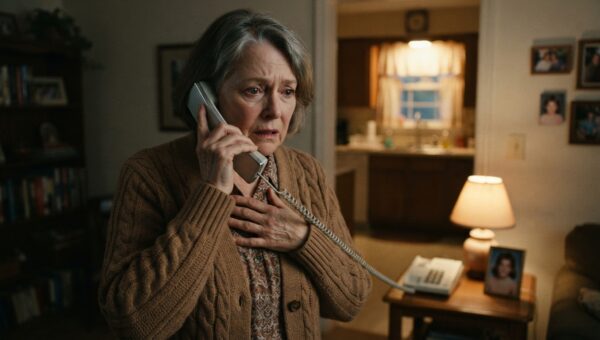
The phone on the wall started ringing, a sharp, metallic sound that made me jump, but I didn’t answer it right away. I just sat there looking at that five-dollar bill and the battered green cover of the book.
Thirty minutes later, I picked up the receiver and dialed the number printed at the bottom of the letterhead.
A man answered on the second ring, his voice low and cautious. “County library. This is Julian.”
I didn’t say anything for a second, and honestly that felt heavier than any words I could find. My throat felt tight, like I’d swallowed a mouthful of dust.
“Julian,” I finally said, and my voice sounded old and cracked in my own ears. “It’s Elena Alvarez.”
There was a sharp intake of breath on the other end of the line, then absolute silence. You could hear the faint hum of fluorescent lights through the wire, and then a low, ragged sound like a man letting go of something he’d been holding in his chest for forty-three years.
“Mrs. Alvarez,” he whispered. “You kept my book.”
“Of course I kept it,” I told him, and my eyes finally let go of the tears I’d been holding back since I opened the package. “You told me to keep it safe.”
We didn’t talk long on that call, just enough to set an afternoon. He asked if he could come by the church office after closing, and I told him the side door would be unlocked.
When he walked in at four o’clock, I wouldn’t have known him on the street. He was tall now, with silver hair brushed back from his forehead and deep lines around his eyes that looked like they came from reading late into the night. But when he stopped just inside the doorway and looked down at my desk, I saw the boy from the third row staring out from behind those silver spectacles.
He didn’t bring flowers or make a speech. He just walked across the linoleum, pulled out the metal folding chair opposite my desk, and sat down with his hands flat on the wood, exactly the way he used to sit at school.
“I brought the rest of it,” he said softly, sliding a small white envelope across the papers.
“Put that away, Julian,” I told him, sliding the five-dollar bill back across the desk toward his fingers. “The debt was settled the day you left that book in my classroom.”
He looked down at the money, then up at me, and his mouth gave a small, crooked twitch that looked almost like a smile. We sat there together in the quiet church office as the afternoon sun slanted through the stained-glass windows, turning the dust motes into tiny flecks of gold.
I didn’t take his money, but I kept the five-dollar bill where it landed, right beside the battered old copy of *The Wind in the Willows* that now sits on my bedside table, waiting for the dark to come down.