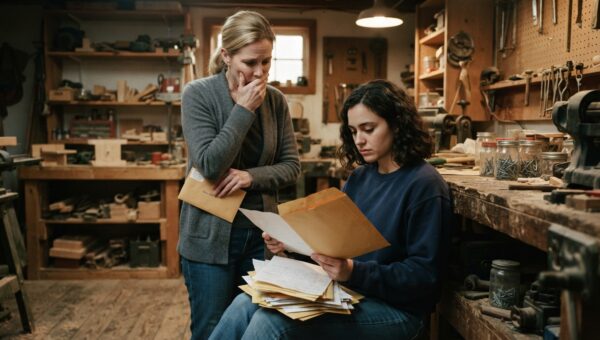
The heavy metal ammo box sat on my workbench under the single yellow glare of the overhead lamp, smelling faintly of gun oil and forty years of dust. I stood there in the quiet of my garage, staring down at the banded stacks of twenties and fifties packed tight against weathered notebooks. Outside, the wind rattled the metal siding of the machine shed.
I didn’t know it yet, but that box was about to turn my whole idea of Arthur Vance completely upside down.
It all started on a Tuesday morning out past the county line where the blacktop gave way to gravel and washboard ruts. I went to a farm equipment auction this past fall out in the county, they were selling off a whole operation after the old farmer died and the kids didn’t want it. I needed a hauler for the acreage, and I came home with his grain truck, an old flatbed with a wood-sided box, for a song. The auctioneer’s helper, hooking it to give it a jump, jerked his thumb back at it and said, “Old man farmed alone out here forty years, trusted the bank about as far as he could throw it. Boys say he never spent a dime he didn’t have to.”
I drove it home, listening to the loose valves clatter against the rusted firewall and the gearshift rattling in the floorboard.
The truck smelled like old grease, stale tobacco, and forty years of sweat soaked into the horsehair stuffing of the bench seat. When I got it back to my barn, I climbed inside with a stiff wire brush and a roll of shop towels to clear out decades of accumulated trash. There were old feed sacks, rusted fence pliers, and a thermos that had gone furry inside.
Then I reached behind the bench seat for the trash back there, and my hand hit a metal ammo box, wedged down in the springs where you’d never see it unless you pulled the whole seat frame out. I pulled it up onto the seat beside me, and it was heavy, too heavy for old bolts or spare spark plugs. I worked the lid up right there in the cab, and the second I saw what that old man had been hauling around all years, every muscle in me locked up tight.
I carried the box into the house that evening and set it on the wood table. The kids had cleared out the main farmhouse in three days, hauling everything of perceived value to the county auction barn while leaving behind the junk they couldn’t be bothered to sort. Arthur Vance had lived alone since his wife passed back in the nineties, and his sons lived down in Columbus now, running a real estate firm and grumbling about inheritance taxes. They figured their old man was just a stubborn hermit who hoarded pennies in coffee cans.
I popped the two metal latches on the ammo box. Inside wasn’t copper wire or old spark plugs. There were neat bundles of currency wrapped in strips of brown butcher paper, each labeled with a date and a name in precise, iron-gall ink. Beside the cash sat three thick ledger books with black buckram covers, the edges worn down to the grey board from years of sliding in and out of a truck door.
I flipped open the top ledger. The pages were filled with columns of figures, land descriptions, and names of people I knew were long gone or struggling to keep their farms afloat. There were entries from the farm crisis years in the eighties, when half the county lost their land to the federal land bank and local lenders. I saw names like Miller, Gable, and Henderson scrawled in Arthur’s sharp, unforgiving handwriting alongside amounts that added up to tens of thousands of dollars.
The next morning, I drove down to the county courthouse to look up plat maps and property records. The courthouse basement smelled of damp lime and old paper, just like it had when my grandfather took me down there to check the boundaries on our north pasture. I spent three hours cross-referencing Arthur’s ledgers with the historical deed books, tracing the legal descriptions of land parcels that had changed hands during the dark days of nineteen eighty-four.
The clerk, a woman named Sharon whose family had run the hardware store for generations, looked over my shoulder when I laid out my notes. She pointed a fingernail at a parcel marked in Arthur’s book as the old Henderson eighty. “Arthur bought that note from the Federal Land Bank in eighty-six,” Sharon said, her voice dropping to a low, flat register. “Everybody thought the bank foreclosed and the Hendersons lost it to some outfit out of Chicago. Old Arthur just kept his mouth shut and let people think he was a cold-hearted miser who bought up distressed acreage.”
I stared at the page. “The Hendersons stayed on the place though,” I said.
“They rented it,” Sharon replied, shaking her head. “Or so they thought. Jim Henderson told me once Arthur only charged them enough to cover the county taxes, and even then, Arthur would lose the receipts in his shirt pocket and forget to collect for two years at a time.”
I drove out to the Henderson place that afternoon, the gravel spitting up against the floorboards of my truck. The farmhouse was painted white once, but the salt air and hard winters had peeled most of it away from the cedar siding. An old man with a oxygen cannula resting under his nose was sitting on the porch, rocking slowly in a cane-bottom chair that creaked in time with the wind. It was Roy Henderson, now well into his eighties, though I remembered him from town when I was just a kid.
He watched me pull up in Arthur’s old flatbed, his eyes narrowing against the bright autumn glare. I cut the engine and the old Ford let out one long, shuddering sigh before the radiator started to ping. I climbed down, carrying a manila folder tucked under my arm, and walked up the gravel path.
Roy didn’t stand up, but his hand tightened on the arm of the rocker. “That’s Arthur’s truck,” he said, before I even reached the bottom step. “Boys sold it off, did they?”
“They did,” I said, stopping at the foot of the steps. “I bought it at the auction last week.”
Roy nodded slowly, looking past me toward the hood of the flatbed. “Good truck. Took forty years of beatings and never missed a stroke. Arthur kept her running with bailing wire and prayer.”
I pulled the original deed and the corresponding ledger page from the folder and held them out toward him. “I found an ammo box behind the seat, Roy. There’s a note in here from nineteen eighty-eight with your dad’s signature on it, and the deed to this eighty acres marked paid in full.”
Roy didn’t reach for the paper right away. He stared at the blue ink on the page, his chest rising and falling beneath his plaid flannel shirt in a heavy, measured rhythm. The wind rustled the dry cornstalks in the field across the road, making a dry, rattling sound that filled the silence between us.
“My daddy thought he lost this farm,” Roy whispered, his voice cracking slightly on the edges. “He went into town to see the banker, Mr. Sterling, and came back out to the truck and didn’t say a word for three days. Just sat at the kitchen table staring at the wall. Arthur came by that Saturday with a load of seed corn and told my daddy the debt was handled.”
“You want the deed, Roy?” I asked. “It’s yours. It’s been yours for thirty years.”
Roy looked up at me then, his eyes bright with a sudden, sharp wetness that he blinked away fast. “Daddy tried to pay him back every harvest,” Roy said, his voice dropping to a ragged murmur. “Arthur wouldn’t take a nickel of interest. Just told my daddy to put the money into the soil and keep the kids in shoes. Said banks were like crows, they only showed up when something was dying.”
I spent the next two weeks tracking down the other families listed in Arthur’s ledgers. There were seven parcels in all, scattered across the township, ranging from small forty-acre woodlots to full homesteads where families were still working the dirt. I drove Arthur’s flatbed to every single one of them, the loose valves rattling like tin cans behind the grille, carrying those old waterproof packets of deeds and promissory notes wrapped in butcher paper.
Some of the families had long since moved away, their children scattered to cities down south or out west, but the older folks still remembered Arthur Vance. They remembered him as the silent, unsmiling man who drove his old truck down the back roads at dawn, never stopping to chat at the diner, never joining the Grange, never asking for anything from anybody. Not once did anyone in the county realize he was running his own private mutual aid bank out of the cab of a forty-year-old Ford, holding forty-odd properties in trust so the local kids wouldn’t have to pack up and leave the valley.
When I finally finished returning the last of the deeds to the Gable family down by the river, the ammo box on my workbench was nearly empty, save for a single remaining ledger page that Arthur had tacked to the inside lid with four small upholstery tacks. It wasn’t a land title or a promissory note. It was just a handwritten list of names and dates, headed with a short sentence in that familiar, spidery ink: “A man’s dirt is his own, long as he knows how to keep it.”
Arthur’s sons never called about the truck, and they certainly never asked about what might have been left behind in the grease and the dust. They got what they wanted, a clean break and a check from the auctioneer that cleared the estate account before the first frost of November set into the stubble.
The old flatbed still sits out by my machine shed now, ready for hauling feed or moving fence posts whenever the ground dries out enough to work. I haven’t painted over the faded blue fenders or fixed the dent in the passenger door where Arthur must backed into a cedar post back during the Reagan administration. It runs rough in the mornings, spitting a little black smoke until the oil warms up and settles into the block, but it always starts.
Yesterday morning, the sun broke through the heavy grey fog hanging over the bottomland, turning the frosted stubble in the north forty the color of old brass. I walked out past the tractor shed and rested my hand on the weathered wooden side of the truck bed, feeling the grain of the oak planks under my palm. The cab is completely empty now, swept clean of every last grease rag and empty oil can, except for one thing. Back in my workshop, pinned securely to the wall right above the workbench where I first popped the latches on that heavy metal box, sits a single, small ledger page framed in plain pine, reminding me of what a quiet man can carry when nobody else is willing to bear the weight.