I got almost everything wrong about my place in that house right up until the Tuesday afternoon I watched a silver travel taxi idle in our gravel driveway.
My father, Arthur, was hauling two matching leather suitcases out of the trunk while my mother, Helen, fussed with the strap of her canvas carry-on. My sister, Maya, stood on the bottom step scrolling through her phone, her sunglasses pushed up into her highlighted hair like a crown she never took off.
They had spent fourteen days in Rome and the Amalfi Coast, eating gelato by the Mediterranean and sending us group chat photos that felt like postcards from a planet I wasn’t allowed to visit.
They had told me right at this kitchen table two months before that money was just too tight this year.
“We’d love to take you both, Clara, you know that,” Arthur had said, cutting into a pork chop while Helen nodded sympathetically across the laminate surface. “But the exchange rate right now is brutal, and Maya really needs this trip for her portfolio. You understand. You’ve always been the sensible one. You can hold down the fort, keep an eye on the mail, and take care of the yard.”
So I stayed behind in my cramped back room with its narrow twin bed and water-stained ceiling tile, while my sister flew over the Atlantic.
They expected me to be standing by the front door when they got back, ready to haul their heavy bags upstairs, listen to endless stories about ancient ruins, and heat up leftovers from a grocery cart I had paid for out of my own pocket.
They expected the house to smell like the lemon furniture polish I bought every month and the fresh coffee they liked to wake up to.
Instead, the front door swung open with a dry, hollow echo that sounded nothing like a welcome home.
Arthur dropped his heavy leather suitcase right on the entryway rug, the brass zipper clinking against the tile. He frowned, his forehead wrinkling deep as he peered down the dark hallway toward the kitchen.
“Clara?” he called out, his voice sharp with the immediate annoyance of a man whose comfort had been delayed by ten seconds. “Are you deaf? Come take these bags.”
Nobody answered. The only sound was the low hum of the refrigerator, except even that sounded wrong. It wasn’t the steady, familiar vibration I had listened to for four years. It was different.
Helen kicked off her walking shoes, her face already tightening into that pinched, disappointed look she reserved for when I didn’t iron her linen blouses quite crisp enough. “Honestly.
You’d think she could at least leave the porch light on after two weeks. Arthur, go check the back. Did she leave the sprinkler running again?”
Arthur muttered something under his breath and heavy-footed it down the hall toward the kitchen. I wasn’t there to see his face when he rounded the corner, but I can picture it clear as day because of what happened next.
The silence didn’t feel like a normal empty house silence. It felt like a vacuum.
Three weeks earlier, sitting right at that same kitchen table while they finalized their flight itineraries, I had stopped crying. For years, I had absorbed every subtle slight, every casual remark about how Maya had the artistic soul while I had the steady paycheck, every assumption that my room, my time, and my bank account belonged to the family collective while Maya’s earnings were her own. I had paid for the living room sectional because the old one smelled like dog.
I had replaced the washing machine when the drum cracked. I had bought the upright pantry freezer and kept it stocked with organic cuts of meat because Arthur insisted on high cholesterol meals that cost twice the price of normal groceries.
I was twenty-eight years old, working fifty hours a week as a senior accounts coordinator for a regional timber distributor, and living like a teenage dependent who owed rent in chores.
“We can only afford one daughter on vacation,” Arthur had repeated that night, as if saying it twice made it an act of financial god rather than a deliberate choice.
So I made a choice of my own.
I didn’t yell. I didn’t pack a single suitcase that night. I simply opened my laptop at 11:45 PM and transferred the retainer to a local moving and storage company with five-star reviews on the county Facebook exchange.
The first week of their vacation, while the rest of the neighborhood assumed I was working my normal shifts, my apartment lease was signed, sealed, and paid for with a cashier’s check drawn from a separate bank account I had opened six months prior.
By the middle of their second week in Italy, while Maya was posting selfies in front of the Colosseum, three burly men named Travis and Leo were carrying my life out of that beige-painted house on Maple Street.
They took the queen mattress I bought when my back started aching from the old twin. They unbolted the stainless steel microwave from the counter. They rolled up the braided wool rug in the hallway. They unhooked the smart television from the living room wall because my name was printed right there on the Best Buy store pickup confirmation slip tucked into my cedar keepsake box.
Every single item that made that house feel like a home rather than a flophouse had a paper trail leading straight back to my earnings.
When Arthur reached the kitchen that Tuesday afternoon, he didn’t find a pot of coffee waiting. He found bare laminate counters, an unplugged toaster slot, and a pantry that looked like a bomb shelter after a famine. The expensive upright freezer was gone, replaced by an empty square of linoleum where dust bunnies had gathered in the corners.
He roared my name down the hallway, the sound bouncing off the bare drywall.
“Helen! Get in here right now! What in God’s name happened to the house?”
I wasn’t there to watch them panic, but I didn’t need to be. I was sitting at a small, sturdy wooden table in my own sunlit apartment three miles away, watching a single stray wasp crawl across the windowsill while I stirred sugar into a steaming mug of peppermint tea. The table was mine. The apartment was mine. The quiet was absolute.
Back on Maple Street, the panic was hitting in rolling waves.
Helen hurried down the hall, her sensible travel heels clicking frantically against the hardwood. “What are you talking about, Arthur? Stop shouting.”
“Look at the kitchen!” Arthur yelled, pointing a thick finger at the empty corner where the pantry freezer used to hum. “The freezer is gone! The microwave is gone! Where is the damn television?”
Helen stopped dead in the doorway, her hands flying up to cover her mouth. She didn’t look at the kitchen first. Her eyes traveled up the short flight of stairs toward the back bedroom.
She hurried past him, her footsteps fast and light, and pushed my bedroom door wide open.
There was no bed frame. There was no dresser. There was no desk where I used to log into my company portal every morning at 7:55 AM. The room was nothing four white walls and a stained subfloor where the cheap beige carpet had been pulled up by the movers because I had paid for that carpet installment too, back when Arthur claimed he was between plumbing jobs.
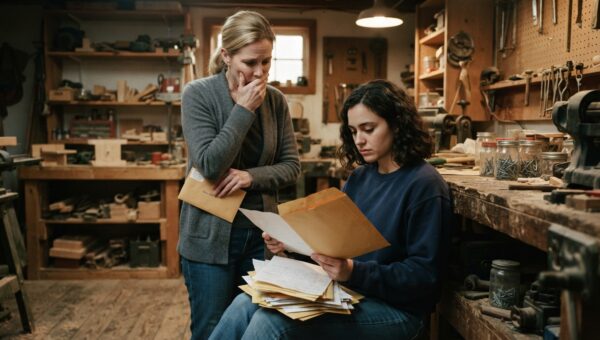
Right in the exact center of the bare floor, resting on a folded square of blue painter’s tape, sat a neat stack of papers.
Arthur followed her into the room, breathing hard through his nose like an overheated bull. He bent down, scooped up the papers, and flipped through them with trembling fingers.
They weren’t notes. They weren’t an explanation or an apology.
They were receipts.
Store receipts, warranty cards, credit card statements, and signed delivery slips dating back four years. Every single one of them bore my name at the top. The purchase price of the sectional sofa, circled in red ink. The receipt for the washing machine, complete with the serial number and the delivery address. Even the receipt for the heavy-duty pots and pans hanging on the kitchen rack.
On top of the pile was a single sheet of lined notebook paper with one sentence written in my normal, block-letter handwriting:
“The daughter they had always treated like a backup plan had finally learned how to leave.”
Arthur didn’t say anything for a long minute. The silence in that empty room felt heavier than any shout.
“She took the router,” Helen whispered, her voice cracking as she stared at the empty wall plug where the high-speed internet box used to sit blinking green lights. “Arthur, the Wi-Fi is gone. How am I supposed to check my email?”
“Forget the damn internet!” Arthur yelled, his face turning that dark, mottled red that usually meant he was about to throw a heavy object. “Look at this! She stripped the place! She took the living room lamps! She took the spare mattress out of the guest room!”
“Because I bought them,” I said out loud to my empty apartment, answering him across the three miles of county asphalt as if he were standing right in my doorway.
The phone on my kitchen counter started buzzing at 6:15 PM.
I let it ring three times. The screen lit up with Arthur’s caller ID, the bold letters flashing against the dark glass like an old warning light I had finally learned to ignore.
On the fourth ring, I picked it up, pressed my thumb against the speaker icon, and held it a few inches away from my ear without saying a word.
“Clara Marie!” Arthur’s voice boomed through the tiny speaker, sharp and ragged with fury. “What the hell do you think you’re playing at? We walk through the front door after fourteen hours of travel and our house has been ransacked! Where is the refrigerator food? Where is the sofa?”
“I moved,” I said. My voice didn’t shake. It sounded astonishingly normal, like I was telling a coworker about a spreadsheet revision.
“You moved?” he sputtered, a high-pitched incredulous laugh escaping his throat. “You didn’t move! You stole half our belongings while we were out of the country! You have twenty-four hours to get a truck back here and put every single one of those things back where they belong, or so help me God I am calling the sheriff and having you arrested for grand larceny.”
I took a slow sip of my tea. The ceramic mug felt warm and solid against my palms.
“Call him,” I said quietly. “Tell the sheriff you want to report stolen property. Tell him you want to inspect the receipts I left on the bedroom floor. Tell him whose name is printed at the bottom of every single invoice for every appliance, piece of furniture, and floor covering in that house.”
A heavy silence dropped over the line. I could hear Arthur breathing on the other end, his chest heaving as his brain tried to bridge the gap between his entitlement and the cold, hard paper trail I had left behind.
“You’re our daughter,” Helen piped up in the background, her voice small and desperate, coming in through the speakerphone function Arthur must have fumbled to turn on. “How could you do this to us? After everything we’ve done for you? After we let you live under our roof rent-free all these years?”
That was the word that finally broke whatever thin thread of patience I had left. Rent-free.
“I paid for the roof, Mother,” I said, and for the first time, my voice dropped into that low, flat register that terrified my managers at work. “I paid for the roof shingles when the hail storm hit two years ago. I paid for the water heater when it blew out in January. I paid for your groceries while Maya was spending her timber trust fund on Italian leather boots. You didn’t give me a home. You gave me a bill collector’s desk with a twin bed attached.”
“You get back here right now and fix this,” Arthur snarled, reverting to the only tool he had left: volume and intimidation. “You hear me? You come back here and make dinner, and you figure out how to get our living room back together before dark, or you are dead to this family. You will never set foot in this house again.”
“Consider it done,” I said.
“What?”
“I won’t set foot in that house again,” I said clearly. “Enjoy your vacation souvenirs, Arthur. Tell Maya I said hello.”
I pressed the red end-call button before either of them could draw another breath.
The screen went dark. The apartment was quiet except for the faint sound of traffic down on the boulevard and the steady tick of the wall clock above the sink.
I walked over to the kitchen window and looked out at the parking lot below. A stray cat was picking its way across the gravel near a green metal dumpster, moving with a quick, careful grace.
My phone buzzed one more time, a text message from Maya, no doubt demanding to know why there was no milk in the fridge and her bedroom smelled like fresh paint instead of lavender. I didn’t open it. I simply slid the phone face-down across the wooden tabletop, right beside my steaming mug of tea.
The house on Maple Street was cold, dark, and entirely theirs.
For the first time in twenty-eight years, I didn’t care.