The smell of old paper and damp concrete always stays in the back of your throat when you spend a whole Saturday clearing out a dead man’s rooms. My brother Wayne had been gone three weeks by the time I finally got the keys from his landlord, a man named Henderson who just wanted the place empty by the first so he could slap a coat of white paint on the baseboards and rent it out again.
Me and Wayne barely spoke the last five years he was alive. Never really knew why. We were tight coming up, hunted together every deer season down by the creek, split a booth at the Cracker Barrel every Sunday after church until the grease started bothering his stomach. Then somewhere along the way he just backed off. Quit calling. Made excuses at Thanksgiving about working late at the lumber yard. I figured I had done something to tick him off, but he never gave me the satisfaction of an argument. He just faded out like an old photograph left too long in a West Texas window.
He was fifty-two when his heart gave out while he was sitting alone watching some old western on his small TV. No wife, no kids, so it fell on me to pack up whatever he left behind. Took me six hours, and it about broke me how little there was to show for fifty-two years of living.
His whole life fit right there in the bed of my F-150 with room to spare for a couple of plastic milk crates. A worn-out green armchair with the stuffing coming out of the armrest. A small table he built himself out of pine scraps. His old VFW cap hanging from a brass hook by the back door, missing the little bronze pin he used to wear on the brim. And a kitchen drawer full of unpaid medical bills from the county clinic, which told me plenty right there about how things had been going since he stopped answering my calls.
I kept looking for something else, some sign that he had friends or a routine I didn’t know about, but the apartment was as bare as a winter cornfield. Then I opened the bedroom closet. Way back in the corner, half-hidden behind an old wool overcoat that still smelled faintly of cedar and stale Lucky Strikes, sat a heavy metal filing cabinet with a bright red padlock clamped through the handles.
Everything else in that place had been sitting out in the open, unlocked and unguarded. That cabinet was the only thing in the whole three rooms that had a lock on it.
I stood there for a minute in the dim light of that closet, looking down at the red steel. Part of me didn’t want to know. When a man locks things away from his own blood, usually it is because he is hiding something messy, some debt or some bad blood you cannot fix even after he is gone. But Henderson was breathing down my neck about the keys, and I knew I couldn’t just haul a locked cabinet to the dump without knowing what was rattling around inside. So I walked out to the truck, dug around under the grease-stained rags in my tool box, and brought back the heavy-duty bolt cutters.
The handles felt cold in my palms. I squeezed until the jaws bit into the shackle, and with a sharp, echoing snap that made the empty walls ring, the lock gave way.
I lifted the metal lid. Stood there a good while just looking at the neat stacks inside, and then I sat right down on the hardwood floor because my knees suddenly felt like they were made of water.
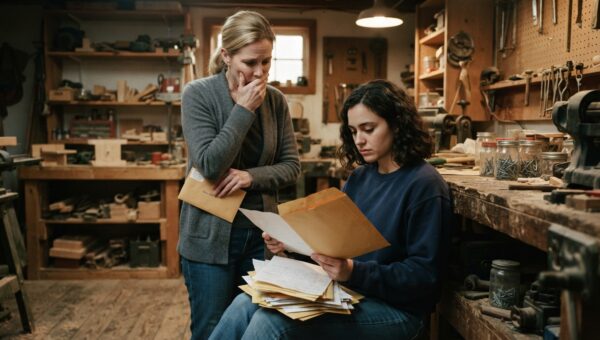
There wasn’t any money in there. No hidden stash of cash or dark secrets I had spent five years imagining. Just a series of thick manila folders, labeled in Wayne’s careful, block-letter handwriting, and a yellow legal pad with dates going back to the exact month he stopped returning my Sunday afternoon calls.
I pulled the top folder out. Inside were hospital summaries and lab reports from the regional medical center down in Tulsa. The dates started about five years ago, right around the time he stopped showing up for Thanksgiving. The diagnosis was written out in clean medical terms that didn’t sound real at first until you read the numbers at the bottom of the page. Chronic kidney failure starting to pull down his heart, combined with a lung condition that made every breath look like he was climbing a hill. The treatment plans were long, and the cost estimates were printed out in black and white on sheets of yellow paper with hospital letterhead. I turned a page and saw numbers that made my breath catch. Thousands upon thousands of dollars for procedures, pills, and specialists.
Wayne had always been proud as an old stump. He was the kind of man who would rather walk ten miles on a twisted ankle than let someone offer him a ride, let alone a handout. I sat there on the floor with the papers in my lap, feeling the blood pound in my ears as the timeline finally clicked together in my head like a dropped transmission.
“You stupid bastard,” I whispered to the empty room, and my voice sounded thin and cracked against the plaster walls.
I reached deeper into the cabinet and pulled out the yellow legal pad. Every page was filled with columns of numbers. He had been tracking every cent he spent, down to a nickel for a postage stamp, trying to figure out how to keep his head above water without asking for help. But right beside the columns of debt were small, neat clippings from the local newspaper. Little square articles about my oldest girl graduating from high school with honors. A mention of the time my youngest son won a ribbon at the county fair for his woodworking project. A tiny blurb about me getting promoted to shift foreman down at the plant. He had been cutting them out for five years. He had been watching every single milestone from a distance, keeping score of our lives while his own world was shrinking down to the size of a rented room in Sapulpa.
The last thing in the bottom of the cabinet was a thick manila envelope tied around with a piece of faded twine. My name was written across the front in pencil, the letters a little shaky compared to the neat block printing on the folders.
I untied the twine, my fingers clumsy and stiff. Inside were five letters, one for each year he kept me at arm’s length. I pulled out the first one, dated November of that first year, right after the diagnosis came down.
Dear Tom, it started out.
I’m writing this because I can’t bring myself to say it over the phone or across a plate of biscuits at the Cracker Barrel. The doctor gave me the news today. It’s not good, and it’s going to cost more than either of us ever made in a lifetime at the yard. I know you too well, Tom. If you knew what was happening to me, you’d sell your truck. You’d remortgage that house you worked so hard to build for Sarah and the kids. You’d spend every dime you had trying to fix something that can’t be fixed, just because we share blood. I can’t let you do that. You’ve got a family coming up behind you, and I’m already a finished book. Best thing I can do for you is make you mad enough to stay away. Don’t come looking. Keep living your life. I’ll be fine on my own.
I sat there in the settling dust of that empty apartment, holding that piece of lined notebook paper while the afternoon sun crawled across the floorboards and hit my boots. I read through the second letter, and the third, and the fourth. Each one told the same story of a stubborn man trying to carry a crushing load all by himself so he wouldn’t crush the people he loved on his way down. In the last letter, written just a few months before his heart finally stopped, he talked about seeing my truck parked outside the hardware store in town.
Saw you go in there Tuesday, he wrote. Looked like you put on a little weight around the middle, same as me. You looked good, though. You looked happy. That’s all I need to know.
I didn’t cry right away. For a long time, I just sat there holding the letters against my chest, feeling the terrible weight of what he had done for me. He had chosen loneliness. He had chosen five years of cold apartments, unpaid bills, and silent Sundays, all so I wouldn’t have to worry about him or empty my own savings account trying to pay for doctors who couldn’t save him anyway. He took all the pain of dying and kept it locked behind a red padlock in a closet, just to leave me alone.
By the time I carried the metal cabinet out to the truck, the sun was dropping behind the telephone poles and turning the Oklahoma sky the color of a bruised plum. I loaded the heavy steel box into the bed right behind the wheel wells, wedging it tight so it wouldn’t slide around on the way home.
Then I walked around to the driver’s side, opened the door, and saw the old VFW cap sitting right there on the rubber floor mat where I had tossed it earlier. I picked it up, dusted off a little drywall grit from the brim, and set it carefully on the passenger seat next to me.
I turned the key, and the old six-cylinder engine caught with a familiar rumble that shook the whole cab. I pulled out of the gravel drive and headed east toward home, watching the dark highway stretch out ahead of me in the headlights. My hand reached over without thinking, my thumb brushing the frayed cloth of the cap’s brim, feeling every stitch of the life he had tried so hard to protect.