I got almost everything wrong about my mother right up until the Tuesday afternoon I watched a pair of state-issued prison guards lead her into a tiny, fluorescent-lit visitation booth with six hours left on her life.
For six years, I told myself the physical evidence didn’t lie. The state of Kansas had built an airtight case around three brutal facts that left no room for doubt in my seventeen-year-old brain: my father dead on the linoleum floor of our kitchen with a deep puncture wound in his chest, the bloody kitchen knife pulled out from beneath my mother’s mattress upstairs, and her favorite fleece bathrobe smeared with dark, drying blood while she slept through the whole thing under a heavy cocktail of prescribed sedatives.
Everyone in our county said the exact same thing when the verdict came down. They said it was her. And God help me, I believed them.
The waiting room outside the Kansas State Penitentiary execution chamber smelled like damp wool and floor wax. My little brother, Matthew, who had been just eleven when they hauled our mother away in handcuffs, sat beside me on the vinyl bench with his knees pulled tight against his chest. He was seventeen now, practically a man, but in that harsh light, he still looked like the terrified kid who used to hide behind the living room couch during my parents’ muffled arguments about money.
“We have to go in for the final visit,” I whispered, my voice cracking against the dry air. My throat felt like it was lined with sand. “Matthew, look at me. We need to say whatever we need to say.”
Matthew didn’t move for a long time. He just stared at the scuffed linoleum floor where a gray industrial mop bucket sat half-full of cloudy water. Then he stood up, his joints popping in the quiet room, and walked toward the heavy steel door without a word.
Inside the cramped booth, the thick glass barrier divided us from a woman who looked more like a ghost than our mother. Her hair was stark white now, cropped short, and her orange jumpsuit hung off her frail shoulders like a sack. She pressed her palm against the glass, and instinctively, I pressed mine against the other side, feeling the chilling, industrial cold of the barrier seep into my skin.
“Don’t cry for me,” my mom said, her voice weary and steady in a way that made my chest ache. “Just take care of Matthew.”
Before I could choke out an answer, Matthew leaned his forehead against the reinforced glass right beside her hand.
His whole body began to tremble, a fine, violent shaking that started in his shoulders and worked its way down to his fingers. He closed his eyes tight.
“Mom… I know who hid the knife under your bed,” he whispered.
The guard by the door shifted his weight, jingling his heavy iron keys against his belt, signaling that our twenty minutes were almost up. But my mother froze. Her eyes widened, losing that hollow, defeated look she had carried for six years, and filled with a sudden, blazing terror.
“What did you just say?” she breathed, pressing her face closer to the glass.
“I saw him,” Matthew whispered, tears finally breaking free and tracking down his cheeks. “I saw Arthur Vance come out of your room that night. He had the knife in his coat. He told me if I ever told anyone, he would make sure they put me in here with you.”
The name hit the small room like a physical blow. Arthur Vance. My father’s trusted business partner, the man who had stepped in after the murder to help us sort through the wreckage of the family construction company, the man who had brought casseroles to our front porch and paid for my first semester of community college out of the kindness of his heart.
I didn’t even wait for the guards to tell us our time was up. I grabbed Matthew by the heavy canvas jacket and pulled him toward the door, my mind racing at a terrifying, manic speed.
The drive back to our old house on the edge of town took forty-two minutes, and neither of us said a word. The dashboard clock glowed a mocking neon green through the cracked windshield of my old pickup truck. Outside, the Kansas flatlands stretched out endlessly beneath a bruised, gray sky that looked like it was about to dump freezing rain. Every mile marker we passed felt like a nail being driven into my mother’s coffin.
When we finally pulled into the gravel driveway, the house looked smaller than I remembered, swallowed up by overgrown boxwood bushes and the neglected weeds of early spring. I unlocked the front door, the heavy oak swinging inward with a dry, complaining squeak that echoed in the empty front hall.
“Get the box from the top of my closet,” I told Matthew, my voice sharp with a sudden, desperate adrenaline. “The one with all her old prison letters. Every single one of them.”
While Matthew ran down the hall, I walked into the kitchen, standing right on the exact spot where my father’s life had ended six years ago. The linoleum had been replaced by the insurance company long ago, but in my head, I could still see the chalk lines the deputies had drawn. I thought about all the letters my mother had sent me over the years, letters I had mostly left unread in a cardboard box because it hurt too much to look at her looping cursive handwriting proclaiming her innocence.
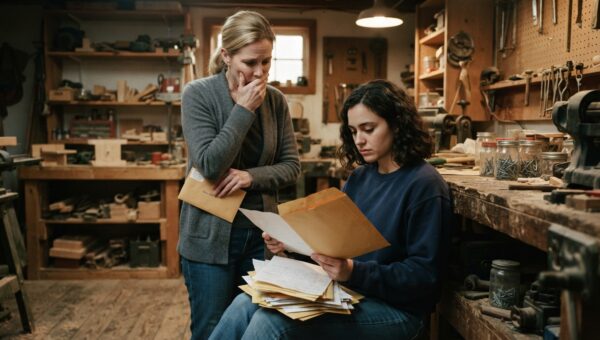
Matthew came back into the kitchen carrying a battered cardboard shoebox filled with dozens of folded envelopes, the blue ink of the state prison stamp visible on every single corner.
“Dump them,” I said.
He tipped the box over, spilling the papers all across the kitchen table. I started grabbing them at random, scanning the hurried lines written in cheap blue ballpoint pens behind bars.
“I didn’t kill him, sweetheart,” read a letter dated four years ago. “Arthur is taking over the books. Check the ledger in the office safe. Look at the numbers from the month before it happened.”
I stared at that sentence until the words blurred together. The office safe. My dad’s old office safe had been hauled away by Arthur Vance a week after the murder under the preemption of settling company debts and business dissolutions. Vance had told us the records were a total mess of bad loans and failed subcontractors. He had told us my father was on the verge of bankruptcy when he died.
I grabbed my phone from my pocket and dialed a number I had memorized from a business card on our refrigerator. Arthur Vance’s cell phone. It rang three times before his smooth, practiced voice picked up on the other end.
“Harlan? It’s late, son,” Vance said, sounding entirely too calm for a man whose old business partner’s ex-wife was scheduled to be executed in less than four hours. “Are you holding up okay about tonight? I can come over if you need someone to talk to.”
“Arthur, I’m at the house,” I said, my voice dropping into a flat, dangerous register that surprised even myself. “I’m looking at the letters my mom sent from Lansing. She kept talking about the ledger. The one from the construction company.”
There was a fraction of a second of dead silence on the line, just enough time for the steady hum of the cell tower to fill the gap. When Vance spoke again, the warm uncle facade had vanished completely, replaced by a cold, sharp edge.
“That old book was full of accounting errors, Harlan. Your father was cooking the books for years before he died. You don’t want to dig into that graveyard.”
“Matthew just told me what he saw six years ago, Arthur,” I lied smoothly, gripping the edge of the kitchen table until my knuckles turned white. “He saw you coming out of our parents’ bedroom with the knife. He remembers you telling him to keep his mouth shut.”
A harsh, ugly laugh came through the speaker. “The boy was eleven years old, half-asleep, and hysterical. No judge in the state of Kansas is going to take the word of a traumatized kid over physical evidence three hours before an execution warrant is carried out. You stay right where you are, Harlan. Don’t do anything stupid.”
The line went dead with a sharp click.
“He’s at the office downtown,” I said, looking up at Matthew, whose eyes were wide with a mixture of terror and vindication. “Get your coat. We’re going to pay Arthur a visit.”
The downtown commercial district was entirely dark except for the security lights glowing over the entrance of Vance Construction & Supply. Our truck tires crunched loudly over the gravel parking lot as I pulled right up beside Vance’s black sedan, blocking him in. The office window on the second floor showed a single, harsh yellow light cutting through the venetian blinds.
We didn’t knock. I shoved my shoulder against the heavy glass-paneled front door, the latch giving way with a sharp crack that rattled the empty lobby. We took the stairs two at a time, the sound of our boots echoing off the concrete walls like gunshots.
I threw open the door to Arthur Vance’s private office. He was standing by his mahogany desk with a heavy leather-bound ledger open in his hands, a stack of shredded paper spilling out of a metal wastebasket beside him. He looked up, his face pale and slick with sweat, a silver letter opener still clutched in his right hand.
“You’re out of your mind,” Vance hissed, stepping backward until his legs hit the edge of the desk. “You think breaking in here is going to save her? The governor already signed the final denial thirty minutes ago.”
“Put the knife down, Arthur,” I said, stepping into the room and closing the door behind Matthew. “Or I swear to God I will tear this office apart with my bare hands until I find every single forged signature in that book.”
“Your father was ruining us,” Vance snarled, his voice rising into a jagged, desperate pitch as he realized the game was over. Saliva flecked the corners of his mouth. “He found out I was siphoning funds to cover my own debts, and he threatened to put me away for twenty years. He came at me in the kitchen with a coffee mug, and things just… happened. I had to protect myself.”
“And my mother?” I demanded, taking another step forward. “You went upstairs while she was out cold from her sleeping pills? You put the knife under her bed and smeared her robe?”
“She was asleep!” Vance shouted, waving the letter opener wildly. “She never even woke up! It was the easiest thing in the world to make a grieving widow look like a cold-blooded killer while I walked away clean!”
He didn’t see Matthew slip around the side of the bookshelves toward the desk. In one swift, desperate motion, Matthew lunged forward and slammed his heavy canvas bag down onto Vance’s wrist, sending the silver letter opener clattering across the hardwood floor. At the exact same second, I pulled my phone out of my pocket, the screen glowing brightly in my palm. The voice recorder app was still running, capturing every single whispered, screaming confession echoing off the paneled walls.
“The recording’s going straight to the state attorney general’s emergency desk, Arthur,” I said, my voice shaking with a cold, terrifying fury. “And if you move an inch, I’ll finish what you started in this room.”
Thirty-eight minutes later, we were sitting in the back of a Kansas State Highway Patrol cruiser with the siren wailing a high, screaming path through the midnight traffic toward the penitentiary. The state trooper behind the wheel had a radio pressed against his ear, his jaw set hard as he listened to the emergency dispatch confirmation coming through from the governor’s residence.
The execution was halted with twenty-two minutes left on the clock.
By two in the morning, the heavy iron gates of the state penitentiary groaned open not to let a hearse out, but to let a battered gray sedan pull through carrying a woman wrapped in a borrowed wool blanket.
We didn’t go inside the prison intake building. We waited by the hood of my truck in the gravel parking lot beneath the harsh yellow glare of the security lights. When the heavy glass door finally swung open and my mother stepped out into the night air, she looked smaller than ever, her shoulders hunched against the damp wind blowing down from the plains.
Matthew didn’t wait. He sprinted across the gravel and slammed straight into her arms, nearly knocking her off her feet as she buried her face in his shoulder, her whole body shaking with dry, racking sobs that had no tears left behind them.
I stood a few feet away, my hands shoved deep into my jacket pockets, feeling the heavy, crushing weight of six years of terrible mistakes pressing down on my chest. My mother looked up over Matthew’s head, her tired eyes locking onto mine across the quiet space between us. She didn’t look angry. She didn’t look triumphant. She just looked like a mother who had finally come home from a very long, very dark place.
“I’m sorry,” I whispered, the words tearing their way out of my throat. “I’m so sorry I didn’t believe you.”
She walked over to me, slow and measured, and reached out to press her cold, rough palm against my cheek, right where my father’s hand used to rest when I was a kid.
“You were just a boy, Harlan,” she murmured, her voice cracking in the midnight air. “We survived. That’s all that matters now.”
Three days later, the sun came up over the quiet neighborhood on the edge of town, painting the frost-covered grass in pale, golden light. The three of us sat together out on the old front porch swing, the rhythmic squeak of the rusty iron chains keeping time with the morning breeze. My mother held the worn cardboard shoebox in her lap, slowly going through the stack of prison letters one by one, folding them neatly in half before tossing them into a small metal trash can beside the steps where they finally belonged.