The smell of instant coffee never quite filled up the kitchen the way a pot of percolated roast used to, but at eighty-two years old, you learn to make peace with the little compromises of keeping house alone. Or at least, that is what I kept telling myself every Sunday morning when I drove out to my mother’s place on the edge of Amarillo.
The house was a solid brick ranch with three bedrooms, a wide front porch, and a mortgage that had been burned in an ashtray back in the autumn of 2008. It was worth $310,000 on paper, but to Mom, it was just the place where she planted her tomatoes and kept my father’s old radio on the sill.
Then Arthur started showing up. He was my mother’s half-brother, a man who had spent most of our lives drifting between odd jobs and distant cousins out in Oklahoma, but suddenly he had found his way back to Texas with a fresh box of cinnamon rolls and a smile that never quite reached his eyes. He started coming every Sunday at two in the afternoon, right when church let out. At first, I thought it was just lonely old-age companionship. I figured family was family, and maybe Arthur had finally settled down after all these years of running.
The shift happened quiet as a shadow, the way most bad things creep into an ordinary life. Mom was pouring tea from her brown Betty pot when she mentioned the nice man from the bank. She called him Mr. Miller, though she could never quite remember which bank he worked for or what street his office was on. She just knew he wore a sharp grey suit and carried a leather briefcase, and that he had been helping her understand how to make her house work for her in her golden years.
“He says the equity is just sitting there doing nothing, honey,” Mom told me that afternoon, smoothing her floral apron over her knees while Arthur nodded sympathetically from the armchair by the fireplace. “Arthur says it is smart business.”
I did not like the sound of it, but Mom had always been stubborn about her independence. I let it go for a few days, telling myself I was just being an overprotective daughter who hated seeing her mother grow older.
But the phrase the nice man from the bank kept echoing in my head like a loose shingle in the wind. By Thursday morning, I could not shake the gnawing in my gut, so I drove out to the house while Mom was at her Tuesday bridge club with the ladies from the First Baptist auxiliary.
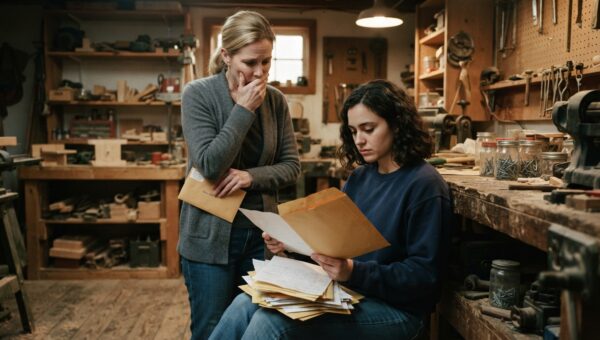
The mahogany desk in the den was unlocked, which was my first real warning that something was wrong. Inside the middle drawer, tucked neatly beneath a stack of old quilt patterns and church bulletins, sat a thick packet of cream-colored paper with bold blue lettering across the top. It was a reverse mortgage application for the full $310,000 value of the house. I flipped the pages with shaking fingers, my eyes scanning the fine print until I hit the signature lines.
Mom’s signature was shaky and weak, penned in blue ink that looked like it had been dragged across the page by an unsteady hand.
But right beneath it, clear as day on the co-borrower line, was the name Arthur had been using, coupled with a signature that was crisp and practiced. He was not just helping her understand the loan. He was listed as the co-borrower slated to receive sixty percent of the cash disbursement, amounting to a cool $186,000 wired straight into an account that did not bear my mother’s name.
The phone on the wall felt heavy as a lead weight when I picked it up to call the regional HUD counseling office. The man who answered, Mr. Harrison, sounded tired and bureaucratic until I read him the loan application number off the top of page one. There was a long pause on the line, followed by the rustle of papers being shuffled in a distant filing cabinet.
“She didn’t pass the counseling requirement,” Mr. Harrison said, his voice dropping an octave. “She answered four out of twelve questions correctly on the comprehension assessment. I recommended immediate denial based on diminished capacity.”
“Then why is it still processing?” I asked, my voice tight and thin. “I found the active file sitting right here in her desk.”
“The loan officer overrode me,” he sighed. “Signed off on it Tuesday morning. Said the family was in full agreement.”
The anger did not hit me as a flash of fire; it settled into my bones like cold grease. I drove straight to the Veterans of Foreign Wars post down on Tenth Street because I knew Arthur liked to sit at the corner booth with a pitcher of cheap draft beer while the afternoon baseball game played on the muted television above the register. The room smelled of stale floor wax, fried onions, and forty years of cigarette smoke that had long since been painted over.
I found him alone in the back booth, nursing a foam-capped glass and thumbing through a grease-stained racing form. I dropped the photocopied pages of the loan application right on top of his racing sheet with a sharp slap that made the bartender look up from the taps. Arthur did not even flinch. He just slowly lifted his eyes, his mouth twitching into that same thin, unconvincing smile he wore in my mother’s kitchen.
“You are trespassing on stolen ground, Arthur,” I said, keeping my voice low enough that the men at the pool table would not turn around. “What do you think you are doing with my mother’s house?”
He took a slow sip of his beer before he answered, his fingers tapping lazily against the damp condensation of the glass. “Mind your business,” he said, his voice flat and devoid of any family warmth. “She signed it herself. The bank approved it. You are just making a fuss over nothing.”
“Sixty percent of three hundred and ten thousand dollars is not nothing,” I told him, leaning across the sticky laminate table until I could smell the stale tobacco on his breath. “I talked to the HUD counselor. I know the test was failed and overridden. I am going to the police before you finish printing your name on her deed.”
Arthur just laughed, a dry, rattling sound that came from the back of his throat. “Go ahead and talk to whoever you want. By the time the paperwork clears, your mother won’t even remember having this conversation.”
I did not go home. I drove straight to the county courthouse and walked into the municipal police precinct with the photocopied application clutched in my hand like a shield. Detective Miller was a heavy-set man with rolled-up sleeves and a desk stacked so high with manila folders that I could barely see his face when I sat down in the metal chair across from him. He listened to my story without interrupting, his pencil tapping a steady rhythm against a yellow legal pad while I laid out the dates, the Sunday visits, the failed HUD test, and the sixty-percent payout line.
When I finished, Detective Miller leaned back in his squeaky swivel chair and pulled a heavy black binder toward him. He did not look surprised. He looked tired in the way only cops who deal with family predators ever look tired.
“Reverse mortgage fraud is an art form for guys who don’t want to work for a living,” Detective Miller said, pulling a slip of paper from his drawer. “Let me run that name he signed on the co-borrower line through the state database. People like that rarely use the same driver’s license twice.”
It took twenty minutes for the printer down the hall to clatter out a single sheet of paper with a mugshot that did not match the graying mustache Arthur wore on Sundays. Detective Miller laid it on the desk between us, his thumb pointing to the text beneath the photograph.
“That is not Arthur,” the detective said quietly. “That is a man named Julian Vance. He has three different aliases across four states, and he has been running the exact same elder exploitation play since 2014. His previous victim was his own mother-in-law down in Little Rock. He stripped her house clean, left her with a foreclosure notice, and vanished before the probate court could even issue a subpoena.”
The room seemed to shrink around me until the walls felt like they were pressing in on my shoulders. “Is there a warrant?” I asked.
“Federal warrant for wire fraud and interstate elder abuse,” Detective Miller said, picking up his desk phone. “And thanks to you bringing this in before the disbursement date next Monday, we are going to serve it right over Sunday dinner.”
The following Sunday at 1:45 p.m., I pulled my car into Mom’s driveway behind a nondescript federal sedan and an unmarked police cruiser parked half a block down under the shade of an old hackberry tree. My heart was pounding so hard my ribs ached, but when I walked up the concrete steps to the front door, I made sure my breathing was steady.
Mom was in the kitchen humming an old hymn while the kettle heated on the back burner. Arthur had just stepped through the front screen door with his usual white bakery box tied up with red string, setting it down on the entryway table just as he had every week for the past six months. He looked up, saw me standing in the hallway, and his smile faltered for a fraction of a second before he recovered his composure.
“Well, look who decided to join us,” Arthur said, reaching for his coat buttons. “I brought those eclairs your mother likes so much.”
“Keep your hands right where I can see them, Julian,” Detective Miller’s voice cut through the quiet hallway like a saw blade as the front door swung open behind him, framing two uniformed deputies and a federal marshal in the bright afternoon sunlight.
Arthur froze, his fingers hovering over the lapel of his jacket. The color drained out of his face so fast his skin looked almost grey against the floral wallpaper in the foyer. He did not try to run. He did not have anywhere left to go. The handcuffs clicked onto his wrists with a sharp, heavy metal sound that seemed to echo through the whole quiet house, drowning out the whistle of the kettle on the stove.
They led him out past the hackberry trees and into the back of the cruiser while the neighbors watched from behind their living room curtains. Inside the kitchen, Mom stood by the counter with a tea towel clutched in her hands, looking from the open doorway to the empty bakery box sitting on the hall table with a look of quiet, helpless confusion.
“Where is Arthur going, honey?” she asked softly, her voice trembling just a little as she smoothed the corner of the tablecloth. “He brought the pastries for us.”
I walked over to her, took the towel from her fingers, and pulled out the chair at the head of the table where the afternoon sun was slanting warm across the polished oak boards. The heavy brass deadbolt on the front door was thrown shut, and the key was safe in my pocket.
“He’s not coming back, Mom,” I said, sitting down beside her and pouring the hot water into the brown Betty pot. “He had some business to take care of out of state.”
We sat together in the quiet kitchen, drinking tea while the shadows lengthened across the porch floor, with no knock at the door and no nice man from the bank waiting in the driveway. The house was paid off, the papers were torn into tiny pieces at the bottom of the precinct trash bin, and for the first time in months, the Sunday afternoon felt like our own again.