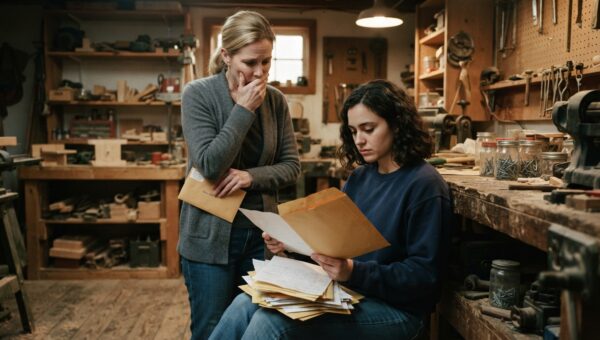
The smell of instant decaf and stale graham crackers always stays in the back of your throat when you spend an afternoon going through an eighty-two-year-old mother’s paperwork. It is a dry, chalky kind of smell that coats your teeth.
Mom owned her house outright. Three hundred and ten thousand dollars, every single dime of it earned through forty years of nursing shifts at the county hospital and paid off in full back in the autumn of 2008.
She kept the satisfaction piece from the bank in a green tin box on the top shelf of her bedroom closet, right beneath a stack of wool blankets that smelled of cedar and lavender.
For the past few months, though, the green tin box had been pushed aside for a thick manila folder. It sat right on the corner of her oval oak kitchen table, held down by a heavy glass paperweight she got on a bus trip to Niagara Falls back when my father was still alive.
“Warren dropped by again,” she told me on a Tuesday, her voice light and airy the way it gets when she thinks she is telling you about something wonderful. She was stirring a mug of hot water with a plastic spoon, her hand shaking just a little bit against the rim. “He brought those little pecan rolls from the bakery on Elm Street. The ones your father liked.”
Warren was her younger brother, or at least he had been calling himself Warren ever since he showed up on her porch out of the blue six months ago with a battered suitcase and a story about bad knees and missing his family. He had started coming over every single Sunday. Just checking in, he said. Just sitting in the floral armchair by the radiator, talking about old times in Utica and asking how her investments were holding up against the inflation.
I didn’t like the look of those pecan rolls, and I didn’t like the manila folder either.
“What did Warren want this time, Mom?” I asked, pulling out a chair and sitting down across from her.
“Oh, just helping me sort out some papers,” she said, looking away toward the back window where the bird feeder was swinging empty in the wind. “He says the house is just sitting here doing nothing.
He knows a nice man down at the bank who can help me unlock some of that money so I can finally take that trip to Nova Scotia we always talked about.”
Nova Scotia. She hadn’t left the tri-state area since 1994.
I reached out and pulled the manila folder toward me across the worn wood of the table. Mom made a small, fluttering motion with her hand, like she wanted to stop me, but she let her arm drop back down to her lap. “Now, don’t go making a fuss,” she murmured. “Warren is just looking out for his big sister.”
I opened the tab. Inside was a complete reverse mortgage application packet, filled out in neat, unfamiliar handwriting that certainly didn’t belong to an eighty-two-year-old woman with arthritis in her knuckles. There were pages and pages of financial disclosures, property appraisals, and HUD counseling certificates.
And right there on page four, under the designated disbursement split, was Warren’s name listed as co-borrower, set to receive sixty percent of the total payout.
One hundred and eighty-six thousand dollars straight into an account I had never seen before.
My stomach didn’t drop. It just went cold, the way it does when you step out onto ice and realize you are already sliding.
“Mom,” I said, keeping my voice as level as I could manage. “Did you sign this?”
“Warren said I had to sign where the yellow stickies were,” she whispered, staring down at her plastic spoon. “He said it was just standard family paperwork so he could help me manage the bills if my memory gets fuzzy.”
I didn’t argue with her. I just slipped the application into my canvas tote bag, told her I had to run some errands, and drove straight down to the regional HUD housing office off Route 9 before my shift at the clinic started.
The counselor on duty was a tired-looking man with graying temples named Mr. Henderson who looked like he had spent thirty years telling people things they didn’t want to hear. He took the application from my hands, slid his glasses down his nose, and stared at the file number for a long time without saying a word.
“You’re her daughter?” he asked finally, tapping a yellow highlighter against the edge of his desk.
“I am,” I said. “And I want to know how my mother signed this when she can’t even remember what day of the week it is half the time.”
Mr. Henderson let out a long breath through his nose, shaking his head. “She didn’t pass the counseling session,” he said flatly, opening a separate logbook on his computer. “Federal guidelines require a comprehensive competency check for reverse products. She answered four out of twelve questions correctly. She didn’t even understand that she could lose the roof over her head if she defaulted on the property taxes.”
“Then why is it still processing?” I demanded, leaning forward across the linoleum-topped desk. “If she failed, the application is supposed to be dead in the water.”
Mr. Henderson looked up at me, his eyes tired and heavy. “She answered four out of twelve questions correctly. I recommended denial.”
He tapped the screen twice with his index finger. “Then why is it still processing?” I asked again, my voice shaking with a sudden, hot wave of protective anger that tasted like copper.
“Because the loan officer overrode me,” Mr. Henderson said quietly. “A man named Miller down at the First National branch on Market Street. He pushed it through as an administrative exception, claiming the borrower understood the terms with family assistance.”
Family assistance. Warren standing right behind her chair, whispering the answers while she guessed at numbers she hadn’t seen since the mortgage was satisfied fourteen years ago.
I didn’t go back to work that afternoon. I drove straight to the Veterans of Foreign Wars post down by the river where Warren liked to sit at the end of the bar every afternoon from three to five, nursing a draft beer and pretending he had served in a war he was barely old enough to remember.
The place smelled stale, a heavy mix of floor wax, old beer, and fried grease. Warren was sitting in a vinyl booth near the back, wearing a faded windbreaker and picking at the salt shaker with a stained thumbnail.
I slid into the booth across from him without asking. He looked up, his pale blue eyes blinking behind wire-rimmed glasses, a practiced smile already forming on his thin lips.
“Well, if it isn’t my favorite niece,” he said, holding up two fingers to flag down the bartender. “Come to join your old uncle for a ginger ale?”
“Don’t do that,” I said.
He stopped smiling. “Do what?”
I laid the reverse mortgage application right on top of the sticky laminate table, flipping it open to the disbursement page where his name was scrawled in that careful, practiced handwriting next to the figure of one hundred and eighty-six thousand dollars.
“You think you’re pretty smart, don’t you, Warren?” I said, my voice dropping down into the register I usually reserved for patients who tried to walk out of the recovery ward before their IV lines were out. “Coming around every Sunday with your little store-bought rolls. Acting like you give a damn about her garden.”
Warren leaned back against the red vinyl, his smile entirely gone now, replaced by a cold, flat stare that didn’t look anything like the bumbling old relative he played in Mom’s kitchen.
“Mind your business,” he said, his voice dropping an octave into something thin and sharp. “Your mother is a grown woman. She wants to take care of her family. She asked me to help her with the paperwork.”
“She failed the counseling test four out of twelve, Warren,” I said, leaning across the table until I was six inches from his face. “And Mr. Henderson has the recording of you coaching her from behind the door. The loan is blocked.”
Warren’s jaw tightened. He didn’t blink. “You think a small-town loan officer cares about a counselor’s notes once the underwriting fee clears? That money is moving whether you like it or not. She signed it of her own free will. Try proving otherwise in a probate court.”
That was the moment I knew he had done this before. No amateur panic, no stumbling over his words, just cold, calculated defiance from a man who knew exactly how far the law could be bent before it snapped.
I stood up, scooped the papers off the table, and walked out of the VFW without another word.
An hour later, I was sitting across from Detective Miller at the precinct downtown, laying out the entire folder on his metal desk along with the bank statements and the HUD denial logs. He was a quiet, thorough man who didn’t say much while he listened, just taking occasional notes on a yellow legal pad with a chewed-up ballpoint pen.
“You said his name is Warren?” the detective asked, looking up when I finished explaining the Sunday visits and the pecan rolls.
“That’s what he calls himself. He’s my mother’s brother. Or at least that’s what she was told when he showed up.”
Detective Miller pulled his keyboard toward him and started typing, his fingers moving with a heavy, rhythmic clatter. “Family members are the hardest ones to prosecute for elder exploitation,” he muttered, staring at the glowing monitor. “They use the familiarity to get the paperwork signed under the guise of assistance. It happens every week.”
He clicked his mouse twice, then stopped. He stared at the screen for a long time, his eyebrows pulling together in a sharp line.
“Let’s run that birth date he gave on the intake form,” the detective said softly, mostly to himself.
He printed out a single sheet of paper from the laser printer in the corner and slid it across the desk toward me. At the top was a mugshot of a man with gray hair and wire-rimmed glasses who looked vaguely like Warren, but the name underneath was entirely different.
“Warren is an alias,” Detective Miller said, leaning back in his chair and crossing his arms. “His real name is Arthur Pendelton. And he isn’t your mother’s brother.”
My throat felt tight. “Then who is he?”
“A professional,” the detective said, tapping the paper. “He has an active federal warrant out of Ohio for interstate wire fraud and elder exploitation. Three years ago, he used the exact same routine, Sunday visits, a fake name, and a compromised loan officer, to drain his own mother-in-law’s home equity down in Cincinnati. Left her with a foreclosure notice and empty accounts before skipping state lines.”
The silence in the small office was heavy, smelling of old coffee and floor wax.
“Can you stop the loan?” I asked, my voice barely above a whisper.
Detective Miller picked up his desk phone, already punching numbers with his thumb. “We aren’t just going to stop the loan,” he said, looking up at me with a hard, steady look in his eyes. “We’re going to intercept the disbursement, freeze every asset he’s touched, and have a pair of county deputies waiting for him when he shows up with his little box of pastries this coming Sunday.”
It took three days of frantic calls to the bank’s fraud department, working with the regional vice president to invalidate the loan officer’s override using the HUD counselor’s official denial record and the detective’s fraud warrant. By Friday afternoon, the reverse mortgage application was officially voided, stamped across the front in bright red ink: CANCELLED – FRAUD INVESTIGATION PENDING.
Sunday morning arrived with a thin, gray drizzle tapping against the kitchen windowpanes.
Mom was sitting at the oval oak table, wearing her good cardigan and drinking her hot water with the plastic spoon. The manila folder was gone, replaced by a fresh, thick blue binder containing the new legal safeguards we had put in place the day before, a complete financial freeze, a revocable family trust with my name on the oversight line, and a permanent do-not-contact directive logged with the local police department.
When the front path gate clicked shut at precisely 2:00 p.m., Mom looked up from her cup, her expression mild and confused as heavy footsteps mounted the porch steps.
“That’ll be Warren,” she said, starting to push her chair back. “I wonder if he brought those pecan rolls again.”
I didn’t answer her right away. I just walked over to the front window and watched through the lace curtains as two county cruisers pulled silently up to the curb, their headlights dark in the gray afternoon light, while Detective Miller and another officer walked up the concrete steps to meet the Sunday visitor at the door.
“Sit down, Mom,” I said softly, resting my hand on her shoulder as the heavy knocking started against the wood. “Let’s just leave the door closed today.”