How long does it take for a marriage to curdle into something you wouldn’t wish on an enemy? I used to think it happened slowly, like milk left too long in the back of the fridge. You don’t notice the sour smell until you’ve already poured it into your coffee. But looking back from where I am now, sitting in a quiet room that doesn’t smell like Arthur or his endless demands, I know some things don’t spoil over time. They just drop the mask all at once.
Arthur and I had been married for six years. We lived in a modest split-level on the north side of Dayton, a house I bought with money from my grandfather’s lumber yard before I ever met Arthur at the regional supply warehouse. Arthur was an assistant manager back then, quiet in a way that felt steady. He wore ironed flannel shirts and listened when I talked about my work in medical billing. I thought his quietness meant he was solid. I didn’t know it was just empty space waiting for his sister Chloe to move in and fill it with her emergencies.
Chloe was thirty-two and lived like a hurricane that never quite touched down anywhere. She couldn’t keep an apartment, she couldn’t keep a job that lasted past the probation period, and she certainly couldn’t keep track of her bills. Every few months, Arthur would come to me with that heavy, injured look in his eyes.
He’d sit at the kitchen table, twist his wedding band around his knuckle, and talk about how family is all we have. That always meant my savings account was going to be lighter by a few thousand dollars.
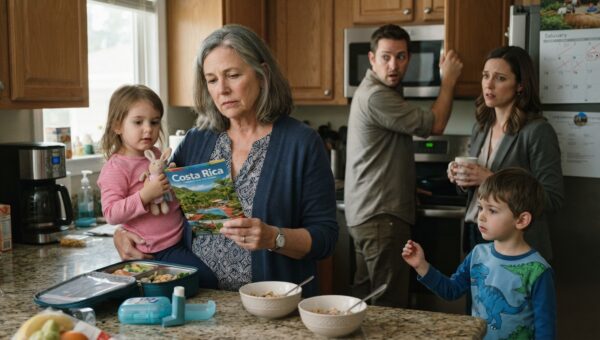
The morning it all ended started like any other Tuesday in October. The kitchen window was fogged up from the kettle, and the radio was playing an old segment on farm prices that nobody was listening to. I was pouring my second cup of coffee when the back door banged open. Chloe didn’t knock. She never knocked. She blew into the kitchen smelling of menthol cigarettes and wet asphalt, dropping her canvas tote bag right onto the bread box with a heavy thud.
“Doreen, I need the black card,” Chloe said, not even taking off her damp windbreaker. Her hair was tangled from the morning drizzle, and her eyes had that frantic, wide-set look they always got when she had another scheme going. “Just for two days.
The transmission in the Civic gave out over by the bypass, and the shop won’t even look at it without a deposit.”
I didn’t look up from my mug. My hand stayed wrapped around the ceramic, feeling the warmth of the roast. “Chloe, the limit is already maxed out from your storage unit fees last month. Arthur told you we weren’t covering that anymore.”
“I am not asking Arthur, I am asking you,” she snapped, stepping right up to the island. “You make enough down at the clinic to cover a little fix without crying about it.”
That was when Arthur walked in from the garage. He had his tool belt unbuckled and slung over one shoulder, his face flushed from the damp chill outside. He didn’t ask what was going on. He never needed to ask. He just saw his sister looking upset and automatically assumed I was the obstacle in the room.
“Just give her the plastic, Doreen,” Arthur said, his voice flat and low. He dropped the tool belt by the refrigerator with a heavy clatter. “Don’t start this morning. She needs the car for her shifts at the bakery.”
“She hasn’t worked at the bakery since July, Arthur,” I said, keeping my voice level. That was the mistake, I think. I didn’t sound scared enough. I sounded tired, and tired makes men like Arthur dangerous because it looks like defiance. “I’m not giving her the card. We have the property tax due next week, and my mother’s headstone marker balance is coming out of my account on Friday. We don’t have it.”
Arthur didn’t argue. He didn’t reason. He just crossed the three paces between the refrigerator and the kitchen island in two long strides. His face went dark, the veins in his neck thickening under his collar. Before I could blink, his hand swept out and caught the rim of my mug. He didn’t knock it over. He tilted it hard, sending the scalding black liquid straight across the bridge of my nose and down my right cheek.
The pain didn’t hit immediately. It was just a heavy, roaring heat, like someone had pressed a hot iron directly against my skin. The mug shattered against the tile floor, shards of white ceramic skittering across the linoleum.
“Hand over your stuff or get out,” Arthur yelled, his voice cracking with a sudden, ugly pitch that didn’t sound human. He was shaking, his hands curled into fists at his sides. “You live under my roof, you keep my family afloat. Hand over the wallet right now or get out of my house.”
The skin on my face felt tight, burning like I’d stood too close to an industrial furnace. My blouse was soaked down the front with cold water and hot coffee, clinging to my chest. For three seconds, I didn’t breathe. I just looked at him standing there over the broken mug, his chest heaving, his eyes fixed on me with total, feral expectation. He thought I’d drop my head. He thought I’d reach into my purse, pull out the leather wallet, and hand over the cards while I cried and apologized for making him angry.
Instead, the burning heat on my cheek turned into a cold, clear bell ringing inside my skull.
“This is my house, Arthur,” I said. My voice didn’t even shake. That surprised me more than the coffee. “And you just made a very expensive mistake.”
I didn’t pack a suitcase because I didn’t want to argue over zippers and folding. I grabbed my car keys off the wall hook, picked my leather handbag off the counter, and walked right past the two of them. Chloe was staring at the floor near the broken mug, her mouth slightly open, finally looking a little scared. Arthur didn’t follow me out the door. He stood by the kitchen island, probably thinking I was going to sit in my sedan for ten minutes and then crawl back through the side door to apologize for ruining his breakfast.
I didn’t sit in the car. I drove straight to Mercy General downtown, keeping my left hand steady on the wheel while my right cheek throbbed in time with my pulse. The ER waiting room smelled of floor wax and old magazines. The triage nurse took one look at my face, didn’t even ask me to sign in at the window, and took me straight back to Trauma Three behind the swinging yellow doors.
Two hours later, my cheek was treated, dressed with silver sulfadiazine cream, and wrapped in clean gauze that smelled faintly of clinical iodine. The doctor took three separate photographs of the scald pattern across my jawline and cheekbone. When he finished logging the chart into the wall terminal, he turned around and looked me square in the eyes.
“Mrs. Hayes, chemical and liquid burns of this specific velocity don’t happen by accident while pouring a cup of coffee,” the doctor said, his voice entirely professional, stripped of any polite small-town sympathy. “We are required by state statute to log these into the county database. Do you want the sheriff’s department dispatched to take an official statement?”
“Yes,” I said. “Send them.”
Two deputies arrived fifteen minutes later. Officer Vance was a tall man with graying temples who looked like he’d seen every version of domestic misery Dayton had to offer. He sat on the metal stool by the examination table, his pen poised over a yellow notepad, while I told him everything. Not just about the coffee. I told him about the storage units, the Civic transmission, the six years of quiet draining that Arthur called being a good brother-in-law.
“We can escort you back to the residence to retrieve your essentials,” Officer Vance said when I finished. “You have a legal right to your personal effects and documents. But once you establish that you’re removing your property, you don’t stay under that roof tonight. We handle the paperwork.”
By 5:45 PM, my sedan was parked in the gravel driveway behind the police cruiser. Officer Vance and his partner, a young woman named Miller who carried her duty belt with easy competence, stood on either side of me as I unlocked the front door. The house was dead quiet. The broken mug had been kicked under the refrigerator, and a damp paper towel lay abandoned by the sink, but Arthur wasn’t home yet. He still had two hours left on his shift at the supply warehouse.
I moved through the rooms with a cold, methodical speed. I didn’t waste time on clothes I didn’t care about. I took my birth certificate, my passport, the deed papers locked in the bedroom safe, and my mother’s cedar box containing her cameo brooch and her gold wedding band. I packed my work gear, my laptop, three changes of practical clothes, and my grandmother’s cast-iron skillet that Arthur always complained took up too much room on the burners.
Officer Miller carried the heavy cardboard boxes out to my trunk while Officer Vance stood by the kitchen table with a black ballpoint pen.
“You need to leave the house keys, Mrs. Hayes,” Vance said quietly.
“I know,” I said.
I set my house key right in the center of the oak table. Then I reached into my handbag, unclasped the small velvet pouch I always kept in the side pocket, and slid my wedding ring out. It was a heavy band of platinum with three small, square-cut diamonds that my father had bought for my mother before he passed, which Arthur had insisted we reuse to save money. I set it right on top of the completed police report, dead center, where the light from the overhead fixture caught the polished metal.
“What’s that?” Officer Vance asked, looking down at the ring.
“The finish line,” I said.
We left at 6:45 PM. I drove to my sister Darlene’s house down in Miamisburg, where the spare room smelled of cedar chips and old quilts. Darlene didn’t ask a million questions when she saw the gauze on my cheek; she just put the kettle on, pulled out a fresh mug, and told me the bed was made up whenever I was ready.
At 7:20 PM, Arthur’s Ford truck pulled into his driveway four miles north of here. He would have killed the engine, grabbed his lunch pail, and walked up the front steps expecting to find me sitting at the kitchen island with dinner warming in the oven, ready to hand over my wallet and apologize for being difficult.
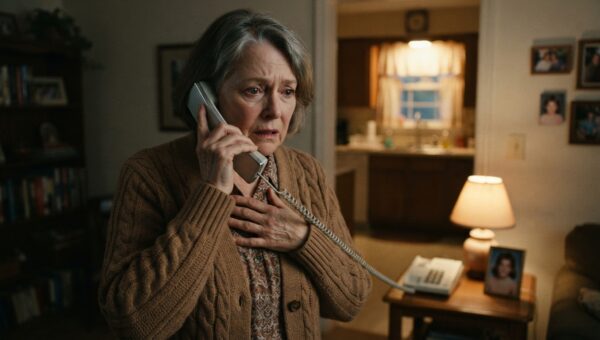
Instead, the house was dark. The key turned in the lock, and the heavy oak door swung open to an absolute, echoing silence. There was no smell of roast beef, no radio murmuring from the counter, no sound of my footsteps coming down the hall. Just the empty rooms, the gray dusk settling through the living room windows, and the police report waiting on the kitchen table with my wedding ring resting cold and solitary right in the middle of the page.