The clipboard had a little notched corner where some previous patient had bitten the plastic, and the total at the bottom of the estimate page said forty-four thousand dollars even. That was the price tag the county hospital handed me for fixing two vertebrae that had ground themselves down to nubs after years of damp weather and working seventy-hour weeks at the dry cleaners.
I was sitting on the scratchy blue vinyl chair in admission room four, trying to hold my breath against the smell of bleach and old floor wax, when the volunteer took my intake sheet. Her name tag said Martha, and she had those round bifocals hanging from a beaded chain around her neck. She read the top line where I had written my maiden name and my married name in block letters. Then she stopped.
Martha didn’t look up right away. She just stared at the little square box where I had scribbled Marianne Cole, and her thumb stayed right over the zip code box. I remember thinking she must have trouble with her reading glasses because she squinted so hard at the ink. The room was quiet except for the hum of the ice machine down the corridor and the squeak of someone’s rubber-soled shoes turning the corner past the nurses station.
“You’re Marianne Cole?” she asked.
I nodded because my neck was too stiff to turn much further to the left. I just said, “Yes, ma’am. That’s me.”
Her eyes lifted from the paper and moved straight past my shoulder, looking out through the small wire-reinforced glass pane in the door toward the hallway where the dietary carts usually rattled by around two in the afternoon. Her mouth went into a thin, straight line. She set the clipboard down on the small metal tray beside my bed like it was made of thin glass.
“Wait right here,” Martha said, and she turned around and walked out without closing the door all the way.
Seventeen years is a long time to look at a set of twin maple bedposts and pretend they are waiting for someone to come home. Back in the winter of 2009, when the oil furnace in the hall was clanking and coughing every time the wind hit the siding, our house smelled like burnt toast and wet wool.
My boy Leo was four then, with sticky fingers and a habit of climbing on the porch rail like a little frog. Chloe was sixteen, old enough to know better, old enough to be watching him while I carried the laundry baskets down to the basement. I remember the sound of the drop more than anything else. It wasn’t a loud thud. It was a dull, heavy thump, like a sack of seed falling off the tailgate of a truck onto frozen dirt. I dropped the basket of towels right there on the concrete floor and ran up the stairs so fast I caught my shin on the corner of the banister, leaving a purple bruise that lasted three weeks. Leo was screaming in the frozen mud by the hydrangea bushes, his arm bent back like an old dry branch. Chloe was standing at the edge of the porch with her hands pressed flat against her mouth, staring down at him as if she had turned to salt.
I didn’t ask if he was breathing first. I didn’t scoop him up and check his pulse before I opened my mouth. I looked at his crooked arm in the dirt, and then I looked up at her face, pale and frozen under her knitted blue cap.
“You were supposed to be responsible,” I said. My voice sounded thin and sharp, like a saw hitting a nail in a piece of scrap wood. “I asked you for twenty minutes. Just twenty minutes.”
“I turned around to get his mitten,” she whispered. Her lips were blue against the cold. “He just slipped right over.”
“You were supposed to be watching him,” I said again, and I pushed past her down the steps to scoop Leo up into my arms. I didn’t look back at her again that evening while we sat in the emergency room waiting for the orthopedic resident to pull the bone back into place. When we got home around midnight, her green canvas coat was gone from the peg in the hall, along with the old brown wicker basket where she kept her school notebooks. On the kitchen table, tucked under the salt shaker, was a single twenty-dollar bill and four fives. That was the hundred and twenty dollars she had saved from her summer working the register at the feed store. She had walked three miles through the sleet to her aunt Helen’s place down near the river, and she never came back through my front door.
I kept her blue bedroom untouched for seventeen years because I thought time would eventually prove me right. I thought if I left her flannel sheets on the bed and her high school algebra books stacked beside the little white lamp, she would eventually realize how much she owed me for the shelter and the food she walked away from. Every autumn I went in there with a feather duster and wiped the sills where the elm pollen drifted through the old wooden sash windows. I washed her curtains once a year and hung them back up while they were still damp so they would stretch straight. The neighbors stopped asking about her around 2014. By then, people in town just knew that Marianne Cole lived by herself with a spine that was slowly folding in half and a daughter who had more pride than sense.
The door to my hospital room creaked open another four inches, and I heard those rubber-soled shoes again, stopping right on the threshold.
“She’s busy with a knee replacement patient in room 412,” Martha said, her voice dropping down to a low murmur as she leaned into the doorway. “She doesn’t usually take admissions on the floor, but I told her who was sitting in here.”
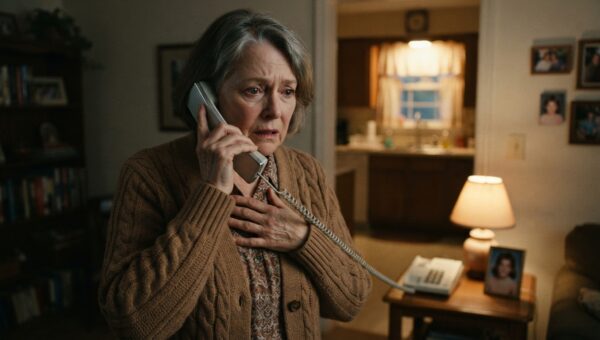
My heart gave a heavy, stupid thud against my ribs, right where the surgical corset was supposed to go next Tuesday. I could hear someone breathing on the other side of that wooden door, shallow and careful, the way people breathe when they are standing outside a courtroom waiting to hear the verdict.
“Is she coming?” I asked. My throat felt dry as a corn husk.
Martha looked at me with those old, tired eyes that had seen too many family fights in hospital waiting rooms to care about the polite fiction of keeping secrets. She crossed her arms over her white volunteer smock.
“She’s walking down the hall right now,” Martha said. “You wanted this, Marianne. Now you’ve got it.”
The shoes stopped just outside my door. I knew those shoes weren’t Martha’s clogs; they had a softer step, lighter and quicker, the walk of a woman who spends ten hours a day on her feet helping strangers bend their knees and straighten their backs. The shadow fell across the linoleum floor first, long and dark under the fluorescent strip lights overhead. Then the handle turned with a dry click.
Chloe didn’t look like the sixteen-year-old girl who had walked out into the sleet with a pocketful of crumpled bills. She was thirty–three now, her dark hair pulled back into a neat clip with a few gray strands catching the light near her temples, wearing a pressed set of navy blue scrubs with her name embroidered on the pocket in white thread: *Chloe Miller, DPT*. She looked at the steel bed, she looked at the clipboards on the rolling tray, and finally her eyes landed on my face. She didn’t smile, and she didn’t drop her head. She just stood there with her hands resting on the pockets of her jacket, holding herself together with a stillness that scared me more than any shouting match ever could.
“They said you needed an L-four fusion,” she said. Her voice was lower than I remembered, deeper in her chest, but it had that exact same stubborn flatness that she must have gotten from my side of the family.
“They want forty-four thousand for it,” I said, and as soon as the words left my mouth I felt like an absolute fool for talking about money when my daughter was standing five feet away after seventeen years of nothing.
Chloe walked two steps into the room, stopping beside the metal IV pole. She didn’t reach out to touch my hand, and she didn’t pull up a chair. She looked down at the chart on the rolling table, her finger tracing the edge of the blue intake cover where Martha had left it.
“I have two boys,” she said, her voice dropping so low I had to strain to catch the syllables over the hum of the wall heater. “Lucas is six and Toby is four. They like to climb on everything in the backyard. Every time they get near the old stone wall by the garden, my stomach just drops right out through my shoes.”
I swallowed hard, feeling the dry heat of the room catch in my throat. “Do they… do they fall?”
“Sometimes,” she said, and for a second a tiny, bitter shadow crossed her mouth. “Kids fall. That’s what they do when they’re learning how to be in the world. You don’t leave them in the dirt when they do it, though. You pick them up and check their bones.”
The silence in that little hospital room got very heavy then. It wasn’t the quiet of an empty house where you can pretend nobody else exists; it was the quiet of two people sitting on opposite sides of a deep ditch, measuring the distance with their eyes and wondering who was going to build the bridge first. I looked at her hands resting on the edge of the rolling tray. Her fingers were long and strong, with clean nails and no rings except for a simple gold band on her left hand. Those were the hands of a woman who spent her days pushing against stiff joints and teaching broken bodies how to stand up again. And I had spent seventeen years dusting a set of empty bedposts because I was too proud to admit that I was scared out of my mind when my boy hit the ground.
“I left your room the way it was,” I whispered, and the confession just slipped out before I could stop it. “The blue sheets. The books. Even your old winter coat hanging on the back of the door.”
Chloe closed her eyes for half a second. When she opened them, her chin was trembling just a little bit, though she caught it right away.
“You should have cleared it out years ago, Mom,” she said, and hearing that word after all this time felt like someone pressing a hot iron against an old scar. “It was just a room. I haven’t lived in that house since I was sixteen.”
“I know,” I said. “I know you haven’t.”
She stood there for a long moment, looking at the gray wool blanket I had pulled up to my chin. Then she reached down and picked up the hospital cost estimate, turning the page to look at the surgeon’s notes. Her professional mask came back down over her face, smooth and practiced, the way it must look every time she walks into a room full of strangers who need her help to walk again.
“The surgery is scheduled for Thursday morning at seven,” she said, her voice businesslike and steady again. “Dr. Vance is good. He did my supervisor’s knee last winter. You’re going to hate the physical therapy on Friday, because you’re stubborn and you won’t want to bend your knees, but I’m assigned to the outpatient recovery wing this month. I’ll be the one making you walk down the hall whether you want to or not.”
My breath hitched, and I felt the first real tear I’d shed since the day she left hot against my cheek. I reached out a shaky, blue-veined hand toward her sleeve, not quite daring to touch the navy fabric.
“Are you… are you coming back after?” I asked.
Chloe looked down at my hand for a long time. She didn’t pull away, but she didn’t take my fingers either. She just let her breath out in a long, slow sigh that sounded like the wind shifting through the trees outside the kitchen window back home.
“My husband is bringing the boys over to my office on Sunday afternoon,” she said quietly, her eyes fixed on the metal IV pole between us. “They’ve been asking why I have a mother when they only ever met my aunt Helen. I told them we’d see.”
She turned toward the door, her rubber-soled shoes squeaking softly against the polished linoleum. Right before she pushed the door open, she looked back over her shoulder, her face softening just enough for me to see the little girl who used to sit on the porch steps reading paperbacks until the sun went down.
“Get some rest, Marianne,” she said. “We’ve got a lot of walking to do next week.”
When I finally got discharged ten days later, the ride home in the back of the town car smelled like peppermint air freshener and cold leather. The house was too quiet when I walked through the front door with my aluminum walker clicking against the hardwood in the hall. I didn’t go into the kitchen first. I walked straight down the narrow hallway past the linen closet until I reached the closed door at the end.
The blue bedroom didn’t look like a shrine anymore by the time I finished with it on Tuesday afternoon. The mattress was rolled up and hauled out to the curb for the county truck, and the maple bed frame was taken apart and stacked in the garage beside the lawnmower. The walls were still that pale, watery blue under the afternoon sun, but the boxes of old school books were taped shut and piled against the closet wall, ready for the thrift store down by the tracks. In the corner, where the maple dresser used to sit, there was just an empty square of floorboards where the dust hadn’t settled yet.
On Sunday morning, the doorbell rang right at two o’clock. My legs were still stiff from the metal brace, and every step I took felt like walking on broken glass, but I made it to the entryway before the second ring. When I pulled the heavy wooden door open, Chloe was standing on the porch with a small boy holding onto each side of her navy cardigan, their little faces flushed from the cold autumn air. Lucas had my chin, and Toby had his mother’s stubborn dark eyes.
They stood there on the porch where the cedar boards had been replaced back in the summer of 2011, right where the old drop had happened seventeen years ago. Nobody said anything about the past or the blue walls or the dry cleaner bills. Chloe just looked down at my feet to make sure I wasn’t leaning too hard on the aluminum frame, and then she stepped past me into the warm hall, pulling her boys along behind her.