The fluorescent lights in the surgical waiting room at St. Anne’s Hospital hummed with a low, tinny vibration that got right behind my eyes and stayed there. It was 3:42 in the morning on a Tuesday, exactly sixteen years and two months after I had held my newborn son in this very building, and my chest felt like it was being squeezed in a vise.
My sixteen-year-old boy, Leo, was down the hall with a scalpel inside him because his appendix had decided to rupture right in the middle of a heavy algebra homework session.
The surgeon had come out fifteen minutes earlier looking tired, wiping a streak of dried saline off his forehead with the back of his bare wrist. He had stopped three feet from my chair, holding a metal clipboard against his white coat like a shield.
“We are closing him up now,” Dr. Vance had said, his voice flat and level the way doctors use when they are trying not to borrow trouble. “Everything went fine with the removal. No complications during the actual procedure. But we ran into a minor discrepancy with the pre-op crossmatch.”
I blinked through the burning grit in my eyes, just wanting to hear the word stable and nothing else. “What kind of discrepancy?”
“Well,” Dr. Vance said, shifting his weight from one foot to the other. “We typed him for a routine blood reserve just in case of any post-op dropping.
The lab ran it twice because the first reading threw an alert. They have him down as B negative.”
I let out a short, dry puff of air that was halfway between a laugh and a cough. “That is impossible. Both his father and I are O positive. My husband David gave blood twice a year at the Elks lodge, and I had my type stamped on every prenatal chart from here to the county line.”
The doctor did not nod or smile. He just held the clipboard a little tighter. “Biology is usually reliable, Mrs. Miller, but laboratory paperwork can occasionally get swapped or misread on a busy night shift.”
“It was not a lab error,” I told him, my voice dropping into that low, flat register I used when one of my high school sophomore classes started getting out of hand. “Go back and run it again.”
Dr. Vance just shook his head slightly, murmured something about checking the recovery ward, and walked away down the linoleum hallway.
David was slumped in the plastic chair beside me, his elbows planted on his knees and his face buried in his calloused palms.
He had driven us here in his truck while I held a folded dish towel against Leo’s lower right side to catch the worst of the pain. When I told him what the doctor said, David did not even look up. He just rubbed his eyes until the skin around them was bright red.
“Labs make mistakes,” David muttered into his hands. “You know how these big regional hospitals are. They process a thousand blood draws a day. Someone swapped a vial label down in the basement. It happens all the time.”
“They do not swap blood types out of thin air, David,” I said.
“Stop looking for monsters under the bed,” he whispered back, his voice thick with exhaustion. “Our boy is in recovery. His appendix is out. Let’s just go home when they let us.”
He wanted it to be a mistake because the alternative required a kind of thinking that made the floor drop out from under your shoes.
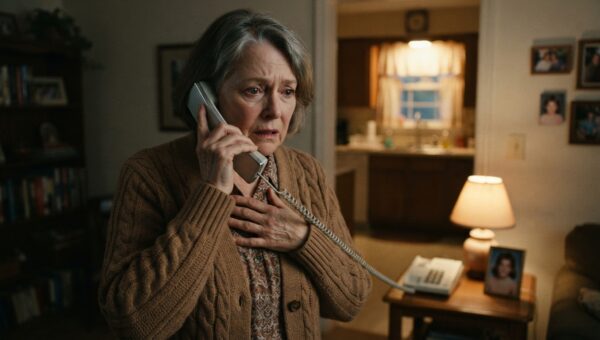
But I knew how my own body worked, and I knew what the card in the baby book said. I left David in the waiting room with his head in his hands, walked down past the vending machines to the public pay phone alcove where the signal was better, and called my sister-in-law Clara, who had kept a spare set of our old filing cabinet keys back in town.
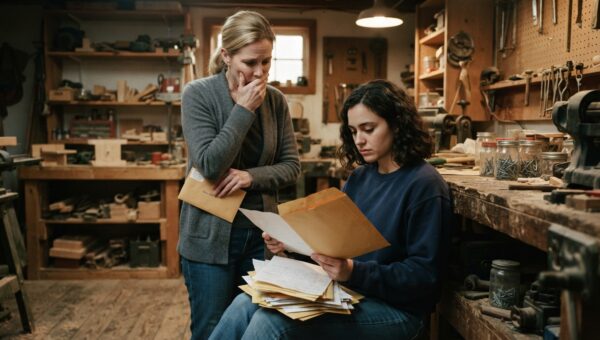
By sunrise, I had the cardboard storage box sitting right on our Formica kitchen table, spilling out yellowed pediatrician receipts, kindergarten art projects, and the heavy parchment birth certificate from St. Anne’s Hospital.
Leo was born on a Tuesday morning in 2009. The hospital record listed his birth time as 3:17 AM in Delivery Room Four. But when I opened the certified ledger copy I had ordered during our second year in this house, my thumb brushed against an attached intake sheet that I had never paid close attention to back then because everything had been a blur of gauze and painkillers.
Right below our entry, logged at 3:41 AM in Delivery Room Six, was another boy. Same attending nurse on duty. Same exhausted OB-GYN who had delivered both children during a brutal ice storm that had backed up traffic across three counties.
David came into the kitchen around seven, his hair sticking up on one side and his flannel shirt half-buttoned. He poured himself a cup of stale coffee from the pot I had brewed three hours ago, took one sip, and set the mug down with a sharp clink.
“The hospital called,” David said, leaning his hip against the counter. “Dr. Vance says Leo is waking up. He wants us back by ten.”
I did not look up from the papers spread out across the table. I tapped my fingernail against the line where the two birth entries met. “David. Look at this time gap. Twenty-four minutes. Same nurse. Same floor.”
“What are you doing?” he sighed, rubbing the back of his neck. “You are scaring yourself over nothing. It was sixteen years ago.”
“Look at the nurse’s name,” I said, pointing straight at the bottom margin. “Karen Miller. Look at her signature.”
“Common name,” he said, turning away toward the sink.
“It is not that common in a town with four hundred people,” I said, my voice rising. “And it is certainly not a coincidence that when I logged into the patient portal to check Leo’s discharge notes twenty minutes ago, I found something else.”
David stopped with his hand on the faucet. He did not turn around. “What did you find?”
“I found the 2015 database migration notes,” I said, my fingers trembling slightly as I held up my phone. “When St. Anne’s transitioned to the unified electronic health record system, the automated cross-reference algorithm flagged a severe genetic anomaly between Leo’s birth profile and our parental blood markers. A system flag was automatically generated on his digital chart.”
David turned slowly, his face tightening. “A flag? What kind of flag?”
“An identity mismatch warning,” I said. “The kind that locks a file until a supervisor verifies DNA lineage or resolves a chart conflict. But it never locked. Someone manually suppressed the warning inside the system.”
“Computers glitch,” David said, though the conviction had completely drained out of his voice. “You said it yourself. They were upgrading the whole server farm that year.”
“Computers do not type in override codes using a specific employee ID,” I said. I slid my phone across the table until it rested right against his coffee mug. “The override was executed by a senior medical records clerk. Her name was Karen Miller. And her maiden name, the name she used when she worked the floor back in 2009, was the exact same surname as the family who had a baby boy born twenty-four minutes after Leo in Delivery Room Six.”
The silence in the kitchen became so heavy I could hear the tiny hum of the refrigerator coils in the back corner. David stared down at the screen for a long time, his lips parted slightly, his eyes tracking the alphanumeric string of the employee ID as if he were trying to read a foreign language.
“That is impossible,” he whispered.
“Is it?” I asked. “Or did a tired nurse mix up two blue blankets during a snowstorm in 2009, and did her own sister or cousin in medical records catch the digital alarm bells six years later and decide to bury the file to keep from destroying two families?”
David did not answer. He pulled out the chair across from me, sat down very slowly, and picked up the 2009 hospital birth record with fingers that suddenly looked clumsy and old.
We did not go back to the hospital at ten o’clock. Instead, we drove straight to the administrative annex of St. Anne’s with a folder containing two birth certificates, a printed audit trail of a 2015 system override, and a blood test that proved the boy we had raised for sixteen years was a stranger.
When we walked into the office of the hospital’s risk management director, we did not have to raise our voices or threaten a lawsuit. We just laid the papers down on the desk in front of him, side by side with the lab printout from Leo’s appendectomy.
The director took one look at the employee ID on the 2015 override log, turned pale, and reached for his desk phone to call legal counsel before we had even finished sitting down.
Two hours later, we walked into Leo’s hospital room. He was propped up against two pillows, eating a cup of watery vanilla pudding with a plastic spoon and complaining that his stomach felt like someone had kicked him by a mule. He looked at us with those same brown eyes, eyes that did not match my green ones, and never had, no matter how many times I had convinced myself it was just a recessive trait from some great-grandfather I never knew.
“Hey,” Leo said around his spoon, his voice still thick from the anesthesia. “When am I getting out of here? Coach said if I miss Friday’s scrimmage, I am riding the bench.”
David stopped at the foot of the bed, his hand resting on the metal safety rail. He looked down at our son, our boy, the one who taught me how to tie shoelaces and helped his father haul firewood through the freezing mud, and his chin quivered just a fraction of an inch.
“We are going home soon, buddy,” David said, his voice cracking slightly on the last word.
I walked over to the side of the bed, reached down, and smoothed the thin hospital blanket over his chest. I did not tell him about the blood tests. I did not tell him about the twenty-four-minute gap in the 2009 ledger, or the woman named Karen Miller whose signature sat quietly inside a locked server room across town. That conversation was coming, and it was going to tear our lives down to the studs.
Right now, sitting on the edge of the mattress with the morning light cutting across the sterile floor, there was only the weight of the blanket, the regular beep of the monitor, and the terrifying, beautiful realization that the boy who called me Mom was entirely mine in every way that mattered, even if the blood in his veins belonged to someone else entirely.