My dad never sat with his back to a door. At a restaurant he’d switch seats till he could see the room. At home it was that one chair in the corner, always. Forty years, and you just got used to it you stop even noticing after a while. He was in the service young, over in Vietnam, and he came back different, and that was that.
You didn’t ask. Ask him about any of it and he’d get up and go find something to do. He passed this fall, seventy-eight. Heart. My mom’s gone already, so clearing out the house was on me. I saved the basement for last. That was his spot workbench, an old radio, a chair down there too, in the corner, same as upstairs. Man kept everything squared away. It made me miss him, going through it, all that quiet order. Down there against the wall was a metal cabinet with a padlock on it. And that stopped me, because nothing else in that whole house locked. Not the shed, not half the time the front door. Just this. I knocked the lock off with a hammer and a screwdriver. Opened it up. There was something standing inside, and when I lifted it out and got a real look, I had to sit down on the bottom step, because my brain kind of stopped working for a second.
It wasn’t guns. It wasn’t money or old journals from the jungle. It was a wooden box, heavy and dark-grained, built with dovetail joints that were sanded down so smooth they felt like skin. I set it on the bottom basement step and brushed a thin layer of gray dust off the lid. The air down there smelled like old paper and concrete dampness. I clicked the small brass latch, and the lid came up with a soft, dry pop. Inside, packed tight as cordwood, were things that didn’t belong to the Arthur I knew. There were photographs, all black-and-white, curled at the edges from age. There were letters, dozens of them, some in yellowed envelopes and others written on cheap, lined paper. And right on top, resting in a nest of faded green cloth, was a child’s silver locket with the chain broken clean through.
I picked up the top photograph. It showed a young woman standing outside a thatched hut somewhere in the delta, holding a baby against her hip.
She wasn’t looking at the camera. She was looking off to the side, laughing at something just out of frame, her hair catching the bright sun. My dad’s handwriting was on the back, neat and small like it always was. He wrote, “Hanh and little Linh. April 1969.” I turned it over and stared at the date. That was three months before he shipped home. That was the year before he started sitting with his back to walls.
Three weeks earlier, I had been standing in the kitchen while Dad complained about the price of beef. He was seventy-eight then, his hands spotted with age, but he still moved with that stiff, careful precision that never left him. He had pointed a butter knife at me and said, “You check the locks before you go? People get careless.” I had laughed it off like I always did, telling him nobody was breaking into our sleepy little Texas town.
He just grunted and looked out the window toward the front walk. “You don’t know who’s out there,” he muttered. I thought it was just old-man paranoia, the lingering static of a war he refused to name. Sitting on that basement step with the silver locket in my palm, the sound of his voice echoed in my head, and the pieces didn’t fit anymore. He wasn’t guarding himself against an intruder. He was guarding himself against a memory.
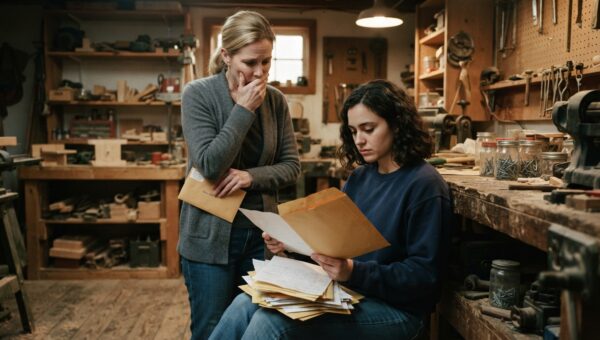
I pulled out the letters next. Most of them were addressed to various organizations I didn’t recognize right away. American Red Cross locator branches, international refugee committees in Geneva, veterans’ affairs offices in Washington. Some were carbon copies typed on a manual typewriter with smudged ribbon ink. Others were handwritten on legal pads. I unfolded one dated from 1984, fifteen years after he came home. Dear Sir, it began. I am writing to inquire about the status of civilian search files for village clusters near the Rach Kien area. I served as a sergeant with the Ninth Infantry in sixty-nine. I am trying to trace the whereabouts of a family displaced during operations in March of that year. The letter went on for two pages, detailing names, a specific village grid, and physical descriptions down to a small scar on the mother’s wrist. It was signed simply, Arthur Miller.
I didn’t know he could write like that. The father I grew up with spoke in grunts and short sentences. If something needed fixing, he fixed it without talking. If dinner was quiet, we sat in silence and listened to the radio. He never talked about Vietnam, not to me, not to my mother. Once, when I was twelve, I found a brass compass in his drawer and asked if he used it in the war. He took it out of my hand, closed the drawer, and told me to go outside and mow the lawn. That was the end of it. Yet here, in these papers, he had spent decades pouring his heart out to faceless bureaucrats across the globe, begging for scraps of news about people most American soldiers were taught to forget.
I kept digging through the box. Beneath the letters were receipts from international aid groups, yellowed slips showing monthly donations sent overseas under a pseudonym that used his mother’s maiden name. For thirty years, he had been sending money to an orphanage in Saigon. Month after month, year after year, long after the war faded from the evening news and everyone else went back to normal. He never bought a new truck. He drove that faded blue Ford until the transmission gave out in ninety-two. He wore his clothes until the elbows wore thin. Every spare dollar he didn’t spend on our modest house had been funnelled across an ocean to kids who lost everything because men with guns walked through their rice paddies.
The next document was a carbon copy of a reply letter from an aid worker dated 1978. It was brief and brutal in its administrative coldness. Dear Mr. Miller, we regret to inform you that civilian displacement records from that district during the 1969 conflict are largely incomplete. Relocation camps were frequently overrun or abandoned. We have no record of Hanh Nguyen or her child. We wish you peace in your continued efforts to reconcile your service. Reconcile your service. That phrase sat there on the onion-skin paper like a branding iron. I folded the letter back up and my hands were shaking. My dad wasn’t broken by malice or anger. He was broken by a profound, unyielding grief that he had no language to express.
I thought about his habits. The way he checked every door twice before he went to bed. The way he never sat where anyone could approach him from behind. It wasn’t about fear of being attacked. It was about hyper-vigilance born of a terrible afternoon when safety failed completely. He had seen a world where families could be erased in twenty seconds, and he spent the rest of his life trying to balance the scales by himself, in the dark, behind a locked metal cabinet in a Texas basement.
The bottom of the wooden box had a false panel. I only found it because the grain didn’t match the sides, showing a slight gap where a thin piece of cedar had been glued into place. I slid my fingernail under the edge and popped it free. Inside lay a single composition notebook with a black-and-white marbled cover. The binding was cracked, and the pages were filled with his tight, precise handwriting. I opened it to the first page, dated March 14, 1969.
The entry started mid-thought. “We cleared the treeline at dawn. The village was already empty except for the one house near the well. I told the lieutenant we should check the root cellar. He said move on. I didn’t push hard enough. I should have pushed. When we came back through that evening, the roof was gone and the well had caved in. Found her under the thatch. Little girl was breathing when I pulled her out, but she didn’t make it to the chopper. Hanh looked at me before she closed her eyes. She didn’t scream. She just looked.”
The entry stopped there. There was nothing else on that page. I flipped forward through the book, but the rest of the pages were blank, forty years of empty paper waiting for words that never came because the weight was too heavy to write down twice.
I sat on the bottom step for a long time. The furnace kicked on somewhere overhead, a low, comforting hum that rattled the ductwork. Up until that minute, I had seen my father as a monolith of quiet endurance, a man of stone who didn’t feel things the way normal people did. Now I looked at the photograph of Hanh and the little girl in my hand, and I realized I had never really known him at all. He had carried that family across the Pacific in his chest every single day of his life, waking up in a warm bed in Texas while a piece of his mind stayed stuck in a muddy village twenty years before I was born.
My phone buzzed in my pocket, startling me in the quiet. It was my sister asking if I was almost done clearing the basement so we could list the house. I looked at the screen, then down at the wooden box. “Give me another hour,” I told her. “I found some personal papers.” She didn’t ask what kind. Nobody ever asked Dad anything about the past, and that habit had rubbed off on all of us.
I stood up, my knees stiff from the cold concrete. I didn’t put the box back in the metal cabinet. Instead, I carried it over to the workbench, cleared away a circle of dust, and laid the papers out flat. I went through every letter one more time, noting the names of the relief agencies, the case numbers, the specific districts mentioned in the 1984 inquiries. If my father spent forty years looking for a thread to connect him back to that moment, the least I could do was see where those inquiries ended.
An hour later, I had packed the wooden box into a cardboard carton alongside my dad’s old service medals, which I found tucked away in a cigar box behind the workbench. Those medals had stayed hidden away too, polished once and then forgotten. But the archive of a civilian family from halfway across the world had been kept close, locked away behind steel where nobody could stumble on it by accident.
I walked back over to the metal cabinet. The door swung open on its hinges, empty and dark inside. The latch hung crooked where I hit it with the hammer. I didn’t fix it. I left the door wide open for the first time since my dad put that padlock on it back when I was still in grade school.
Carrying the wooden box up the basement stairs felt different than carrying trash out to the bin. Each step felt heavier, not because the box weighed much, but because of what was inside it. I set it down on the dining room table right under the afternoon sun streaming through the window. The dust motes danced in the light, settling across the dark wood and the silver locket.
I pulled out my phone and started searching online for Vietnamese-American heritage groups in Houston, places that helped bridge the gap for families separated by the war. There were organizations run by second-generation kids who specialized in tracking down old records and reuniting lost archives with surviving relatives. It was a long shot, maybe an impossible one after all these decades, but looking at my dad’s handwriting on those carbon-copy letters, I knew he wouldn’t have wanted the paper to die with him in a dark basement.
The house was completely silent now, save for the ticking of the kitchen clock. I opened the front door and stepped out onto the porch, breathing in the dry Texas air. For forty years, my father sat inside watching the door, waiting for something he lost in a field across the world to finally come home. He never found it. But standing there in the sunlight with the front door wide open behind me, I figured it was time someone else took up the watch.