The paring knife was old, its wooden handle worn down to a dull, gray stub where my thumb had rested every October for thirty-eight years. I was peeling a honeycrisp at David’s kitchen island, listening to the refrigerator hum its dull little tune, when my son finally decided to look up from his glowing screen long enough to tell me where I’d be sleeping for the holidays.
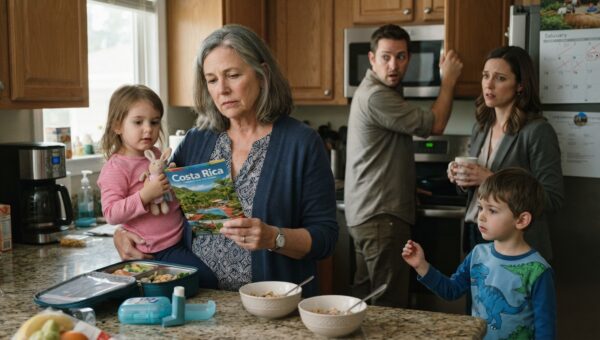
“We’re putting a cot out in the caretaker’s cottage for you, Mama,” David said, his eyes already drifting back to whatever spreadsheet or stock ticker was eating his afternoon. “It’s just for four days. Arthur’s father has that bad lumbar disc, and he needs the main floor guest room. You understand. It’s close to the heater.”
The cottage hadn’t had a working wall furnace since the winter of 2014. The floorboards were tongue-and-groove pine that let the damp up from the creek bed like a wet sponge, and the single window didn’t latch right unless you jammed a folded matchbook into the frame.
I didn’t drop the apple. I didn’t yell. I just kept turning the fruit, letting the red skin curl away in one long, unbroken ribbon until the white meat showed.
“Forty of Chloe’s relatives are driving up from the Philadelphia suburbs on Wednesday,” David added, as if he were reading off a packing manifest for a shipping firm. “Her sister is bringing the gluten-free pies, so you don’t need to worry about baking.
Just keep out of the mudroom when they arrive. Chloe wants the entryway clear for the coat racks.”
Back when my husband Arthur was still here, before the hospital bed took over the downstairs parlor and the medical bills ate through our savings like termites in an old hickory beam, this house had meant something else. We built these counters ourselves out of white oak from the lower timber lot. We didn’t have granite or stainless steel back then. We had rough hands, three local guys from the hardware store, and a mortgage that kept us awake until midnight every single month. David grew up running barefoot through that very orchard out back, stealing green apples that gave him a stomachache every single time, swearing up and down he’d never leave the valley.
Now he sat there in a tailored wool-blend sweater that probably cost more than my first pickup truck, looking at me like I was a piece of inherited furniture he needed to drag out to the curb for bulk trash pickup.
“Your father’s apples are coming in early this year,” I said quietly, setting the peeled apple down on the wooden board.
“Yeah, well, things change, Mama,” he muttered, tapping the trackpad. “Agriculture isn’t a retirement plan anymore.”
That was when I saw the cardboard box sitting half-hidden behind the espresso machine.
It was one of those heavy-duty shipping crates from a commercial linen supplier in Harrisburg. The packing tape had been sliced open with a box cutter, revealing a stack of stiff, brilliant white cloth napkins folded with military precision. I reached out, pulled the top one free, and ran my thumb over the gold embroidery stitched right into the corner.
Founder’s Table.
The name didn’t belong to any local church group or grange hall I’d ever heard of in fifty years of living in this county. It sounded like something you’d see on the menu of a steakhouse in downtown Pittsburgh where they charge forty-two dollars for a pork chop smaller than my palm.
“What’s this?” I asked, holding the napkin up toward the light of the pendant lamp.
David stiffened. Just for a second, his shoulders went rigid under that expensive sweater, his fingers freezing over the keys. Then he let out a short, forced breath that sounded like a dry tire leaking air.
“Corporate retreat stuff,” he said, not turning around. “Chloe’s firm is doing a branding event next month. We’re holding a tasting dinner here. It’s just networking, Mama. You don’t need to worry about it.”
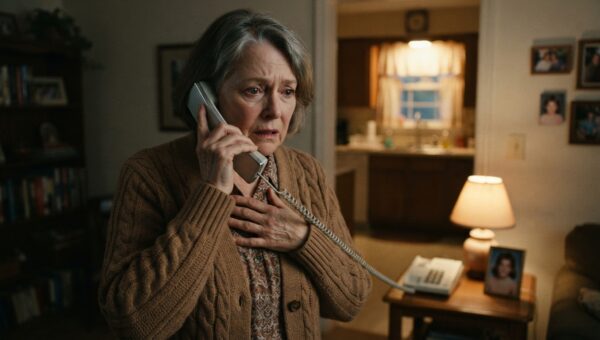
Before I could ask why a corporate branding event needed forty custom napkins delivered to my kitchen, the landline on the wall mounted by the pantry began to ring. It was an old wall-mount bell with a brass ringer that always made Arthur jump whenever it went off during supper. David didn’t move to answer it, so I reached out and lifted the heavy black handset.
“Mrs. Callahan?” a sharp, clipped voice asked before I could even say hello. “This is Marcus Vance over at First Liberty Commercial. I’m calling to confirm the updated land valuation on parcel four-b, specifically regarding the resort footprint and the agricultural lease reversion waiver signed on the fifteenth of last month. We’re finalizing the title insurance rider today.”
The kitchen seemed to tilt just a couple of degrees, like a canoe taking on water over a hidden rock.
“What resort footprint?” I asked, my voice sounding smaller than I meant it to.
There was a long, heavy pause on the other end of the line, the kind of silence where you can hear the hum of copper wires crossing three counties.
“Oh,” the banker said, his tone shifting from professional briskness to sudden, cautious hesitation. “I assumed Mr. Callahan had walked you through the partnership structure. The sixty-acre orchard tract transferred into the Founder’s Table Hospitality LLC portfolio for development. Your signature is right here on the rider as primary land contributor.”
My fingers tightened around the plastic receiver until my knuckles turned the color of lard.
“My signature,” I repeated.
“Yes, ma’am. Witnessed and notarized digitally on the sixteenth. Now, if you could just verify that your tax ID, “
I didn’t let him finish. I hung the phone back up on its cradle with a sharp, hollow click that made David finally swivel his chair around to face me. His face wasn’t pale. It was flushed, dark around the ears where he always got red when he was lying about something in middle school.
I walked over to his laptop, reached right past his arm, and woke the screen with a tap of my fingernail.
There it was. Right on the desktop. A folder labeled *Resort_Phase 1_Final*. Inside it were PDF scans of deeds, municipal zoning variances, and architectural renderings of a massive timber-and-glass lodge sitting right where the old cider press and the Jonathan apple rows had stood since my grandfather’s time.
I opened the document titled *Lease_Reversion_Waiver_Signed*.
At the bottom of the page was my signature. Every loop of the *C*, every shaky cross of the *t*, down to the little upward hook at the end of my maiden name that I’d used since I was nineteen years old. It looked like me. It was me. Except I had never signed that piece of paper in my life.
I scrolled down to the metadata box in the corner. Created by David Callahan. Source file scanned from a 1999 tractor equipment lease Arthur had signed twenty-five years ago. Pixel for pixel, stroke for stroke, lifted right off an old piece of yellowed parchment sitting in our metal filing cabinet in the basement.
“You copied it,” I said. My voice didn’t shake. That surprised me. It sounded like an old church bell struck with a hammer, flat, heavy, and completely dead.
David stood up then, his chair legs screeching against the wide-plank oak floorboards we’d laid down the year he lost his first tooth.
“Don’t look at me like that, Mama,” he said, his hands coming up in that defensive, pleading gesture he used to use when he broke a window with a baseball and tried to blame the neighbor’s kid. “The bank wouldn’t touch the development loan without unencumbered title. You were going to sign it anyway. We talked about this ages ago.”
“We never talked about this,” I said.
“You don’t understand how commercial real estate works!” His voice cracked, rising into that high, desperate register that always meant he was losing control of a room. “An orchard doesn’t pay the property taxes anymore! Nobody buys fresh cider from old ladies in station wagons! Chloe’s father brought in the investors. We’re getting a thirty percent equity stake in the hospitality group. We’re modernizing the family name, for God’s sake. You should be thanking me for dragging this place out of the last century.”
Before I could answer, the front door swung open with a bright, cheerful bang that echoed through the hallway.
“David, darling?” Chloe’s voice chimed from the mudroom, followed by the heavy thud of designer shopping bags hitting the bench. “Did the linen delivery arrive? My mother is insisting on charcoal gray place cards, but I told her the gold embroidery on the Founder’s Table napkins matches the autumn scheme much better. Oh, hello, Eleanor. You’re still here?”
She walked into the kitchen wearing a camel-hair coat that looked like it cost more than our annual fertilizer budget, holding a takeout cup from the artisanal coffee shop down in the county seat. She took in the scene, me standing by the laptop, David looking like a boy caught with his hand in the church collection box, and her smile didn’t drop so much as it hardened into something sharp and cold.
“Is there a problem?” she asked, looking at her husband. “We have the caterers coming to walk the grounds at four. The grading crew starts on the lower block on Monday morning, David. You told me the title clearance was 100 percent locked.”
“It’s locked,” David muttered, wiping a bead of sweat from his upper lip. “Mama just… she’s having a hard time adjusting to the timeline.”
I didn’t look at Chloe. I didn’t look at her coat or her coffee cup or the way she was already tapping her fingernail against her leather handbag, as if we were keeping her from an important dental appointment.
I picked up the wall phone again, ignoring the modern cordless sitting on the counter, and dialed three numbers from memory that I hadn’t had cause to use since Arthur drew up his final will six months before he passed.
“Thomas?” I said when the receiver picked up on the third ring down at the firm on Main Street. “It’s Eleanor Callahan. I need you to drive out to the homestead right now. Bring the original 1984 deed, a fraud affidavit, and whatever paperwork you need to freeze an active corporate filing at the state registry.”
Thomas didn’t ask questions. He’d known Arthur since they played little league behind the old grain elevator.
“On my way, Eleanor,” his gravelly voice came back through the static. “Ten minutes.”
David lunged forward then, his hand shooting out to grab the phone from my grip, but I dropped the handset back onto the metal hook before his fingers could brush the plastic. The cord swung back and forth against the wall like a small pendulum.
“You can’t do that,” David whispered, his face finally draining of all color, the flush turning into a sick, grayish pallor. “The investors have already wired the earnest money. The zoning board signed off this morning. If you blow this up now, we’re on the hook for four million dollars in default penalties.”
“Then I suggest you start packing your bags for the caretaker’s cottage,” I said, picking up my paring knife and the half-peeled apple from the board. “Because the water’s off out there, the heater doesn’t work, and you’re going to need all four days to get your things off my land before the sheriff serves the eviction notice.”
Chloe let out a sharp, incredulous laugh, her voice climbing an octave. “You can’t evict us! We live here! We have a signed agreement, “
“You have a digital forgery of a dead man’s lease attached to a corporate shell that doesn’t own a single blade of grass,” I told her, finally turning my eyes square onto hers. “And Thomas is bringing the state police liaison with him because mail fraud and signature duplication are felonies in this commonwealth, last I checked.”
The kitchen went dead silent. Not the quiet of a peaceful afternoon, but the heavy, suffocating silence of a house settling onto a foundation that had just cracked right down the middle.
Outside the large picture window over the sink, the afternoon sun was dipping low behind the ridge, casting long, dark shadows across the rows of apple trees my husband had planted with his own two hands back when we were young enough to believe the world was fair. The wind picked up just enough to rattle the loose pane in the pantry window, a dry, rhythmic tap that sounded like someone knocking on a door they knew nobody was going to open.
I didn’t say another word. I walked over to the table, picked up my apple, and walked down the hall toward the front porch to wait for Thomas’s sedan to turn into the gravel drive, leaving them standing there in the middle of their thousand-dollar linens with nowhere left to hide.