Me and my brother Wayne barely spoke the last five years he was alive. Never really knew why. We were tight coming up, back when summers smelled like hot pine needles and wet canvas on the lake, and we hunted together every deer season without fail. Every Sunday after church we split a booth at the Cracker Barrel over eggs and country ham, jawing about local politics or whatever junker truck we were trying to keep running.
Then somewhere along the way he just backed off. Quit calling. Made excuses at Thanksgiving when mama’s dressing was sitting right there on the table. I figured I’d done something to tick him off, but whenever I asked, he just muttered that he was busy.
He passed last month. Fifty-nine years old, his heart just gave out while he was sitting in his armchair. No wife, no kids, so it fell on me to drive down to Sapulpa and clear out his rental house before the landlord took the keys back. Took me a couple of days and it broke me how little there was. His whole life fit right there in the bed of my F-150 with room to spare. His VFW cap hanging on a wall hook by the door. A drawer full of unpaid medical bills in the kitchen, which told me plenty right there about how he’d been living.
In the bedroom closet, shoved back behind a stack of old flannel shirts, there was a metal cabinet with a heavy brass padlock on it. Everything else of his was just sitting out in the open, unlocked and dusty. Only thing locked in the whole house. Part of me didn’t want to know what was in there. But the landlord wanted the place cleaned out by the first of the month, so I walked out to the truck, got the bolt cutters, and came back inside. I squeezed the handles until the metal snapped with a loud ping. I opened it up, pulled the steel door back, and stood there for a long time just looking. And then I started reading.
The silence between us hadn’t been about a fight. It hadn’t been because he was mad at me for something stupid I said over coffee or during deer season.
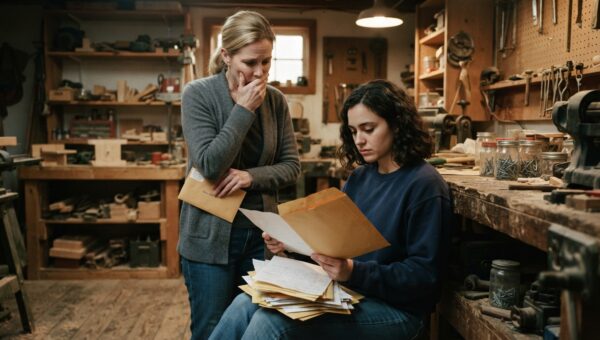
The bills in the kitchen were just the beginning. Inside that cabinet were hospital folders with dates going back exactly five years. That was the exact week he stopped answering my phone calls. That was when he started telling me he was too busy to come down for Sunday dinner.
The diagnosis was written out in clean, sharp medical print on letterhead from a Tulsa cardiology clinic. Congestive heart failure, progressive and severe, with a prognosis that didn’t leave much room for guesswork. Wayne had known right down to the month how much time he had left. Instead of telling me, instead of letting me drive him to his appointments or help him pay for the pills that cost more than my mortgage payment, he built a wall around himself so high nobody could climb it.
I pulled out a stack of manila folders tied together with old twine. Inside were newspaper clippings of my kids, his niece and nephew, cut out from the local paper whenever they won a track meet or made the honor roll.
He didn’t call to congratulate them because calling meant having to talk, and talking meant risking his voice cracking. There were photos of our old hunting trips, too, marked with precise dates on the back in his neat, blocky handwriting. Cracker Barrel receipts from years back, flattened out like bookmarks.
And then I found the letters. There were six of them, all folded up neatly and tucked inside unsealed envelopes with my name written across the front. He never mailed a single one. I sat down right there on the dusty floorboards of that empty bedroom with the afternoon sun slanting through the bare window, and I opened the top envelope. Wayne’s handwriting was shakier in these than it was on the photo backs.
“Clifford,” he wrote in that plain, stubborn way he always talked. “If you’re reading this, it means I finally ran out of clock. I’m sorry I stopped picking up your calls. You always were too good at fixing things, brother, and I knew the second you saw me hooked up to tubes or moving slow, you’d try to fix me too. I couldn’t bear the thought of you watching me shrink down to nothing. I wanted you to remember us sitting in that booth sharing a plate of biscuits, not wiping my chin or paying my nursing home tab. It wasn’t about you. It was about pride, I guess, or whatever you want to call the stubborn streak our daddy passed down to both of us.”
I sat there on the floor for a long time holding that piece of paper. The house was dead quiet except for a dog barking somewhere down the street. My chest felt tight, like someone was tightening a strap around my ribs. He had spent five whole years living three towns over, dying a little bit every day, and he didn’t let me say goodbye because he was trying to save me the trouble of watching him go. That wasn’t brotherly love written in a storybook style; that was a hard-headed, old-school kind of love that hurt worse than a punch to the jaw.
At the very bottom of the cabinet, beneath the medical files and the unsent letters, sat a small piece of carved cedar. It was a wooden mallard duck, sanded smooth with a pocketknife, the kind we used to set out in the reeds when we were boys. He had carved the eyes with a hot nail and painted the head green with some old model paint he must have had laying around in the garage. There was no note attached to the duck, but it didn’t need one. It was the decoy we lost down on the river back in ’88, the one we spent half an afternoon looking for before giving up as the sun went down. He must have carved a new one just to have it sitting there.
I packed the letters and the wooden duck carefully into my canvas duffel bag alongside the VFW cap. When I loaded everything into the back of my F-150, the bed looked even emptier than it had before. The drive back home took two hours on the two-lane highway, the engine humming a steady rhythm against the pavement while the sun dipped low behind the tree line. When I pulled into my driveway, I didn’t go inside right away. I sat out on the tailgate in the quiet evening air, turning that little wooden duck over and over in my hand while the wind rustled through the oak trees out back, feeling the ghost of every deer season we ever shared settle right down beside me.