The lid always clicked shut with a specific, hollow snap that meant it was airtight. Mom had forty-two of them, stacked by size in the narrow pull-out drawer next to the stove, and if you brought one back home with a tomato stain on the rim, she’d look at you over the top of her reading glasses like you’d tracked mud across an altar.
Every single Sunday at six in the evening, the routine was as fixed as the tides. My phone would buzz against the kitchen counter, the family group chat would light up, and there it would be in plain text. Dinner at 6. Bring tupperware.
She had done it every week for ten years since Dad passed away in the brick-front colonial on Maple Street. It was her anchor and ours, a quiet way of making sure my brother Leo and I were still eating vegetables and showing up where we belonged. So when my phone buzzed at 10:00 a.m. on a bright, hazy Sunday in late September, I didn’t expect anything out of the ordinary. I figured she was reminding us about the pot roast or telling us to pick up extra rolls from the bakery down on 4th Street.
Instead, the screen lit up with a message that made my coffee cup freeze halfway to my mouth.
PLEASE DON’T COME TODAY. No punctuation other than the caps. No smiling emoji with the sunglasses she usually put at the end of every sentence to soften her commands. Just those five blunt words sitting in the middle of the screen like a brick dropped on glass.
I stared at it for three seconds. Then I tapped her name and hit call. It rang twice straight to voicemail, which was impossible because Mom kept her phone glued to her apron pocket or sitting right beside her silver-handled butter knife on the kitchen table.
I texted back immediately. Is everything okay? Do you need groceries?
Read at 10:02 a.m. No reply.
I don’t even know why I remember the exact minute, but the microwave clock said 10:03 when my phone buzzed again, this time with a text from Leo. I called Mom but she doesn’t pick up, his message read. Have you talked to her?
I texted him back instantly. She just told me not to come today. Call her landline.
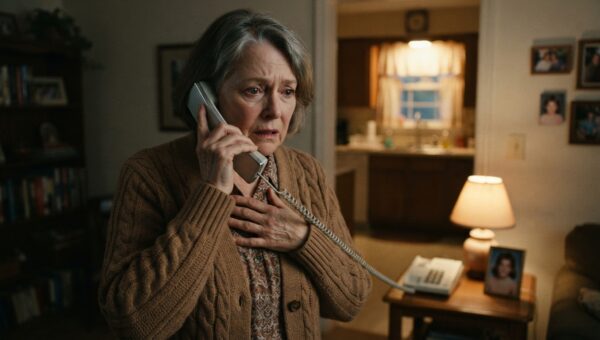
A minute later, Leo called my cell. His voice was tight, high in his throat the way it got whenever one of our kids scraped a knee or the car started making that grinding sound on the interstate. “She’s not answering the landline either,” he said, and I could hear the faint hum of his truck engine in the background. “She always answers the landline, Clara. Even when she’s out in the garden with the portable.”
“Maybe she’s at the hardware store,” I said, though I knew damn well Mom didn’t go anywhere on Sunday mornings before church let out. “Maybe she ran out of flour.”
“At ten in the morning on a Sunday?” Leo snapped. “When the pot roast has been marinating since Saturday night? Come on. I’m five minutes away from her street. Meet me there.”
The drive from my apartment to Maple Street usually took twelve minutes, but that morning every stoplight seemed stuck on red and every Sunday driver was moving like they were wading through wet cement. My hands felt slick against the steering wheel, and my foot kept pressing down harder on the gas until the little sedan groaned at sixty in a thirty-five zone. I kept seeing that flat, capital-letter text flashing behind my eyelids. PLEASE DON’T COME TODAY. It didn’t sound like Mom. Mom gave instructions; she didn’t issue warnings from behind a closed door.
When I turned onto Maple Street, Leo’s truck was already idling half-parked in the driveway, its front tires crooked against the curb. I killed my engine before the car had even finished rolling and jumped out, my keys already digging into my palm.
Leo was standing on the narrow concrete porch, his fist hammering three quick times against the heavy oak front door. “Mom!” he shouted, his voice cracking slightly on the syllable. “Mom, open up!”
The house was dead silent. No television murmuring in the den, no radio playing the local church broadcast, not even the faint hiss of the sprinkler on the side lawn. Just the cicadas buzzing in the oak trees overhead and the heavy, humid autumn air pressing down on the roof.
“Did you try the side window?” I asked, rushing up the steps and shoving past him.
“It’s locked tight,” Leo said, his face already pale under his farmer’s tan. “Every single one of them. I checked.”
I didn’t waste time knocking. I reached into the zippered pocket of my purse, pulled out the heavy brass spare key Mom had given us the winter she slipped on the ice by the mailbox, and shoved it into the deadbolt. It turned with a dry, metallic click that sounded far too loud in the quiet morning.
I pushed the door open, the heavy wooden panel gliding smoothly over the entryway rug, and I screamed when I saw her.
Mom was lying sideways across the narrow hallway floor just past the coat rack, her left arm twisted awkwardly beneath her hip and her fingers curled tight around the edge of a white linen kitchen towel. Her head was tilted back toward the baseboard, and her eyes were open, fixed on the ceiling with a cloudy, unfocused stare that made my breath catch in my throat.
“Leo,” I choked out, stumbling backward into his chest before I could catch my balance. “Leo, call 9-1-1. Now.”
He didn’t ask questions. He shoved past me into the narrow corridor, dropping to his knees beside her with a dull thud against the hardwood. “Mom?” he whispered, his big calloused hand hovering over her shoulder as if he were afraid to break something fragile. “Mom, can you hear us? Clara, look at me.”
She didn’t move her head, but her lips parted with a faint, dry rasp, and a tiny bubble of air escaped her mouth. Her eyelids fluttered once, slow and heavy, like she was trying to fight through a thick wall of cotton. Her right hand twitched against the floorboards, scraping the white towel another inch toward the kitchen doorway.
“I’m calling,” Leo muttered, pulling his cell phone out with shaking fingers while his other hand reached down to gently touch her wrist. “Stay with her. Just talk to her.”
I dropped down onto the cold wood beside him, ignoring the dust and the stray lint balls near the baseboard. I reached out and took her other hand, and the skin felt dry and cool, like paper left in the shade. Her fingers didn’t squeeze back, but when I pressed my thumb against her knuckles, a low, frustrated groan rattled deep in her chest.
“We’re right here, Mom,” I said, and my own voice sounded small and terrified, like a child’s voice echoing in an empty room. “Leo’s here. I’m here. You’re okay.”
She tried to turn her face toward me, but only her chin moved. Her mouth worked silently for a second before a single, rough sentence dragged itself out of her throat.
“The… stove,” she whispered, the words thick and slurred on the left side of her mouth. “Turn… off…”
That was all she managed before her eyes drifted closed again, her breathing settling into a slow, heavy rhythm that sounded like someone pulling a saw through damp pine.
Within six minutes, the quiet of Maple Street was torn apart by the rising wail of an ambulance siren. Red and blue lights flashed across the white lace curtains in the front window, painting the living room walls in shifting neon streaks as two paramedics in navy blue jackets came through the front door with heavy equipment cases banging against their knees.
The next two hours were a blur of sharp metal sounds, clipped medical jargon, and the heavy smell of antiseptic overriding the familiar scent of lemon furniture polish that always lived in Mom’s hallway. They strapped her onto a narrow board, her silver hair spilling over the edge of the blue blanket, and carried her out past the porch where her potted geraniums sat waiting for Monday watering.
Leo rode in the back of the ambulance, and I followed behind in my sedan, my hands locked onto the steering wheel so hard my knuckles were white.
By early afternoon, we were sitting in a small, windowless consultation room on the third floor of St. Joseph’s, staring at a young doctor with tired eyes and a silver pen tucked into his breast pocket. He had a clipboard with a notched corner where someone had chewed the plastic, and he set it down on the laminate table between us with a soft clatter.
“She suffered an ischemic stroke,” the doctor said, speaking plainly without any medical filler. “Judging by the onset and the residual weakness on her right side, it likely happened right around ten o’clock this morning. It blocked blood flow to the left hemisphere of the brain.”
I looked over at Leo. He was staring down at his large, dirt-streaked hands resting on his knees, his jaw clenched tight enough to show the muscle jumping in his cheek.
“She sent a text message right at ten,” I said, my voice barely audible in the small room. “To our group chat. Telling us not to come.”
The doctor gave a slow, solemn nod. “That explains a lot. People who experience this kind of sudden arterial blockage often retain just enough cognitive awareness in the first few minutes to realize something is catastrophically wrong. She knew she was losing her speech and her balance. She used her remaining motor function to send that warning so you wouldn’t walk into a scary situation unprepared.”
The words sat in the air between us, heavy and sharp. She hadn’t canceled Sunday dinner out of annoyance or caprice. Even while her own body was failing her, her first and last instinct had been to lock the door and keep her kids from walking into an empty, silent house where she lay broken on the floor.
Two days later, Leo and I went back to the house on Maple Street to pick up some clothes and toiletries for her room down at the rehabilitation center. The place was unnervingly quiet without her. The refrigerator hummed in the corner, and the wall clock ticked away the afternoon hours in a steady, monotonous rhythm that felt almost accusatory.
I walked into the kitchen to grab her hairbrush from the bathroom cabinet, and that was when I saw them.
Right in the center of the laminate countertop, neatly lined up in a row of three, sat three clear plastic tupperware containers with their yellow lids snapped securely into place. Next to them lay a piece of lined yellow notepad paper with a grocery list written in Mom’s careful, slanted cursive.
Item number one was pot roast. Item number two was carrots. Item number three was fresh rolls.
She had already prepped the counter before the stroke hit. She had set the containers out the way she did every Sunday morning, expecting the house to fill up with noise and the sound of our boots on the front rug at six o’clock sharp.
I stood there for a long time, my fingers resting on the cool plastic lid of the middle container, listening to the clock tick against the wall. We wouldn’t have Sunday dinner this week, and probably not next week either. Things were going to change now, because we had to figure out daily check-ins and install one of those emergency buttons around her neck that she swore she’d never wear.
But looking at those three empty containers sitting patiently under the kitchen light, I knew one thing for certain. Next Sunday, or the Sunday after that, when she was back home and strong enough to stand by the stove again, that group chat would light up at precisely six o’clock.
And we’d bring our own tupperware.