The cedar drawer on my bedroom dresser always smelled faintly of dried lavender and old paper. Inside it, tucked beneath a pile of linen handkerchiefs that never saw church anymore, sat thirteen folded birthday checks made out to an address I had not known for over a decade. Forty dollars every year. Exactly forty dollars, because that was what I could spare without Arthur asking questions he had no right to ask.
Each check was dated April twelfth, neatly tucked into a white envelope, never stamped, never mailed. I don’t even know why I kept writing them. I guess part of me thought that if I put the ink on the paper, the universe would somehow hand it over.
The mail up here comes right around noon when the carrier’s truck doesn’t throw a fan belt, which it does about once a month. Last spring, on a Tuesday when the kitchen floor needed sweeping, the brass box by the gate held something that wasn’t a flyer or a coupon for heating oil. It was a heavy cream-colored envelope with my name written in a sharp, unfamiliar hand that leaned hard to the right. Inside was a crisp, thick card inviting me to the North Hudson High School graduation ceremony for Leo. Not Arthur’s boy. My boy. Though I hadn’t heard anyone call him that since he was six years old and crying in a courthouse corridor with his small fingers hooked into the belt loops of my Sunday coat.
I didn’t call Arthur to ask about it. Arthur hadn’t lived under my roof since the winter of 2012, when he walked out the back door with his duffel bag and a half-empty bottle of rye, leaving behind a stack of eviction notices and a phone number that had been disconnected by suppertime. I didn’t need to ask Arthur because I knew what he would say. He would say it was some kind of trick. He would say Miriam was just trying to stir up trouble again. For years, that was the grease I used to keep the wheels of my own conscience turning. Miriam was bitter. Miriam was freezing him out. Miriam was turning the boy against his own blood.
On a Saturday morning in June, I put on my good navy dress with the white collar and drove my sedan thirty miles south to the high school athletic field.
The bleachers were packed with families holding folding chairs and bouquets of cellophane-wrapped carnations. I sat three rows from the back, all by myself, with my black leather purse clutched in my lap like a shield. When they called Leo’s name over the tinny loudspeaker, a tall, broad-shouldered young man in a blue gown stepped across the wooden stage, and the announcer mentioned a twenty-eight-thousand-dollar regional scholarship for engineering. I didn’t know he was good at math. I didn’t know anything about him except that he had his father’s tall frame and hair the color of rusted iron.
After the ceremony cleared out, parents and graduates spilled onto the grass in a loud, happy tangle of camera flashes and hugs. I stood by the brick wall near the bicycle racks, feeling smaller than my seventy-two years. Then I saw him walking toward me through the crowd. He wasn’t smiling, but he wasn’t running away either.
He stopped about two feet away, looking down at me with eyes the exact same shade of gray as mine. He had a white business-size envelope in his hand.
“You came,” Leo said. His voice was deeper than I expected, steady and flat, without any of the nervous tremble Arthur used to get when he was lying.
“I wouldn’t have missed it,” I said, and my own voice sounded thin and dry in the open air. “You looked wonderful up there. Twenty-eight thousand dollars is quite something.”
He didn’t thank me. He just held out the white envelope, the paper stiff between his fingers. “My mom didn’t want me to send this invitation,” he said quietly. “She told me I was wasting a stamp. She said you made your choice in two thousand and nine.”
I felt the blood drain right out of my face, leaving my cheeks cold. “Leo, I had to, “
“Read it,” he said, pressing the envelope into my hand. “Read it after you get home. But there’s something you need to hear right now before you get back in your car.”
He stood there for a second, watching me struggle to catch my breath in the June heat. Nobody said anything for a second and honestly that felt worse than shouting. Then he looked right at me, his jaw tight, and finished the sentence that had been hanging over my life for thirteen years.
“Grandma, did you know I begged you to tell the judge about the bruises on my ribs, and you told me to stop lying because my dad would be sad?”
The parking lot seemed to tilt sideways. I opened my mouth, but my tongue felt thick and useless, like an old piece of leather. “I thought…” I started, then stopped because I couldn’t even remember what comfortable lie I had told myself back then.
“You thought Dad was just having a rough time,” Leo said, his voice hard as a railroad spike. “You thought Mom was exaggerating. But he wasn’t just having a rough time. He was drunk every night, and he told me if I said anything to you or the social worker, he’d make sure I never saw my dog again. And when I finally told you in that hallway, you patted my shoulder and told me to be a good boy for my father.”
He didn’t wait for me to answer. He turned around, his blue gown swishing against the dry grass, and walked back toward a woman standing by a silver sedan. I watched Miriam pull him into a brief, fierce hug before they got into the car and drove out of the lot, leaving me standing alone by the brick wall with my black purse and the white envelope burning a hole in my hand.
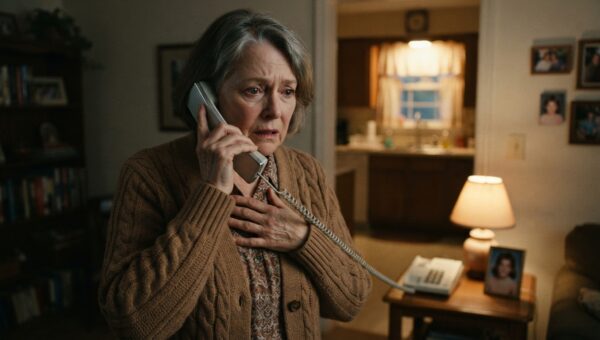
The drive home took forty minutes, and I had to pull over twice on Route 9W because my hands were shaking so hard I couldn’t keep the car straight between the painted lines. When I finally unlocked my front door, the house was dark and smelled faintly of old floor wax and pine cleaner. I didn’t turn on the kitchen lamp. I went straight up the stairs to my bedroom, pulled open the cedar drawer, and stared down at the neat stack of thirteen birthday checks. Forty dollars each. Five hundred and twenty dollars total. It looked like blood money in the dim evening light.
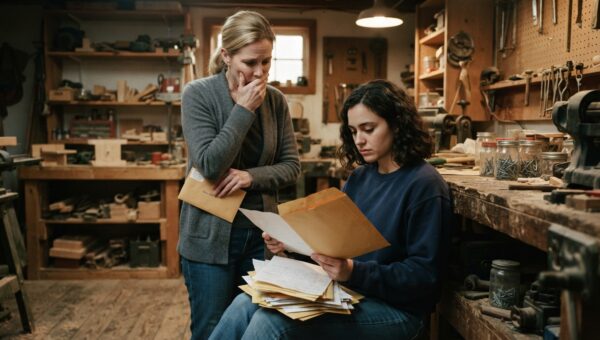
I sat down on the edge of the mattress and finally opened the envelope Leo had given me. Inside wasn’t just a letter. There were photocopies of old family court documents from the summer of 2009, stamped with red ink from the county clerk, showing every petition Miriam had filed and every time Arthur had failed to show up for court-ordered counseling. And beneath the legal papers was a piece of folded, yellowed notebook paper with jagged crayon lines. It was a drawing of a small boy standing next to a broken kitchen chair, with red crayon scribbled heavily across the ribs. In the corner, in clumsy six-year-old printing, it said: *Daddy did this.*
I had signed my name on an affidavit that very same week swearing that Arthur was a fit and loving father who only needed guidance. I had looked the social worker in the eye and said my son had a good heart.
The house was so quiet I could hear the antique clock in the hallway ticking away the seconds, loud and heavy like a hammer hitting an anvil. I picked up the stack of birthday checks from the dresser, carried them down to the kitchen, and dropped them straight into the metal trash can under the sink. I didn’t tear them up. Tearing them up would have felt like doing something purposeful, and I didn’t deserve to feel purposeful. I just let them fall among the potato peelings and the junk mail.
Arthur didn’t call that night, and he didn’t call the next week, either. He hasn’t called in three years, and according to my cousin who still lives down in Kingston, he’s living in a rooming house near the railroad tracks, working odd jobs when his liver holds out. He never was a father. He was just a grown man who needed someone to cover for him until there was nobody left to do it.
The cedar drawer is empty now. I took out the linen handkerchiefs and washed them in hot water with lemon soap, letting the old smell go completely out the window. Every once in a while, I look at the framed photograph of Leo in his blue cap holding his scholarship certificate that I printed out from the school website and set on the mantelpiece. Miriam didn’t send it to me. I had to ask the high school office for a copy, and when it arrived in the mail last month, there was no note attached. Just the picture.
I don’t expect Leo to call me for Christmas, and I don’t expect him to invite me to his college orientation down in Ithaca this fall. But I know where he is now, and I know what I pretended not to see in the summer of 2009. Sometimes I sit at the kitchen table with a cup of black coffee and look out at the gravel driveway where Arthur’s truck used to leak oil, and I say the rest of his sentence out loud to the empty room, just so I don’t ever forget how it feels to hear the truth.