The cedar drawer on my bedroom dresser always smelled faintly of dried lavender and old paper, but underneath that, it held thirteen years of yellowed envelope glue. I opened it every April seventh just to slide in another slip of blue-lined paper. Forty dollars. That was the amount I settled on back when my social security check started stretching thin, enough to buy a boy a decent pair of sneakers or a stack of books, though none of them ever made it past the local post office box.
David told me every single time that the envelopes came right back stamped return to sender or simply vanished into whatever town his ex-wife had dragged the boy off to. I believed him because he was my son, and mothers are built to swallow their doubts the way a dry throat swallows dust.
Back in 2009, the courtroom smelled of wet wool and floor wax while the radiators clanked in the corners like loose pipes. Six-year-old Leo had a small greenish shadow just above his left wrist, right where his sleeve kept slipping down whenever he reached for a paper cup of water at the intake table. I saw it. I remember the exact shape of it, round like a thumbprint crossed with a knuckle. When David leaned down to whisper that the boy had taken a tumble off the porch railing while chasing our old beagle, I nodded and pushed the memory down into the dark part of my mind where old women keep things they cannot bear to inspect too closely.
The judge asked me directly if I had any reason to doubt my son’s care. I looked at David sitting there with his shoulders slumped and his tie pulled loose, looking like a man who had the whole world stacked against him, and I told the court he was a good father. I said it clearly enough for the court reporter’s machine to catch every syllable. That single sentence cost me thirteen years of seeing my grandson grow teeth, learn fractions, and turn into someone who didn’t even know my telephone number. David made sure of that part long after the gavel dropped, moving from one rented duplex to another while telling me the courts were still enabling a bitter mother who wouldn’t let a father breathe.
The mail up here arrives right around noon when the carrier’s truck doesn’t throw a fan belt, which it does about once a month.
Last spring, the blue envelope came wedged between an electric bill and a circular for gutter cleaning. It wasn’t one of David’s scrawled yellow legal pads or a text message sent at two in the morning when he was three drinks deep. It was a heavy cream-colored card with smooth embossed lettering that announced the graduation commencement exercises for the regional high school district across the county line. Leo James Miller. Nineteen years old. Valedictorian alternate and recipient of the regional foundry foundation scholarship worth twenty-eight thousand dollars.
I didn’t tell David I was going. If I had, he would have spent three hours on the telephone explaining why it was a trap set by lawyers or an old grievance meant to humiliate him in public. Instead, I put on my good gray cardigan, the one with the pearl buttons that always caught on my sleeve, and drove my old sedan forty miles down the state highway with the windows cracked because the heater core had started smelling like hot antifreeze.
The high school stadium was packed with folding chairs sunk into the dead football turf, and I sat three rows back from the brass section where the sun hit the metal horns and made everyone squint.
When they called his name, a tall, broad-shouldered young man stood up from the second row of folding chairs and walked across the plywood stage with a steady, unhurried stride that didn’t look anything like his father’s nervous shuffle. He had his mother’s sharp jawline and the same deep-set dark eyes I remembered staring up at me from the back seat of my Buick thirteen summers ago. When the principal handed him the leather folder, Leo didn’t smile for the flashbulbs the way the other boys did. He just scanned the bleachers until his eyes locked onto mine through the wire mesh fence.
The crowd took twenty minutes to thin out into the parking lot, families shouting across station wagons and slamming trunks in the afternoon heat. I stayed by the chain-link gate with my purse clutched against my ribs like a shield, watching the green folding chairs disappear into metal dollies wheeled by boys in track jackets. Then shadow fell across my shoes, and I looked up to see him standing there, taller than me by half a head, wearing a dark blue suit that fit his shoulders properly.
He didn’t reach out to shake my hand or pull me into a performance for the passing neighbors. He just reached into his inner jacket pocket and pulled out a standard manila envelope sealed with gray packing tape. “You kept coming to these things alone,” Leo said, his voice dropping low enough that the nearby car doors slamming didn’t drown him out. “I saw you at the junior high track meet three years ago from the bus window. You wore that same gray sweater.”
My throat felt dry, like I’d swallowed a mouthful of fireplace ash. “Leo,” I started, but I couldn’t find the rest of my own name for him.
He held the envelope out until the corner touched my knuckles. “Grandma, did you know I begged you to tell the judge about the bruises on my arm when we sat in that little hallway behind the courtroom?”
The parking lot seemed to tilt slightly, the gravel shifting under my sensible walking shoes. I didn’t answer because my brain kind of stopped working for a second, every excuse I had stored up in the cedar drawer turning into gray smoke. “Your father said you fell off the porch,” I whispered, and the words sounded small and ugly even to my own ears.
“I didn’t fall off anything,” Leo said, and his voice didn’t have any anger in it, which somehow felt much heavier than if he had started screaming at me right there between the asphalt lines. “My mom kept everything. Every report the social worker wrote, every clinic visit where the doctor took photographs of my ribs, and every letter she tried to mail you that David intercepted and burned in our backyard burn barrel.”
He didn’t wait for me to open it while he stood there. He just turned around, walked twenty paces toward a waiting blue sedan where a woman with silver-streaked hair sat behind the steering wheel watching us through the windshield, and got into the passenger seat without looking back.
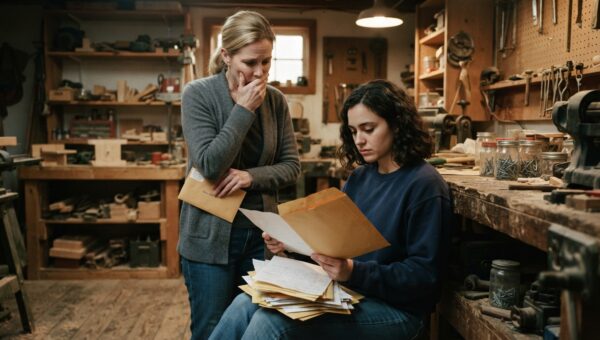
I sat in my car for an hour with the engine off and the windows rolled up while the steering wheel grew cold in the shade of the stadium lights. When I finally cut the packing tape with my house key, the contents spilled out across my lap like a handful of gravel. There were photocopies of court documents bearing stamps from 2009 that I had never been allowed to see. There were medical intake notes describing a six-year-old child who had learned to flinch whenever a heavy door slammed in an apartment hallway. And right on top was a short note written in clean, sharp ballpoint ink: You can call me on Thursdays if you want to know who I actually am now.
Driving home took twice as long because my hands kept shaking against the vinyl steering wheel whenever I had to signal for a turn. When I walked through my front door, the house smelled of nothing at all, just stale linoleum and old wool carpets that needed a good beating in the spring wind. I went straight to the bedroom, pulled open the cedar drawer, and hauled out the thick stack of thirteen blue-lined envelopes with forty-dollar checks written out in my own cramped handwriting, dated every April seventh like clockwork.
I didn’t call David until six o’clock, right when I knew he’d be sitting in his recliner with the television tuned to the evening news. When he answered on the third ring, his voice had that familiar, raspy drag that meant the gin bottle was already open on the end table. “Mom, I told you I’m busy tonight, what is it?”
“I went to the graduation,” I said, and I didn’t bother keeping my voice low or careful the way I had for thirteen years.
The line went quiet for three seconds, just the sound of a television anchor talking about weather patterns over the receiver. “You did what? Why would you go listen to her drag him through that circus again?”
“He’s nineteen, David,” I said, and my hand stopped trembling because the anger finally felt cleaner than the guilt. “And he’s taller than you now. He doesn’t fall off porches anymore.”
“She’s lying to you,” David shouted, his voice cracking on the high note the way it always did when he was cornered. “She poisoned him against everyone in this family from day one, you know how she is!”
“No,” I told him, and I felt something in my chest snap back into place after thirteen years of crooked leaning. “I know how you are.”
I hung up the phone before he could finish whatever name he was calling his ex-wife, then I walked out to the kitchen, stacked the thirteen birthday checks into a fresh brown mailing envelope, and wrote David’s apartment address across the front in thick black marker without adding a single note inside.
The next Thursday, I drove down to the diner on Elm Street twenty minutes early and sat in booth four where the laminate tabletop had a slight wobble that you had to fix by sliding a folded matchbook under the chrome leg. The waitress brought over a green ceramic mug of coffee without me even asking, leaving the pot on the table so I could top it off myself while I watched the front door. At precisely three o’clock, the brass bell above the screen door chimed, and a tall young man with his mother’s dark eyes walked in, shook the rain off his jacket, and slid into the vinyl seat across from me without a word. He didn’t smile right away, but he didn’t pull away either when I set my hand flat on the table, right next to a clean, unlined paper napkin where he immediately picked up a ballpoint pen and wrote down his new telephone number in steady, adult handwriting.