PART 1
My father walked out the front door when I was nine years old, and he never looked back.
He didn’t call on Sunday afternoons. He didn’t send a five-dollar bill inside a birthday card. My mother took three cleaning jobs to keep the oil tank filled in the winter, and whenever his name came up, she just pressed her lips together and told me that some men simply were not built for family. I grew up believing I had been easy to discard.
At twenty-two, after working three years as a medical records clerk, I got my acceptance letter to the four-year nursing program at the university in town. The tuition was $34,000. For someone living paycheck to paycheck on eleven dollars an hour, it might as well have been a million. I filled out thirty-two financial aid applications, sat through interviews, and went to bed every night wondering how I was going to buy scrubs, let alone pay for credit hours.
Then, two weeks before the fall semester began, a certified envelope arrived from the university bursar.
I had been awarded a private, anonymous endowment. It paid $8,500 a semester, guaranteed for four years as long as I kept a 3.0 grade point average. That was $68,000 total, covering full tuition, lab fees, and book vouchers. There was no donor name on the letter.
When I went to the financial aid office to ask who gave it, the director told me the fund was held in an irrevocable educational trust through a regional bank, with strict legal instructions that the benefactor’s identity remain confidential until their death.
I treated that money like sacred ground. I worked forty hours a week, studied at the kitchen table until two in the morning, and finished on the Dean’s list.
After graduation, I took a staff job in the cardiac step-down unit at Mercy Hospital, earning $61,000 a year. Every time I clipped my registered nurse badge to my scrubs, I thought of the stranger who had saved me from a lifetime of minimum wage. I pictured a wealthy retired doctor or an old woman with no children of her own. I kept a thank-you note in my desk drawer, rewritten four times over the years, waiting for the day I could mail it.
Eight years went by. I got married, bought a modest home, and built a stable life.
Then, on a Tuesday when I was thirty years old, an official letter arrived from the university legal department.
The letter was brief: *Your anonymous donor has passed away. Per his written instructions lodged with the trust administrator, we are authorized to release his identity and final personal effects.*
The name printed on the certificate was Thomas Vance.
His address was a small brick bungalow on Maple Street, only six miles from my apartment.
I sat in my parked car outside the house for twenty minutes before I could make my feet move. The yard was tidy, with yellow marigolds lining the cracked walkway and an old blue work truck in the driveway. I walked up the three porch steps and knocked on the screen door.
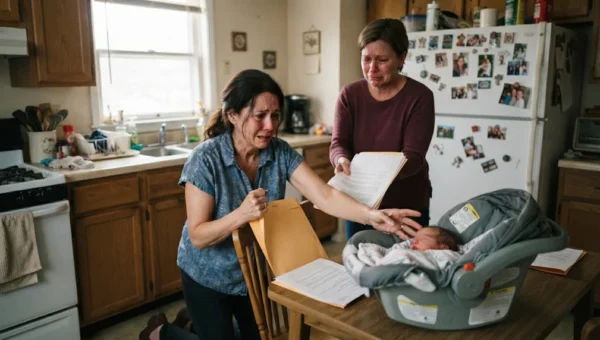
A woman in her early sixties opened it. She had gray hair pulled back in a silver clip, wearing a faded cotton cardigan and reading glasses. Her eyes were swollen, red from recent tears.
“Can I help you?” she asked.
“My name is Megan Hayes,” I said, my voice barely carrying over the hum of a passing delivery van. “I received a letter from the university about Thomas Vance.”
The woman’s hand went to her collarbone. She didn’t gasp. She just looked at my face, staring at my jaw and my eyes, and a slow, gentle sorrow settled over her features.
“You’re his daughter,” she said.
“I didn’t know he lived here,” I whispered. “I thought he moved to California twenty years ago.”
“Thomas never left this county,” she told me, pushing the screen door open. “Come inside, Megan. I’m Martha, his wife. He married me twelve years ago. He told me that when this day came, you’d probably drive over.”
I stepped into a small, neat living room that smelled like cedar and black coffee. On the side table sat a framed photograph of a man with thick graying hair, wearing a dark work jacket and smiling beside a fishing boat. It was the face from my childhood, just lined with thirty years of hard labor.
“Why did he hide from me?” I asked, my hands clenching into fists inside my coat pockets. “Why pay for my school and never pick up the phone?”
Martha looked at the photograph, then walked over to a dark wooden hutch in the corner.
“Because he knew what he was,” Martha said quietly. “He watched every graduation from the parking lot. He sat in his truck with the windows rolled down, watching you walk across that stage in your cap and gown. He wanted to come in so badly his hands shook. I told him you’d forgive him if he just showed his face. He told me you shouldn’t have to.”
She reached into the bottom cabinet of the hutch and pulled out a heavy cardboard shoebox wrapped with two thick rubber bands.
She turned and placed it in my hands.
“He wanted you to have this,” Martha said. “He told me that if you read what was inside, you would finally understand why he stayed on the other side of the glass.”
PART 2
The shoebox was heavy, covered in brown kraft paper that had yellowed at the edges.
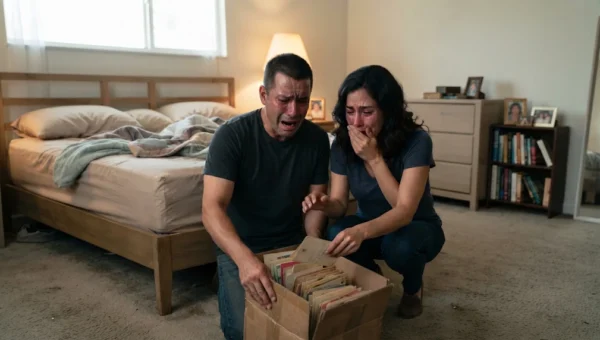
I sat down on the slipcovered armchair by the window. My hands were shaking so hard I had trouble snapping the thick rubber bands off the cardboard lid.
When I lifted the top, the first thing I saw was my second-grade school picture.
I was seven years old in the photograph, missing two front teeth, wearing a blue corduroy jumper my mother had bought from a clearance rack. Beneath it was my third-grade picture, then fourth, fifth, sixth, right through my senior portrait in high school. Every single school photo I had ever taken was stacked in chronological order, mounted on cheap gray cardstock.
Beneath the pictures were my report cards. The handwriting on the envelopes was my mother’s, sent to a post office box in the next town over. Beside them lay a newspaper clipping from the county courier: my wedding announcement from four years ago, with a small circle drawn around my name in pencil.
“Where did he get these?” I asked, looking up at Martha.
Martha was standing by the kitchen archway, holding a mug between her palms.
“Your mother sent them,” Martha said. “Every June, like clockwork. Thomas had a court agreement through an attorney. He never missed a single child support payment, Megan. Not one. He worked sixty hours a week as a structural welder at the rail yards, and half of every check went into the bank for you. But part of the legal covenant your mother demanded was total silence. If he approached you, if he called your house, if he sent a letter with his name on the envelope, your mother had the right to petition the court to terminate all visitation permanently.”
“My mother told me he abandoned us,” I said, the words coming out bitter and thick. “She told me he packed a duffel bag and walked out because he didn’t want the responsibility of a child.”
“Thomas was twenty-eight when he left that house,” Martha said. “He was a rough man back then, Megan. He drank too much on the weekends, and he had a temper when the money ran out. Your mother wasn’t wrong to protect you from that household. When she asked for the divorce, Thomas looked at his life and realized he was going to drag both of you down with him. So he signed the agreement. He gave her the house, he gave her the car, and he promised he would stay out of your sight until you were an adult.”
“And the university money?” I asked. “He worked as a welder. Where did he get $68,000 for tuition?”
Martha set her mug down on the dining table. She walked back over, pulled a flat manila folder from the bottom of the shoebox, and laid it across my lap.
“In 2008, when you were sixteen, there was an explosion at the freight depot in Canton,” Martha said. “A fuel tank ruptured on a maintenance rig. Thomas was working on the undercarriage. He went back into the burning bay twice to drag two young apprentices out before the roof collapsed. He took second-degree burns across his chest and back, and his lungs never fully recovered. The rail company settled out of court for a little over one hundred thousand dollars.”
I opened the manila folder.
Inside was the legal settlement document from the Northern Rail Corporation, dated July 2009. Below it was the bank certification establishing the irrevocable educational trust in my name. Thomas had taken eighty thousand dollars from that settlement, placed it directly into the trust, and lived on the remainder in this small six-room house for the rest of his life.
“He could have bought a new house,” I whispered. “He could have retired.”
“Thomas didn’t care about a house,” Martha said softly. “The day you got into that nursing program, he came home from the mailbox with your enrollment confirmation notice the university had forwarded to the trust officer. He sat right at that kitchen table and cried for an hour. He told me his daughter was going to heal people for a living. He said it was the only clean thing his blood had ever produced.”
I turned the papers over. Tucked into the bottom of the folder was a faded pink hospital receipt from St. Jude’s Children’s Pavilion, dated November 14th, nineteen years ago.
I recognized the date immediately.
When I was seven years old, I had contracted a severe, invasive bacterial infection following a ruptured appendix. I had developed sepsis, spent two weeks in the pediatric intensive care unit, and almost died from internal complications. My mother had told me years later that my survival was a miracle, that the hospital staff had barely managed to stabilize me after three blood transfusions.
The receipt in my hands was an emergency blood donor voucher from the county blood bank.
The donor name was Thomas Vance.
I stared at the voucher, reading the medical notes written in purple ballpoint ink in the margin.
Then Martha stepped closer and touched my shoulder.
“Thomas was at the hospital that night, Megan,” she said. “He sat in the basement waiting room for three days straight while you were in that oxygen tent. But that receipt isn’t for the blood he gave you. That receipt is for something else.”
PART 3
I looked up at Martha, my throat tightening so hard I could barely breathe.
“What do you mean?” I asked. “My mother told me they used donor units from the county bank.”
Martha pulled out a wooden dining chair and sat down directly across from me. Her face was completely calm, carrying that steady, unyielding patience that comes from living alongside a quiet man’s regrets for decades.
“Your father’s blood type was O-negative,” Martha said. “He had universal blood. When you crashed on that second night, the hospital’s local reserves were depleted because of a multi-car pileup on the interstate. The pediatric surgeon came into the hallway and told your mother that if they couldn’t get three units of typed whole blood within forty minutes, your organs would fail.”
She pointed to the yellowed pink slip in my hands.
“Thomas had been sitting outside on the emergency room curb because your mother had threatened to call the police if he came into the ward,” Martha continued. “When the doctor came out looking for immediate direct donors, Thomas walked straight into the triage bay. He rolled up his sleeve. He gave two pints of blood back-to-back, which was more than the nurses legally wanted to draw from a man his size. He was so dizzy he couldn’t stand up, but they got the units into you in time.”
I looked at the donor voucher. At the bottom, in the space marked *Recipient Verification*, the surgeon had written: *Direct paternal donation, units 1 and 2. Patient stabilized at 04:15.*
“He saved my life,” I whispered.
“He did,” Martha said. “And that was the night your father learned the truth.”
I froze. The room was dead silent except for the faint ticking of a kitchen clock on the wall.
“What truth?” I asked.
Martha reached into the shoebox, slid her fingers beneath the remaining papers, and pulled out an official laboratory envelope from the county health department, sealed with faded red wax tape that had been slit open years ago.
She didn’t hand it to me immediately. She held it against her lap.
“When they ran the blood cross-match that night to ensure compatibility,” Martha said, her voice dropping to a low, steady whisper, “the pathologist ran the standard genetic antigen markers. In 1999, it was routine protocol for direct family transfusions.”
She handed the envelope to me.
Inside was a single typed page on county hospital letterhead.
I scanned the medical terminology, my eyes dropping down to the bold conclusions at the bottom of the page:
*Direct serological and genetic marker comparison confirms donor Thomas Vance possesses zero paternal biological linkage to recipient Megan Hayes. Paternity excluded.*
The paper felt like ice between my fingers.
“I wasn’t his,” I breathed out.
The room seemed to tilt slightly. All the memories of my childhood, all the anger I had carried for twenty-one years, all the bitter nights I had spent wondering why my father didn’t love me enough to stay, suddenly cracked open like dry bone.
“Your mother had an affair when they were twenty-four,” Martha explained gently. “She had been seeing a supervisor at the department store where she worked before Thomas took the rail job. When she got pregnant, she told Thomas the child was his. Thomas raised you for seven years believing you were his blood. He held you when you had the colic. He taught you how to ride your bicycle on the sidewalk behind the duplex.”
“And that night at the hospital,” I said, “he found out.”
“He found out while you were lying on the table with his blood pumping into your veins,” Martha said, tears finally spilling over her eyelashes. “The doctor had to tell him because the genetic profile didn’t align. Thomas walked out of that hospital at dawn, went back to their house, and confronted your mother.”
I looked at the document, tracing the faded official stamp with my thumb.
“Your mother broke down,” Martha said. “She admitted it. She told him that if he stayed, she would tell everyone in town that he was a fool who had raised another man’s daughter. She told him that if he tried to fight for custody, she would drag him through the family court and make sure he never saw you again. She knew Thomas had that temper, and she knew the court would favor a mother.”
“So he left,” I said.
“He left so you would never know,” Martha said. “He looked at a little seven-year-old girl who was fighting for her life in a hospital bed, and he knew that if he fought your mother, your childhood would be torn to pieces by lawyers, rumors, and small-town gossip. He didn’t want you to grow up thinking you were a mistake. He didn’t want you to carry the shame of your mother’s secret. So he let your mother make him the monster.”
Martha reached out and closed her warm hand over mine.
“He told your mother he would leave the county, leave the house, and pay child support every single month until you were eighteen, on one condition: that she never told you he wasn’t your real father. He wanted you to believe you had a father who just couldn’t get his life together, rather than knowing the man who raised you wasn’t your father at all.”
“And he paid for my college,” I sobbed, the tears burning hot against my cheeks. “He took skin grafts and smoke in his lungs, and he gave sixty-eight thousand dollars to a girl who didn’t even share his blood.”
“You did share his blood, Megan,” Martha whispered, her voice breaking. “He gave you his blood when you were seven years old. He always said that was the only contract that mattered.”
ENDING
I stayed in that small living room until four in the afternoon.
Martha made a pot of tea, and together we went through every single photograph, every report card, and every newspaper clipping in that shoebox. Thomas had kept a small black ledger in the bottom where he had written down every milestone he had watched from afar: *Megan’s middle school track meet, 2nd place in the 400m.* *Megan’s high school graduation, row 4, seat 12.* *Megan’s first car, gray Ford, bought June 2012.*
He had never left me. He had been six miles away the entire time, standing behind the wire fences, sitting in the cab of his truck, keeping his distance so that my life could remain clean and untouched by his past.
Before I left, Martha walked me out to the driveway. She handed me a small brass key on a worn leather strap.
“This is for the lockbox at the community bank downtown,” Martha said. “There is thirty-two hundred dollars left in the residual trust. Thomas left instructions that it was for you to take your husband out for a proper dinner, and to buy yourself a decent stethoscope.”
I looked at the house, at the marigolds, and at the quiet street he had lived on for twelve years.
“Where is he buried?” I asked.
“He didn’t want a plot,” Martha told me, wiping her eyes. “He was cremated. His ashes are spread out on the riverbank behind the rail depot where he used to fish on Saturday mornings.”
I didn’t drive home to my apartment. I drove across town to the suburban subdivision where my mother lived.
She was seventy-one now, living in a modern condo with manicured lawns and a white vinyl fence. When she opened the front door, she was wearing her gardening apron, holding a pair of shears. She smiled when she saw me, reaching out to give me a hug.
“Megan, what a surprise,” she said. “Come inside. I just made some lemonade.”
I didn’t step across the threshold. I stood on the concrete porch, reached into my purse, and pulled out the yellowed hospital receipt and the county health department report.
I handed them to her.
My mother looked down at the papers. For five seconds, the smile stayed on her face, confused and polite. Then her eyes hit the red wax stamp and the name Thomas Vance.
Every trace of color drained from her skin. The shears slipped from her fingers, clattering loudly against the concrete step.
She looked up at me, her mouth parting, but no sound came out.
“He died last week,” I told her. My voice was low, flat, and completely clear. “He left me sixty-eight thousand dollars for nursing school. He kept every report card you ever sent him. And he kept your secret for twenty-three years.”
“Megan,” she stammered, her hands trembling as she reached for my arm. “You have to understand how difficult things were back then. Your father… Thomas was unstable. I had to protect you—”
“Don’t you dare call him unstable,” I said, stepping back so her hand fell away into the empty air. “He took the blame for your unfaithfulness so I wouldn’t have to grow up broken. He let me hate him for twenty-one years so I wouldn’t have to hate you.”
She stood there on her porch, her eyes welling with tears, looking smaller and older than she ever had before.
“Are you going to tell people?” she whispered, terrified.
I looked at my mother. The woman who had taught me to be proud, who had lectured me about dignity and honesty while building our family on a lie that destroyed a good man’s name.
“No,” I told her. “I’m not going to tell anyone. Thomas gave up his entire life so this family wouldn’t be dragged through the mud, and I won’t ruin his gift just to punish you.”
I turned on my heel and walked down the driveway to my car.
“Megan, please!” she called out from the porch. “When will I see you?”
“I don’t know,” I said, opening my door. “I have a shift at Mercy Hospital tonight. I have work to do.”
I drove down to the river behind the old rail depot.
The afternoon sun was sinking behind the freight trestles, casting long orange ribbons across the brown, moving water. The air was cool and smelled of diesel exhaust, river mud, and autumn leaves.
I walked down the gravel bank until the water lapped against the toes of my running shoes.
I reached into my pocket, pulled out the brass key, and held it tightly in my fist.
For twenty-one years, I had thought I was the daughter of a man who didn’t want me. But standing there on the edge of the river where he used to fish, looking at the water that had carried him away, I knew the truth.
I wasn’t an abandoned child. I was a child who had been loved with an impossible, silent ferocity by a man who gave up everything he had, just to make sure I never had to look at the ground when I walked.
I unclipped my hospital badge, looked at the letters *Megan Hayes, RN* printed beneath my photo, and whispered a quiet thank you into the wind.