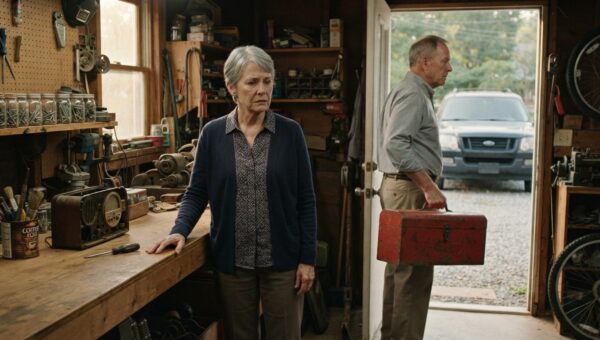
The cold linoleum under my socks was the first warning that something was wrong with the house. Arthur was upstairs in the small back bedroom, propped up on three flat pillows with a gray wool blanket over his knees, trying to get his breath back after six weeks of recovery from his triple bypass. When the refrigerator hum died in the middle of a Tuesday afternoon, I figured it was just another transformer blow on our side of town.
The power lines in this older mill district have always been held together with rusted wire and spit.
I walked down the dark hallway to check the breaker box behind the cellar door, sliding my hand along the familiar wood paneling where we had marked Ethan’s height every August until he turned eighteen. The red plastic flashlight on the kitchen counter was dead when I clicked the switch, the batteries corroded into white powder inside the metal tube. I had to feel my way down the basement steps in the dark, my fingers trailing along the cold stone wall that always smelled faintly of damp coal dust and old jar lids.
The main breaker wasn’t tripped. It was sitting right where it belonged in the open position, but the little digital meter outside the cellar window was completely dark, staring back at me like a dead eye.
Ethan had promised he took care of the online auto-pay transfer three weeks ago when Arthur came home from the hospital.
He stood right by our kitchen table with his car keys jangling in his palm, wearing his gray work jacket and telling me not to worry about a single thing. “I got the electric and the water covered this month, Mom,” he had said, his voice flat and steady. “You just focus on Dad’s meds and making sure he eats his soup.”
I believed him because mothers always believe their only child until the evidence is shoved right down their throats. Arthur couldn’t work, my own hours at the dry cleaners had been cut back to three days a week while I managed his physical therapy schedule, and every single dollar in our savings account had gone toward the out-of-pocket deductible for the surgeon. Ethan was supposed to be chipping in one hundred and forty dollars a month toward the utilities, the exact amount we agreed upon when he moved back into our spare room between jobs.
Except he hadn’t been sleeping in that spare room for the last four months nearly as much as he claimed. His bed stayed made for days at a time, but I told myself he was pulling double shifts down at the freight yard or staying late with friends from his bowling league. You make excuses for your children because the alternative is admitting you raised a stranger who looks you dead in the eye and lies without blinking.
I climbed back up the cellar stairs, my knees clicking the way they always do when the weather turns damp, and picked up my landline. The dial tone was a long, unbroken hum, which meant the phone lines were still live even if the juice to the house was cut off. I dialed the electric company using the little paper card taped right beside the kitchen wall jack.
The woman on the other end of the line had that smooth, bored customer service voice that makes you want to throw the handset through the window.
She put me on hold twice while she checked the meter number off the back porch. When she came back, her tone had shifted from bored to carefully polite, the kind of polite that usually means trouble.
“Mrs. Miller,” she said, her voice crackling through the old plastic earpiece. “The service at that address was suspended at 9:15 this morning for non-payment. The current balance past due is four hundred and eleven dollars and twelve cents.”
“That is impossible,” I told her, my fingers tightening around the cord until my knuckles went white. “My son Ethan set up the automatic monthly draft from his account three weeks ago. We have receipts.”
“Well, ma’am, I’m looking right at the digital portal history,” she said, tapping something on her keyboard on the other end. “The billing address and the online profile credentials were changed on the fourteenth of last month. The notifications aren’t going to your street address anymore. They were redirected to a private residence on Elmwood Lane.”
Elmwood Lane is on the other side of the railroad tracks, out past the old tannery where the gravel roads turn into rutted dirt and the houses are all small, identical split-levels with overgrown patches of crabgrass for front lawns. Ethan had never worked out that way, as far as I knew. He told me his job was down at the interchange warehouse off Route 9.
“Who changed it?” I asked, my voice dropping so low I barely recognized it as my own. “That’s our family home. Nobody else has the account number.”
“The online user profile was updated from a mobile IP address registered under an Ethan Miller,” she said, her words dropping like small stones into a well. “And the mailing address for all paper statements was updated to 414 Elmwood Lane. If you want the power restored today, you’ll have to pay the full balance plus a reconnection fee over the phone right now.”
Four hundred and eleven dollars and twelve cents. That was more than half the grocery money I had set aside in the kitchen tin for the rest of the month. Arthur needed his blood thinners refilled by Thursday, and the pharmacy doesn’t take IOUs.
“No,” I said, staring out the kitchen window at the empty bird feeder swaying in the gray wind. “Don’t turn it back on yet. Just leave it.”
I hung up the phone before she could ask me another question. The silence in the kitchen was heavier than the darkness outside, thick with the smell of the chicken soup I had been heating on the gas stove before the pilot light died. Upstairs, I heard Arthur shift against his pillows, his dry cough rattling the floorboards above my head.
I didn’t yell. I didn’t cry. I just walked over to the mudroom by the back door, pulled my old brown canvas jacket off the brass hook, and slid my car keys out of the ceramic bowl on the shelf. My hands didn’t shake until I tried to turn the ignition key in the dashboard of our battered Ford sedan, the engine coughing twice before it finally caught and settled into its familiar, noisy idle.
The drive across town took twelve minutes because the freight train was sitting across the tracks on Elm Street, its long string of red and gray hopper cars stretching out into the gray afternoon haze like a iron spine. I sat behind a rusted pickup truck with no tailgate, watching the moisture bead up on my windshield while my mind went over every lie Ethan had told us since the snow started melting.
He said he was saving for his own apartment. He said rent in this town was too high for a single guy starting out. He said he was eating dinners down at the diner so he wouldn’t wake his recovering father up late at night when he came home from his shift. Every single piece of it fit together now, neat and terrible, like a jigsaw puzzle you didn’t know you were building until the very last corner piece dropped into place.
When the train finally groaned and began to roll forward, I pushed the gas pedal down a little harder than I should have, the tires spitting loose gravel against the wheel wells.
Number 414 Elmwood Lane was a boxy little house with peeling white paint on the trim and a plastic tricycle lying on its side in the patchy grass near the driveway. There was a blue sedan parked right behind a battered Honda Civic in the gravel patch, both of them covered in a fine layer of gray road dust from the quarry down the road.
I parked right behind the blue sedan, killing the engine so the sudden silence swallowed the neighborhood. The dashboard clock glowed 3:42 in the red light. My purse was sitting on the passenger seat right beside the unopened electric bill I had printed out from our computer the night before, still showing our name at the top with that strange secondary address tucked underneath in neat, computer-generated print.
I walked up the three wooden steps to the front porch, the boards groaning under my boots. Before I could even raise my hand to knock on the scarred wooden door, the deadbolt clicked from the inside and the door swung open about three inches.
A little girl with dark, curly hair pulled back in a mismatched yellow clip peered out at me through the gap, her small hand resting on the brass security chain. She couldn’t have been more than five or six years old, wearing faded pink pajamas with little white sheep all over them even though it was the middle of the afternoon.
She looked right past me at the gray Ford parked in her driveway, then down at the white envelope I was holding in my hand. Her eyes went wide with the easy, natural recognition of a child who had seen that exact piece of blue-and-white paper a hundred times before.
She turned her head back into the dark hallway behind her, her voice ringing out clear and bright through the screen door.
“Mom,” she called out, her small hand pointing straight at the paper in my fingers. “Grandma’s name is on Dad’s bill again.”
The house behind her smelled of boiled hot dogs and cheap laundry detergent, that heavy, indoor smell of young families trying to stretch a paycheck until Friday. A second later, a young woman with tired eyes and flour dusted across the front of her denim apron appeared in the hallway, wiping her hands on a dishtowel. She stopped dead when she saw me standing on the porch, her gaze dropping from my face down to the envelope in my hand and then across to the car in the drive.
“Can I help you?” the woman asked, her voice tight and defensive, the voice of someone who spent half her life bracing for bad news.
Before I had to answer her, the back door of the kitchen clicked open and heavy footsteps hurried down the short hallway from the back of the house. Ethan appeared beside her, wearing his gray work shirt with the sleeves rolled up to his elbows, a smudge of black grease staining his left forearm. He stopped breathing the second he saw my face framed in the screen door.
“Mom,” he whispered, the word coming out flat and thin, like air leaking from a tire. “What are you doing here?”
The kitchen behind them was warm, too warm, the overhead fluorescent light humming away without a care in the world. On the counter beside the refrigerator, I could see a small toaster oven glowing orange and a plastic cup with a straw sticking out of it. The lights were on here. The refrigerator was humming here. Elmwood Lane had full power, running smoothly on the four hundred and eleven dollars and twelve cents that was supposed to keep the lights burning for his recovering father in the house we built with our own hands twenty-five years ago.
Maya looked between Ethan’s pale face and my canvas jacket, the dishtowel bunching up in her white knuckles. “Ethan,” she said, her voice dropping into a dangerous, low register. “Who is this?”
Ethan didn’t answer her. He just stood there in the narrow hallway of a home I had never been invited into, staring at the white envelope in my hand as if he could make the words disappear by sheer force of will.
“You can put your coat back on if you want to stay,” Maya said, her eyes fixed on his face now, all the color draining right out of her cheeks. “Or you can tell me right now why your mother is standing on our porch holding your utility bill.”
I didn’t step inside. I didn’t want the smell of their boiled hot dogs or the warmth of their stolen electricity touching my clothes. I just reached out, slid the paper through the narrow gap in the screen door until it touched the little girl’s fingers, and let go.
“Make sure he pays you back for the reconnection fee too, dear,” I told her, my voice as steady as an old stone wall. “He’s got plenty of experience managing other people’s money.”
I turned my back on the front door before either of them could say another word, walking back down the wooden steps and across the gravel drive without looking back once. The engine of the Ford started on the first turn this time, roaring to life in the quiet street as I pulled away from the curb.
When I got home, the house was still dark and cold, the hallway smelling of stale air and old linoleum. I walked upstairs to the back bedroom where Arthur was just waking up from his afternoon nap, his eyes blinking slowly in the dim light coming through the lace curtains.
“Is the power back on yet, Martha?” he asked, his voice rough with sleep as he reached out a thin, pale hand to touch my sleeve.
I sat down on the edge of the mattress, smoothed the gray wool blanket over his knees, and looked out the window where the streetlights across our neighborhood were just beginning to flicker on against the gathering dusk.
“It will be,” I told him, my hand resting warm and steady over his. “It will be very soon.”