My mother-in-law asked me to teach her to drive while her son was in the garage saying she should be grateful we lived close.
“I want to learn,” Nora said, standing at my kitchen sink with her hands in a dish towel. “Would you take me to the driving school?”
I looked at her. “Of course.”
My husband, Matt, came in through the back door. He had heard the last part.
“Why would you need a driving school?” he asked. “I can take you wherever you need to go.”
Nora folded the towel once. “I don’t want to keep asking.”
“You’re not asking. We’re family.”
She looked at me, not him.
Matt and I lived in a ranch house in western Pennsylvania. Nora had moved into the small apartment above our garage after her husband died, planning to stay “a few months” while she figured out what to do with her house. Two years later, she still lived upstairs. We had become used to having her near us. We had also become used to her needing rides.
At first, I offered. I took her to the pharmacy, the grocery store, her church, and a doctor’s office in town. Then the offers turned into a schedule. Tuesdays for errands. Thursdays for appointments. Matt drove her on weekends when he could.
I did not resent Nora. I resented the way people spoke as if the rides cost nothing because I was already going somewhere.
Matt kissed my cheek and said, “You don’t even like driving.”
“I like choosing when I drive.”
“That’s different.”
“It is.”
Nora put the towel down. “I’m sorry. I didn’t mean to make this into an argument.”
“No,” I said. “You asked a normal question.”
Matt shook his head and went back outside.
Nora had never had a driver’s license. When she was nineteen, she married Leonard, who liked driving and took her everywhere. After their children were born, they lived near the school and grocery store. Leonard drove to work, and later he drove to the doctor. It was not that Nora had been forbidden. She simply never learned, and the longer she waited, the more nervous she became.
When Leonard died, she kept her house for a year. She paid for taxis when she needed them, but the cost wore her down. She sold the house and moved into the apartment above our garage, close enough to come down for coffee and far enough to close her own door.
The first time she needed a ride, she asked Matt. The second time, she asked me. By the third month, she had started asking a day ahead so I could “work around it.” I told myself I was happy to help. I did not want to admit that help had started to feel like an obligation.
That evening, I found Matt in the garage putting away his tools.
“She asked me,” I said.
“She asked you because you’re a woman.”
“No. She asked because she knows I can help her find a class.”
“Driving at sixty-eight is a bad idea.”
“She hasn’t even taken a lesson.”
“She’s never driven before.”
“Neither had any of us before we learned.”
“She could get hurt. She could hurt someone else.”
“So could I.”
“You’ve been driving for thirty years.”
I rested my hand on the doorframe. “You can be worried about her and still listen to what she wants.”
He looked down at the wrench in his hand. “I’m just trying to keep her safe.”
“Safe is not the same as dependent.”
He put the wrench away and closed the drawer. “I don’t want her to get her hopes up.”
“I don’t think that’s yours to decide.”
He did not answer.
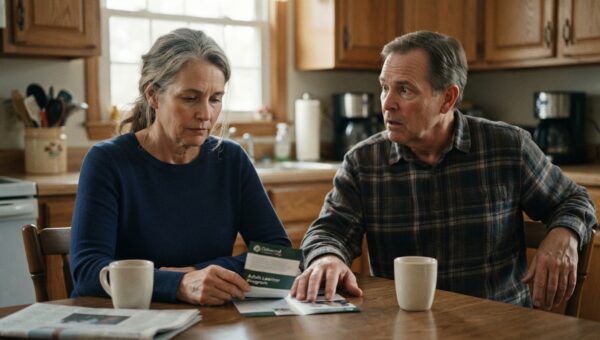
The next morning, I brought Nora a cup of coffee and a brochure for a driving school in town.
“You found one,” she said.
“I found three. This one has adult beginner lessons.”
“I’d like to call them.”
“I can sit with you if you want.”
She studied the brochure. “I’m nervous.”
“You should be. It’s new.”
She laughed. “That’s not very reassuring.”
“It’s honest.”
We called the school and booked a first lesson. Nora insisted on paying the fee herself.
When I told Matt, he frowned but did not argue. He said he would go with her to the first lesson, then left early for work before she could answer.
Nora and I went instead.
The instructor was a patient man named Jim who had taught people from age sixteen to seventy-five. He asked Nora what she wanted to learn and what made her nervous. She said parking lots and left turns. I sat in the back while she practiced in a small sedan with dual controls.
She kept both hands tight on the wheel. The car jerked forward once. She apologized.
“You don’t need to apologize to the car,” Jim said.
“I’ve spent a long time apologizing to people who are trying to help me,” Nora said.
I looked at her in the rearview mirror. She had never said that to me before.
After the lesson, I asked if she wanted to stop for lunch.
“Would that be inconvenient?”
“No.”
“I mean for you.”
“It’s my lunch hour. I can decide what to do with it.”
She smiled at that. We went to a diner and split a turkey sandwich. Nora told me about the first time she had wanted to learn. Her father had said there was no need because she would have a husband who drove. Later, Leonard offered to teach her, but she had already started driving with him everywhere. Then came children, work, and habit.
“I never asked myself whether I wanted it,” she said. “I only asked whether I needed it.”
“You need it now.”
“I do. But I also want to do it.”
That difference mattered. It made the lessons feel like something she was choosing, not a task she had been assigned.
Over the next few weeks, Nora had one lesson every Tuesday. She made mistakes. Once, she turned too wide and nearly clipped a curb. Another time, she forgot to check her mirror before changing lanes. Jim corrected her, and she listened carefully.
I started to understand what the lessons meant to Nora when we were sitting at her small kitchen table upstairs. She had laid out the road test paperwork and a map of town. The map was old, with her house marked in blue pen and the hospital marked in red.
“Why didn’t you learn before?” I asked.
She considered the question. “Because Leonard liked driving. He made it easier for me not to learn. Then I got used to it.”
“Did you ever ask him to teach you?”
“Once. He said we’d do it next weekend. The next weekend, the children had a game. The weekend after that, it snowed. By the time I asked again, I was embarrassed that I still didn’t know.”
She smoothed the map. “He wasn’t keeping me from anything. I let the matter go, a little at a time.”
I had been imagining that Matt’s concern was the only thing holding her back. It was not. She had decades of habit to work through, and she was the one doing it.
“Do you want to keep the apartment?” I asked.
“I like it. I can close my door. But I don’t like feeling as if I’m staying because you and Matt have made a place for me.”
“You can stay because you want to.”
“That’s what I’m trying to decide.”
I was surprised by how much I wanted her to say yes. The apartment was convenient for us. She was close, and I could see her light on in the evening. I had mistaken convenience for consent.
“You should decide what you want,” I said. “Not what keeps us comfortable.”
She looked at me over her glasses. “You’re a good daughter-in-law.”
“I’m not always.”
“No. Neither am I a perfect mother-in-law.”
We laughed.
Matt had started to notice our Tuesday schedule. He would text to ask whether his mother had made it to her lesson. Sometimes he offered to come along. Nora usually said no, but one rainy afternoon she asked him to join us. She wanted him to see that she could take direction from an instructor without becoming frightened or confused.
At the lesson, Jim asked her to make a three-point turn. She completed it slowly, then checked the mirrors. Matt sat in the back seat with his arms folded. When the lesson ended, he thanked Jim and carried Nora’s umbrella to the car.
“You were good today,” he told her.
“I was better today.”
“You were good, too.”
She nodded. He opened the passenger door for her, but she moved to the driver’s side.
“I’m driving us back.”
He hesitated, then let her.
On the way home, he sat quietly beside her. When she turned onto our street, he pointed at the driveway.
“Not that way,” she said. “The instructor says I need to practice the route to my church.”
Matt lowered his hand. “Right. Sorry.”
Nora drove on.
That evening, Matt told me he had not realized how often he spoke for his mother. He said he had been doing it since his father died, not because she was incapable, but because being useful was the only way he knew to show he missed his dad.
“I thought if I handled things, she wouldn’t have to be scared,” he said.
“She gets to be scared and still do them.”
He nodded. “I know that now.”
It was the first time he had said anything about his own grief without wrapping it in a warning about Nora.
Matt tried to help by giving her instructions from the passenger seat when we took her to the grocery store. Nora asked him not to.
“I can’t learn if you tell me every second,” she said.
“I’m just trying to help.”
“I know. Let Jim teach me.”
That night, Matt complained to me that his mother had “snapped” at him. I asked whether she had been wrong to ask him to stop.
He stared at the television. “She’s scared.”
“So are you.”
“I’m not scared.”
“You’re scared she’ll get hurt. You’re also scared she’ll stop needing you in the same way.”
He looked at me. “You think that’s what this is?”
“I think she has spent her whole life arranging herself around what other people thought was best for her.”
He sat quietly for a long time.
When Nora took her first road test, Matt came with us. She did not pass. The examiner said she had missed a stop sign at a low-speed intersection and needed more practice.
Nora sat in the car and held the paper in her lap. “I’m embarrassed.”
“You did the hard part,” I said. “Now you know what to work on.”
Matt leaned toward her. “Maybe we should think about whether this is worth it.”
Nora looked at him. “I’m not quitting.”
“I didn’t say you had to.”
“You said maybe we should think about it. I have thought about it.”
Matt opened his mouth, then shut it.
She took another month of lessons. The second test was on a rainy morning. She passed. She brought home the paper and put it on the kitchen table without saying anything.
“What happened?” Matt asked.
“I passed.”
He stood up so quickly his chair scraped the floor. “You did?”
She laughed, and he hugged her. He was proud. He was also relieved that the thing he had feared had not happened.
Nora’s first drive alone was to the grocery store and back. She took her time. When she returned, she parked beside the garage and sat for a moment with the engine off.
I came down the steps. “How was it?”
“Quiet,” she said. “I liked the quiet.”
She decided to keep driving short routes. The next week, she went to her church. Then she drove to a café to meet her friend Rose. She was not reckless. She checked the weather, planned her route, and avoided rush hour.
On the first rainy day after she passed, Nora called me before leaving the apartment.
“I don’t feel ready to drive in this,” she said.
“Would you like me to take you?”
“If you have time.”
“I do.”
She did not apologize for asking. I drove her to church, and she sat beside me with an umbrella on her lap. On the way back, she said, “I’m glad the license didn’t turn into a test I have to pass every day.”
“It doesn’t have to.”
“Good. I like knowing I can drive. I don’t have to prove it in every kind of weather.”
That afternoon, Matt asked if she had changed her mind about driving. I told him she had simply chosen not to drive in heavy rain.
“That makes sense,” he said.
It was a small sentence, but he no longer treated her decisions as evidence for or against her ability.
Matt stopped asking when she needed a ride. He still offered, but he waited for an answer.
A month later, Nora invited us to lunch at the diner. She drove there by herself and saved us a booth.
Matt looked at her keys on the table. “You drove all the way here?”
“I did.”
“How was it?”
“Fine.”
He smiled. “I’m proud of you.”
“I know.”
She turned to me. “Thank you for taking me to the school.”
“You did the work.”
“I know. It helped that you didn’t tell me I was too old.”
I had thought about the rides I would no longer have to give. I was surprised to find that I missed them a little. They had become our time together, even when I resented the obligation.
“Want to take me to the garden center next week?” I asked.
“Do you want a ride, or do you want company?”
“Company.”
“Then I’ll pick you up.”
The next Tuesday, she drove us to the garden center. She waited for me while I chose basil and marigolds. On the way home, she took the longer road because the traffic was lighter.
At the garden center, Nora bought two small pots of lavender for the apartment balcony. She asked me which one looked stronger, then chose the other because she liked the color.
“I’m allowed to pick the one I like,” she said.
“You are.”
“I know. I’m practicing.”
We laughed. The flowers sat between us on the back seat while she drove us home.
That evening, she sent me a picture of them on the balcony. I wrote back that they looked good. She answered, “They look like mine.”
I understood what she meant. The little apartment, the license, the flowers, the quiet drive: none of it was dramatic. It was a life she had chosen for herself, one ordinary decision at a time.
I sat beside her and watched the familiar streets go by. Nora was still my mother-in-law. She was still part of our family. But she was no longer just the person I drove to her appointments.
She had a key, a car, and somewhere she wanted to go.