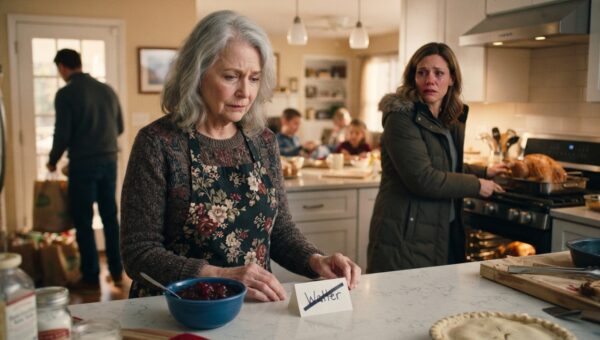
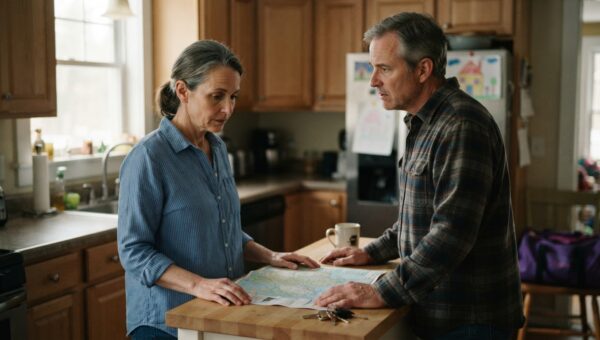
The autumn wind in our corner of western Pennsylvania always smells like wet coal dust and dead leaves, but that Tuesday morning my kitchen smelled like burned toast and instant coffee. We were sitting around the drop-leaf table where my father had eaten his morning eggs for forty-two years. The house still felt heavy with his absence, the air thick with the sort of quiet that settles in when someone who took up a lot of room finally stops breathing.
Mom pushed her ceramic mug away, leaving a dark brown ring on the laminate, and looked at the three of us with dry, tired eyes. She didn’t cry anymore. She just looked flat, like an old battery.
“Your father didn’t plan well,” she said, her voice dropping into that dull, final register she used whenever she wanted an argument to die before it started. “There wasn’t any policy. We let the whole thing lapse back when the mill cut hours in ninety-eight.”
I remember looking around the table, waiting for one of my brothers to say something, but nobody did. We all just nodded because we were tired and grieving and nobody wanted to dig into bank statements while the dirt on the grave was still settling. I believed her because she was the beneficiary and I didn’t want to question her grief. Part of me wanted to pretend I hadn’t noticed the tight way she held her purse whenever the mail came.
Once you ask the right question, you can’t always go back to the old version of your family. I probably would’ve dropped it if not for one thing.
The next few weeks were a blur of cold casseroles and thank-you notes that felt hollow. It was nearly November when I finally went up to the spare bedroom to clear out Dad’s old metal desk. It was a utilitarian green thing he had salvaged from the basement of the old union hall back when Reagan was in office. The drawers were packed with loose receipts, expired coupons for tractor parts, and a stack of yellowed tax folders held together with rusted paperclips. I was just dumping the junk into a black garbage bag when a small, folded slip of heavy cream paper slid out from the back of the ninety-four folder. It wasn’t a tax form. It was a premium statement from a mutual life company in Harrisburg, showing an automatic bank draft that had cleared every single month right up until the spring before he died.
I sat back on the edge of the squeaky twin bed, the paper feeling entirely too crisp against my thumb. The numbers didn’t make sense with what Mom had said at the kitchen table. The monthly amount was small, but multiplied across decades, it represented a steady, deliberate investment that a man who supposedly left nothing behind simply would not have maintained. I didn’t think about fraud then. I just thought there had been a misunderstanding, or maybe Mom had simply forgotten in the fog of the hospital visits and the funeral arrangements. I only wanted one clear answer so I could put the folder away and stop feeling that strange, nagging itch behind my ribs.
Two days later, I sat at my own kitchen counter with the phone pressed to my ear, listening to the automated prompts tick away while the kettle hissed on the burner. I called the insurer only to close the file properly.
I was still trying to process it, half-expecting some polite clerk to tell me the policy had expired twenty years ago and be done with it. Instead, after a long series of muffled clicks and a ten-minute wait while the agent checked archives, the tone on the line shifted from bored routine to something cautious. The representative said the claim had been paid six months earlier to two beneficiaries.
“Two?” I said, staring out the window at the neighbor’s bare apple tree. “There must be some mistake. My mother was the sole survivor.”
“No, ma’am,” the voice on the other end said clearly, the keyboard clacking softly in the background. “The disbursement was split fifty-fifty per the updated rider on file. Half went to Martha Vance, and the remaining balance was distributed to Arthur Miller of Altoona.”
The name sat in the air between the toaster and the microwave like a dropped brick. Arthur Miller. I had never heard that name in my life. My parents had two children, my brother Ray and me, and as far as anyone in our family tree was concerned, that was the entire branch. I thanked the clerk in a voice that didn’t sound like mine, hung up the phone, and just stood there for a long time watching the little red light on the coffee maker blink in the quiet room.
The investigation wasn’t complicated once I actually started looking through the bottom of Dad’s metal box. Behind a stack of old property deeds, I found a narrow ledger book with his handwriting, neat and slanted like he was keeping score in a very slow game. There were names and dates and small, careful notes about money sent through postal orders back in the seventies and eighties, long before Ray or I were born. One entry listed a birth certificate. Another listed a child support payment receipt from a courthouse fifty miles away. Dad had a life before Mom, a brief, forgotten marriage that ended in a quiet separation when he was barely twenty-two, and a little boy who had been left behind on the other side of the mountain when Mom and Dad started over.
I didn’t sleep that night. I kept seeing Dad sitting in his worn armchair in the corner of the living room, listening to the radio with his eyes closed, looking like a man who carried a heavy bag and never once complained about the straps digging into his shoulders. Mom had known. She had to have known every time she signed those annual renewal notices or looked at the deduction on their joint checking account statement. She hadn’t forgotten a thing. She had simply buried the past so deep she probably started believing her own story about how my father didn’t plan well.
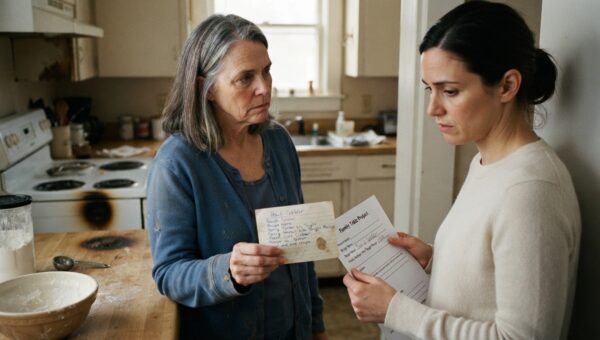
The next afternoon, I drove out to Mom’s house with the bank statements and the printed ledger pages tucked inside a manila folder on the passenger seat. The little white house looked smaller than it used to, the aluminum siding faded to a chalky gray where the hemlock tree dripped sap on it every spring. When I let myself in through the back porch, the smell of vinegar and wood polish hit me instantly. Mom was standing at the sink, rinsing a single ceramic plate under a thin stream of cold water. She didn’t turn around right away, but she must have heard the way my boots hit the linoleum.
“You’re late,” she said, her voice dry. “I thought you were bringing those groceries an hour ago.”
I didn’t answer. I walked over to the kitchen table, the exact same table where she had told us about the nonexistent insurance policy, and dropped the manila folder right in the middle of the flowered oilcloth. The papers made a sharp, dry slap against the surface. Mom turned around then, drying her hands on a checkered dish towel, her eyes narrowing as she looked at the brown cardboard tab sticking out of the folder.
“What is this?” she asked.
“You told us he didn’t leave anything,” I said, and my voice sounded rough, like it was dragging over gravel. “You sat right there and told us he didn’t plan well.”
Mom didn’t flinch. She folded the dish towel twice, very carefully, and laid it down beside the butter dish. “Your father was a stubborn man. He didn’t think about tomorrow.”
“Arthur Miller is a stubborn man too, I guess,” I said, watching her face. “Or at least he would be if he knew his father left him thirty-eight thousand dollars six months ago.”
The color didn’t drain from her face because Mom wasn’t the type to turn pale or cause a scene in the movies. She just went completely rigid, the skin around her mouth tightening into a hard white line that looked like a scar. The kitchen grew so quiet I could hear the refrigerator compressor humming down in the corner, rhythmic and steady, like a clock running out of time.
“Where did you get that?” she whispered.
“In his tax folder,” I said. “The one you told me to throw away in the green trash bin outside. I called the insurance company, Mom. They told me about the dual payout. They told me about the split disbursement that went out before the funeral even made the local paper.”
She reached out and gripped the edge of the table with both hands, her knuckles showing yellow beneath the thin, liver-spotted skin. “He didn’t have any right to that money. Not after what he did to this family before we even built this house. That boy wasn’t part of us. He was a ghost from a summer twenty years before you were even a thought in your father’s head.”
“He was Dad’s son,” I said, and the words felt heavier than I expected. “That doesn’t make him a ghost just because you didn’t want him in the family album.”
“Your father worked thirty-five years at that stamping plant,” she said, her voice rising now, losing its flat edge and turning sharp and bitter. “He gave every drop of sweat he had to pay off this mortgage and keep food on this table. That woman took everything he had when he was twenty-three, and he spent the rest of his life paying for a mistake he made before his beard even grew in. I earned every cent of that policy by staying through the strikes and the hospital stays and the winters when we didn’t have coal. I earned it.”
She wasn’t crying. She was just angry, the deep, ancient anger of a woman who had built her entire life on a foundation she had to guard with her fingernails. I looked at her across the table, and for the first time I didn’t see the mother who kissed my scraped knees or baked me birthday cakes. I saw a stranger who had spent forty years protecting a fortress against an enemy who wasn’t even trying to get in.
“You kept it all,” I said quietly. “Every last dollar of it.”
“There wasn’t enough to matter,” she muttered, looking down at the oilcloth. “And now it’s gone into the roof repair and the back taxes. It’s spent.”
It wasn’t spent. I knew that from the deposit slips I found in the second folder, sitting in a neat stack inside her savings account book at the local credit union. But I didn’t argue with her about the numbers anymore. There was no point in tearing the house down brick by brick when the foundation was already cracked straight through the middle. The unquestioning trust I once placed in her was gone, replaced by a cold, wide distance that wasn’t going to close up just because we shared a last name.
I didn’t yell at her, and she didn’t apologize. We just stood there in the quiet kitchen while the afternoon light slowly shifted off the linoleum and crawled up the wallpaper near the pantry door. I picked up my folder, left the bank statements where they were on the table, and walked out without saying goodbye.
The rest of that week was long and quiet. I spent two evenings sitting at my desk with a local directory and a legal pad, tracking down an address in Altoona that matched the name on the insurance register. It took three phone calls to various county offices before I found a number for a plumbing supply warehouse where an Arthur Miller had worked as a dispatcher for twelve years. I didn’t call him right away. I didn’t know what I would even say, or how you explain to a fifty-year-old man in another town that his father had remembered him in the end, even if the woman in the kitchen tried to make sure the message never reached him.
By Sunday morning, I had made up my mind. I drafted a short, careful letter on plain white paper, explaining who I was and what had been left behind by a man we both called Dad, though we never shared the same roof. I didn’t ask for forgiveness on behalf of anyone else, and I didn’t make excuses for the way things turned out. I just enclosed the check for the restitution amount I had calculated from my own savings, matching the exact half that should have crossed his threshold six months before.
When I finished sealing the envelope, I drove back out to Mom’s house while I knew she was at the afternoon church social. I didn’t go inside. I just walked up the wooden steps of the back porch and placed the single stamped envelope right in the corner of the kitchen table, right beside the spot where she had told her first lie about the insurance policy. It sat there white and stark against the dark wood, marking the exact spot where the old version of our family ended and the truth finally took its place.