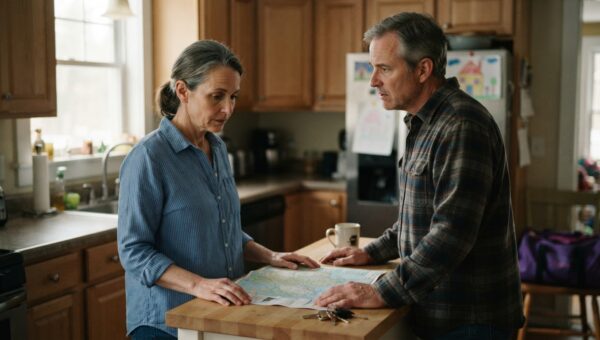
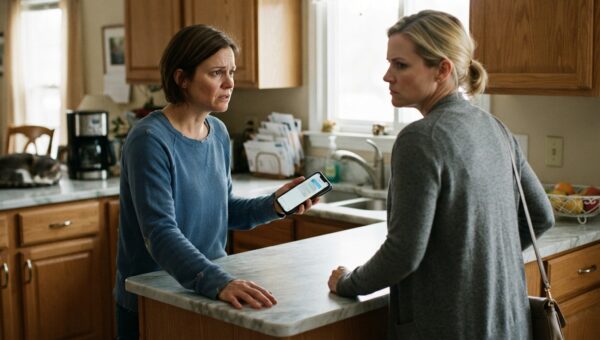
My daughter had written Walter’s name on the place card, then crossed it out before I arrived.
She left the card beside my plate at the kitchen counter, as if I might not notice the thick black line through his name.
“Is this a mistake?” I asked.
Ellen looked at the turkey in the oven. “I thought maybe this year we could keep it to family.”
“Walter is family to me.”
“He’s been your friend for six months.”
“Eight.”
She lowered her voice. “Mom, this is the first Thanksgiving without Dad where you’re bringing somebody.”
“It’s the fifth.”
“That doesn’t mean it gets easier.”
I put the place card down. For a moment I could smell the sage from the roasting pan and the cinnamon in the sweet potatoes.
I had brought the cranberry sauce in the blue bowl my husband, Bob, used to complain was too small. He had complained every year and eaten most of it.
“I’m not bringing someone to replace your father,” I said.
Ellen pressed her lips together. “I didn’t say that.”
“You didn’t need to.”
She was still wearing her coat. Her husband was unloading bags from the car, and my grandchildren were arguing over a tablet in the living room. The house was full of familiar noise, but something in the kitchen had gone quiet.
Walter was waiting in the car outside. He had offered to drive separately. He had even brought his own pie so no one would feel he had arrived empty-handed.
I looked at the card again. “Did Mark ask you to do this?”
“No.”
“Did the children?”
“No.”
“Then tell me what you want.”
Ellen’s eyes filled. “I want one day where I don’t feel like the past is getting pushed out.”
I was seventy-one years old. I had been married to Bob for forty-three years.
For the first year after he died, I left his chair empty at the table. I kept his slippers by the bed. I did not wash the blue sweater hanging in the closet because it still smelled like his aftershave.
I knew what it was to be afraid that loving someone new meant losing someone old.
The first Thanksgiving after Bob died, Ellen had insisted we leave his chair at the table. She placed his napkin beside the empty plate and kept looking toward the kitchen as if he might still come in late. After dinner, she asked if I thought I would ever want to move his things. I told her I did not know. She said she did not want me to forget him. I told her I could not forget him if I tried.
For months, we each watched the other for signs of moving on. Ellen would ask whether I had gone to the garden club.
I would ask whether she had called her brother. We were both trying to keep one another from being alone, and neither of us knew how to ask for a different kind of company. That was why the crossed-out card hurt. I had thought we had learned to let each other change at a different pace.
“I will tell Walter he doesn’t have to come,” I said. “But I’m not pretending he doesn’t matter to me.”
Ellen looked relieved and wounded at once. “I’m sorry.”
“I know.”
I picked up the place card and turned it over. On the back, I wrote Walter’s name in my own handwriting.
I had not always planned to meet anyone after Bob. I had planned to be fine. I kept busy with the garden club and my two shifts a week at the library. I made myself answer the phone when the children called.
I tried not to measure my life by the quiet after dinner.
Walter came to the botanical garden one Tuesday morning with a thermos of coffee and a paper bag of apples. He had been volunteering there for years. I had seen him before, but we had never spoken beyond the polite exchange people make when they reach for the same pair of pruning shears.
That day, he asked if I knew the name of a plant with purple berries.
“I’m the person who keeps the labels from falling out,” I said. “I’m not an expert.”
“Good,” he said. “Then I can tell you something confidently wrong, and neither of us will know.”
I laughed. He had the calm face of someone who had spent a long time learning not to rush a person.
We started talking during our shifts. He had been widowed too. His wife, June, had died eight years earlier. He told me about her when it came up, not as an apology and not as a test. He never asked me to stop saying Bob’s name.
When he invited me to a chamber music concert, I almost said no. Then I looked at the ticket in his hand and thought about how many evenings I had spent waiting for the day to feel less strange.
I said yes.
That did not make me less married to the past. It made me less alone in the present.
The children did not mean to punish me. They had each responded to Bob’s death differently. Mark called every night for a year, then stopped when his new job took over his schedule. Ellen stayed in the house with me for two weeks, sleeping on the couch because she did not want me to be alone. They had carried their own memories, and sometimes they mistook my moving forward for a request that they do the same.
The first time I brought Walter to meet them, we had lunch at a café near the river. I told the children he was a friend from the garden. That was all I said. My son Mark shook his hand and asked what kind of work he had done before retirement. Ellen asked how long he had been widowed. They both tried to sound casual.
Walter answered without making the conversation about himself. He had been a mail carrier for thirty-one years. His wife had been a music teacher. She had loved crossword puzzles and hated driving at night. He did not describe her as perfect. He told one story about her leaving a shopping cart in the middle of a parking lot because she had spotted a cardinal.
Ellen smiled at that. Mark did not.
On the ride home, Mark said, “I’m glad you have people to spend time with.”
I knew the sentence was meant to be kind. “People?”
“Friends.”
“Walter is a friend.”
“Okay.”
He watched the road as if there were something important on it. I waited for him to say more, but he did not. I could see him trying to understand what role a new person could have in our family without displacing anyone. I was trying to understand it, too.
The next month, my granddaughter Maya asked whether Walter would sleep in Grandpa’s room if he came to dinner. She was eight and had never known a world without her grandfather’s name in our house. I told her no, he would go home afterward.
“Is he Grandpa’s friend?” she asked.
“He never met Grandpa.”
“Then how does he know he can come here?”
I had no neat answer. “I invited him.”
She thought about that. “Okay.”
I was relieved by her simple acceptance. It reminded me how often adults make children carry meanings they have not asked for.
When Ellen asked me not to bring Walter on Thanksgiving, I knew it was not the first time grief had made her defensive. She had called me the week before to talk about the old recipe book she had inherited from her father. She wanted to make his pecan pie for the first time, then worried that the recipe would taste wrong. I told her to try it. She said she did not want to ruin one more thing.
I understood then that the crossed-out place card was not really about Walter. It was about the way ordinary days kept taking pieces of Bob away. Every meal we ate without him felt like evidence that the world was continuing. Ellen did not want to betray him by letting the day change.
I could understand the fear without agreeing to live inside it.
I sat in the passenger seat beside Walter while the autumn leaves slid across the road.
“You don’t have to come in,” I told him.
He looked ahead. “I know.”
“I don’t want you caught in the middle of something.”
“I’m not in the middle. I’m in the car.”
I smiled despite myself.
“Would you rather go home?” I asked.
“No. I’d rather go in with you. But I don’t want the children to think you brought me to prove a point.”
“Neither do I.”
He turned to me. “Then go in because you want me there.”
“I do.”
He nodded. “That’s enough.”
Inside, the house smelled warm and crowded. Mark and his wife were already there. My grandson ran to me, and my granddaughter held up a drawing of a turkey wearing a crown. Ellen came out of the kitchen.
“Walter, you made it,” she said.
“I brought pie,” he said. “It’s apple, and I made it badly, so no one needs to be impressed.”
My granddaughter took the pie from him and carried it to the counter.
At the table, Walter sat beside me. Mark sat across from us. Ellen had kept Dad’s chair at the head, though she had never asked me whether she should. I had not asked her to remove it. It was a chair, and we all understood why it was there.
My son raised his glass. “To Dad,” he said. “He would have loved having this many people at his table.”
It was a kind toast. I felt the old ache, and I did not mind feeling it. My grandchildren clinked their juice glasses. Walter lifted his glass and said, “To Bob.”
Mark looked across the table at him. “Dad would have liked that,” he said.
Walter nodded. “I wish I’d met him.”
“He would have asked what you did for a living,” Mark said.
“And then told me how to fix something.”
Mark laughed. It was the first time he had spoken about his father to Walter as if they shared the same room, instead of guarding the memory between them.
Ellen glanced at him. She had not expected him to say my husband’s name so naturally.
After dinner, Walter helped Mark wash dishes. They talked about a baseball game. My daughter stayed in the living room with me.
“Did you really think I was trying to replace Dad?” I asked.
“No,” she said. “I think I’m afraid of forgetting what he was like.”
“You won’t.”
“You don’t know that.”
“I know you. You tell the same stories every year.”
She smiled weakly. “He did burn the rolls every Thanksgiving.”
“He insisted the oven was calibrated wrong.”
“I remember.”
We sat with our coffee. The grandchildren were playing with the toy train Bob had assembled from a kit years ago. One of them had put a plastic horse in the coal car.
“Mom,” Ellen said, “I don’t want you to be lonely.”
“Then don’t ask me to prove I loved your father by staying lonely.”
She looked down at her hands.
“I’m sorry I crossed out his name,” she said. “I was upset, and I thought if Walter came, I’d feel like Dad had become one of the people we used to know.”
“He has become someone we used to know. That’s what death does. It doesn’t make him less your father.”
“I hate that.”
“I do, too.”
She moved her coffee cup aside. “What do you like about Walter?”
“He lets me finish a story even when he knows how it ends.”
Ellen laughed, then covered her mouth. It sounded too much like Bob’s laugh, which is why she had stopped herself.
“Does he make you happy?” she asked.
“He makes me feel like I have a life that belongs to me.”
She nodded slowly. “That sounds good.”
“It is.”
The next morning, Walter called to ask whether I had left his pie plate. I told him I had put it by the sink. He offered to come get it, then asked if I wanted to walk through the garden.
I was putting on my coat when Ellen came by to collect her scarf. She saw me at the door.
“Are you going out with him?”
“Yes.”
She hesitated. “Would you ask him to come to Maya’s school concert next week? If he wants to. I don’t want him to think he has to stay home because we’re still sad.”
I looked at her carefully. “You don’t have to invite him to make me feel better.”
“I know. I’d like him there.”
At the concert, Walter sat at the end of the row. Maya sang loudly and off-key, exactly as I had done at her age. Afterward, Ellen introduced him to the other parents as “Mom’s friend Walter.”
After the concert, Ellen stayed behind to help the teacher fold chairs. Walter offered to carry the music stand, but Maya insisted she could do it. He let her. I watched the two of them walk down the hall together, talking about the song Maya had liked best.
Ellen came back to me with a box of programs.
“I’m glad he came,” she said.
“Me too.”
“He doesn’t try to act like Dad.”
“He couldn’t, even if he wanted to.”
“I know.” She rubbed the edge of a program with her thumb. “I think I was afraid you would start saying you were happier with him than you were with Dad.”
“I was happy with your father. I’m happy with Walter. Those are different parts of my life.”
She nodded. “I’m still learning that.”
“So am I.”
We walked outside together. Ellen took one side of the program box, and I took the other. No one asked her to choose a feeling before we got to the car.
It was a small phrase. It gave him a place without asking anyone to change the past.
On the drive home, I thought of Bob in the blue chair, Walter in the passenger seat, my daughter in the school auditorium. Grief had not disappeared. It had simply stopped insisting that every room remain exactly as it was the day Bob left.
The following Thanksgiving, I set out the blue cranberry bowl again. Walter brought a pie. Ellen wrote his name on the place card and did not cross it out. Mark made the toast. He raised his glass to his father and then to all the people still sitting around the table.
He told Walter one of Bob’s favorite jokes, the one about a plumber who charged extra for a leak he couldn’t find. Walter laughed at the wrong place, and Mark explained the punch line. They were sharing a memory, not testing whether anyone deserved it.
I missed Bob. I loved my children. I was glad Walter was there.
For once, I did not feel as if those truths needed to compete.