PART 1
My husband insisted I close my small bakery because it wasn’t real income.
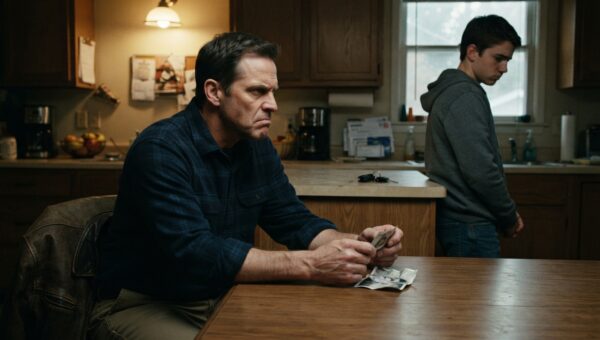
We were sitting at the kitchen table on a Sunday night, the same round oak table where I used to help our two boys with their fourth-grade spelling lists. Greg had his iPad propped against the salt shaker, scrolling through our joint checking account with his thumb while his tea cooled.
“You’re exhausting yourself for pocket money, Claire,” he said. He didn’t even look up from the screen. “You were on your feet for ten hours yesterday. You smelled like vanilla and burned butter, and for what? Three hundred dollars after supplies? It’s silly. Our kids are grown and out of the house. You don’t need a hobby that takes over the whole garage.”
I had spent years being the person who kept the peace, so my first instinct was to swallow it again. There was more history behind it than anyone at the table seemed to remember. When Greg was laid off from the machine parts plant back in 2011, I took on three night cleaning shifts at the elementary school so we wouldn’t miss a mortgage payment. I never called that money small. I never called his work small when he spent four years trying to flip used boats in our side yard and lost nine thousand dollars doing it.
I built my bakery from my kitchen table after our younger boy, Tyler, moved into his college dorm five years ago. I started with birthday cakes for neighborhood kids, then got my commercial kitchen license, took over the back half of the utility garage, and bought a used four-tray convection oven with my own savings. I was proud of that oven.
“It’s not just pocket money, Greg,” I said softly, wiping down the edge of the placemat. “I covered the property taxes last November. I paid for my own flour, my butter, my insurance, and the new mixer.”
“And that’s great,” he sighed, finally locking his screen and looking at me with that patient, heavy expression he used whenever he thought I was being difficult. “You proved you could do it. But you’re fifty-six. You should be resting. We could turn that back space into a proper storage room for my lawn tractor and the golf clubs.
Think about it. Just wrap up whatever little jobs you have on the calendar this week and let it go.”
I didn’t want to be the suspicious one, and honestly that kept me quiet longer than it should have. When a marriage lasts thirty-one years, you learn which hills are worth dying on, and Greg had always been particular about our house looking like a quiet retirement home rather than a working business.
I probably would have dropped it if not for one thing: a wholesale order for 900 cookies.
The request had come through my bakery email three days earlier from the sales office at the Riverfront Grand Hotel downtown. They had an annual regional banking symposium coming up the following Thursday, and their catering director wanted 900 custom-embossed almond shortbread rounds packaged in individual gold-tied boxes. The quote I sent back was $2,700, with half down as a deposit.
It was the largest single order I had ever received. It was the kind of account that could turn my seasonal weekend hustle into a steady, year-round commercial contract.
When I checked my laptop after Greg went up to bed, the confirmation email was gone from my inbox.
I opened the trash folder. The email was sitting right there, marked as read, moved at 4:15 that afternoon while I was at the grocery store buying twenty pounds of unsalted butter.
I stopped arguing and checked for myself.
The next morning, at eight-fifteen, my phone rang while I was pulling a test batch of shortbread from the oven. The caller ID showed the downtown hotel. The woman on the line asked for me by name.
Her voice sounded cautious. “Claire? This is Megan Vance, the events coordinator at Riverfront Grand. I’m calling because a gentleman called our office twenty minutes ago from your primary contact number. He said he was your business manager and told us you had a family emergency, so we needed to release the catering slot to our backup vendor. I wanted to verify that with you directly before we processed the cancellation.”
PART 2
I stood by my stainless prep table with the hot baking sheet still resting on the wire cooling rack. The sweet, warm smell of toasted almond filled the room, but my stomach went completely cold.
“Megan,” I said, keeping my hand steady against the edge of the counter. “Who gave you that message?”
“He said his name was Greg Miller,” Megan replied. She sounded relieved to hear my voice. “He said you had sudden family obligations out of state and wouldn’t be able to fulfill large-volume contracts for the foreseeable future. He asked us to void the invoice and take your bakery off our approved vendor list. But your proposal was so detailed, Claire, and our general manager specifically loved your samples. It didn’t sound right to me.”
“I am not out of state,” I said, speaking every word with deliberate care. “There is no family emergency. My bakery is fully operational, and I will have all 900 boxed shortbread cookies delivered to your service entrance by six in the morning on Thursday, exactly as agreed in the contract.”
“Wonderful,” Megan said. “I’ll keep the purchase order active and email the signed vendor agreement directly to your private address right now. We’ll see you Thursday, Claire.”
I hung up the phone.
My heart was beating in my ears, but my hands didn’t shake. I walked into the kitchen, picked up Greg’s coffee mug from the sink, washed it, dried it, and put it away in the cupboard. Then I went into his small home office near the front door.
Greg had already left for his part-time consulting job at the distribution center. His desk was neat, with his bills stacked in a wire basket and his daily planner open to Monday.
I opened the top desk drawer. Underneath a pad of company letterhead was a thick gray folder from a local commercial property firm called Keller & Woods.
Inside was a signed listing agreement dated October 12, four weeks ago.
Greg had listed our detached two-car garage and the adjacent side parcel for lease as a private commercial storage depot. The broker’s flyer had full-color pictures of my garage, but the photos had been cropped tightly to show only the concrete floor, the reinforced electrical panel, and the rear roll-up door. The listing price was $1,100 a month.
Underneath the broker agreement was a printout of an email exchange between Greg and an independent landscaping contractor named Dale Rourke. Dale had agreed to take the space starting December 1 to store two commercial riding mowers, three trailers, and his winter salt reserves.
Dale’s message from Friday afternoon read: *We’re ready to sign the two-year lease and hand over first, last, and deposit on Monday night, Greg. Just make sure that back room is totally cleared out of tables and baking equipment by November 28 like you promised.*
Greg hadn’t asked me to close my bakery because he worried about my tired feet. He hadn’t asked me to quit because he wanted a quiet retirement.
He had secretly rented out my workspace behind my back for $1,100 a month to pay for something he hadn’t told me about, and my 900-cookie corporate contract was standing directly in the way of his timeline.
I stood there in the quiet office holding the paper. I looked at the bottom of the lease draft where a line was marked for *Owner / Co-Owner Signature*.
Greg had signed his own name on the first line.
The second line, the line for my signature, was completely blank.
PART 3
The title to our house and the detached garage had been held in both of our names since we purchased the property in 1996. Greg couldn’t legally execute a commercial lease on our residential parcel without my written consent, and any real estate attorney with ten minutes of training would know it. But Greg had always assumed that if he presented me with a done deal and a little pressure, I would fold to keep the peace.
He had done it when he bought the boat. He had done it when he loaned his brother four thousand dollars without asking me. He expected me to cry, feel overwhelmed, and then quietly pack my mixing bowls into cardboard boxes.
I didn’t pack a single bowl.
I spent the next three days working. I woke up at four in the morning, tied my apron, and measured 45 pounds of unbleached flour, 22 pounds of butter, and ten pounds of powdered sugar. My friend Sarah from church came over on Tuesday and Wednesday to help me tie the satin ribbons on the white bakery boxes.
Greg came home on Tuesday evening and found four hundred cookies cooling on the bakers’ racks.
He stopped in the doorway of the garage, his jacket half-unbuttoned, his face dark with irritation. “What is all this, Claire? I thought we agreed you were winding down this week.”
“I have an order to deliver, Greg,” I said, sliding another tray into the oven without looking at him.
“I told you on Sunday, you don’t have the stamina for this kind of volume,” he snapped, his voice rising. “You’re acting like a stubborn child. You need to call these people and tell them you can’t handle it.”
“I already spoke to the client,” I said, setting the timer for twelve minutes. “She called me on Monday morning. She told me a man named Greg Miller called to cancel my order on my behalf.”
Greg froze. His hand stayed on the door handle.
“Claire, I was just trying to protect your health,” he said, though his voice dropped an octave, losing its confident authority. “You were running yourself ragged. I was trying to take the pressure off you.”
“The lease with Dale Rourke is on your desk, Greg,” I told him plainly. “The one where you promised him he could move his mowers in on December first for eleven hundred a month.”
He stared at me, his mouth opening slightly before he closed it again. He didn’t deny it. He couldn’t.
“That was extra income for us,” he muttered, looking down at his shoes. “It would have brought in over thirteen thousand dollars a year without you having to lift a finger. It was for our retirement.”
“It wasn’t for our retirement,” I said. “You listed the garage because you wanted control over the property, and you thought I would never check the trash folder on my computer. You tried to sabotage my business to cover a promise you had no legal right to make.”
“Claire, listen to me—”
“I have five hundred more cookies to bake tonight,” I said. “Get out of my kitchen.”
He stood there for five seconds, waiting for me to soften the blow. When I turned my back to pull the next batch of dough from the cooler, he turned and let the door bang shut.
At five-thirty on Thursday morning, Sarah and I loaded eighteen heavy catering cartons into the back of my station wagon. We drove through the quiet city streets to the loading dock of the Riverfront Grand Hotel. Megan Vance met us at the service elevator with two luggage carts and a clipboard.
Every single box was tied with a clean gold ribbon, sealed with my bakery label, and accompanied by the required allergen certification.
At seven o’clock, Megan handed me a corporate cashier’s check for the remaining balance of $1,350, along with a signed vendor contract for four upcoming quarterly conferences in the new year.
“These are stunning, Claire,” Megan said, sliding the folder into my hands. “Our general manager wants to discuss providing morning pastries for their executive suites starting in February. We’ll be in touch next week.”
I took the check, folded it into my pocketbook, and drove straight to the bank.
ENDING
I opened a separate business account at First Merchants Bank that morning, placing the hotel’s payment directly into my own name with my bakery’s corporate tax ID.
When I got home at nine o’clock, a white pickup truck with *Rourke Landscaping* printed on the door was idling at the curb in front of our house. Greg was standing on the front lawn, his hands shoved deep into his coat pockets, talking to a tall man in a canvas work vest.
I parked in the driveway, got out of the car, and walked across the grass.
“Morning, Greg,” I said. Then I turned to the driver. “Mr. Rourke?”
“Yes, ma’am,” the man said, touching the brim of his cap. “We were just finalizing the keys for the garage rental.”
“There are no keys,” I said pleasantly. “This property is deeded jointly. I am the co-owner, and I operate a licensed, certified commercial baking facility in that detached building. I have not signed a lease, and I will not be signing one. If you store equipment here, it will be trespassing on a regulated food production site.”
Dale Rourke looked at Greg. Greg’s face was bright red, his jaw clenched tight, but he didn’t say a single word.
“You told me your wife was onboard with this, Miller,” Dale said, his tone turning sour.
“There was a misunderstanding,” Greg mumbled, looking everywhere except at Dale’s face.
Dale shook his head, climbed back into his truck, and put the transmission into reverse. “Don’t call my office again.”
The truck pulled away, leaving our street completely quiet in the crisp morning air.
Greg turned on his heel and walked into the house without looking at me.
We didn’t yell that evening. We didn’t have a dramatic shouting match over dinner. But the silence that settled over our kitchen table was different from the silences we used to have. The dynamic that had carried our marriage for thirty years—where Greg made the executive decisions and I adjusted my life to keep the peace—was over.
Two days later, I hired a local handyman to install a deadbolt on the garage door. The key stays on the ring in my handbag, right next to the keys for my car and my bank deposit pouch.
Greg stays in the main house, watching his morning sports shows from the recliner in the living room. He doesn’t come out to the back building anymore, and he hasn’t mentioned the lawn tractor, the golf clubs, or my tired feet since the hotel truck pulled away.
This morning, I unlocked the heavy back door at five o’clock.
The garage was warm from the pilot lights, smelling of brown sugar, butter, and cinnamon. I tied my white apron around my waist, set my metal mixing bowl on the counter, and turned the dial on my commercial oven. Outside the small window above my prep table, the sun was just beginning to rise over the fence line, bright and steady in the cold November sky.
I pressed my hands into the soft, floured dough on the wooden board, listened to the steady hum of the fan, and went right to work.