PART 1
My husband complained that I had become boring after twenty-eight years of marriage, so I stopped trying to impress him.
Warren said it on a Sunday evening while scraping leftover pot roast into the garbage disposal. He was fifty-four, a senior underwriting consultant at an insurance brokerage, and he had recently started wearing fitted dress shirts and going to an upscale gym near the interstate.
He didn’t yell. He just looked at me over the counter and said my world had gotten too small for him. He said listening to me talk about the community choir or grocery discounts drained whatever energy he had left after a long week.
I wore my old sweaters, planted tomatoes, and spent Saturday mornings at the library. I kept the kitchen clean, folded his laundry, and stayed out of his way. I figured that was what people did when thirty years of marriage thinned out into quiet tolerance.
Then on a rainy Thursday afternoon in October, I went into his study to retrieve the title paperwork for our water heater. Warren was at a regional conference in Indianapolis until Saturday.
Underneath a stack of old warranty booklets in the bottom drawer of his walnut desk, I found a black spiral-bound notebook.
At first, I thought the notebook was a bad joke until I recognized the names.
The handwriting was unmistakably Warren’s, neat and heavy with a blue ballpoint pen.
Across the first six pages were detailed timelines for selling our three-bedroom brick house on Sycamore Lane, closing our joint money market fund, and relocating to an apartment in Sarasota. A woman named Patricia was named in the margin with notes about her rental lease ending in February. Patricia was his firm’s regional marketing coordinator, someone he had brought to our summer cookout two years ago.
Below that were dates and specific dollar amounts. Then came a page that made my hands shake.
Warren had kept a visitor log from the previous four months. There were entries for three separate Tuesday nights in July and August with arrival times around one in the morning, noting that Patricia had visited our house while I was asleep in the back bedroom upstairs after taking my nightly allergy medication.
I read it twice.
I quietly copied every page with my phone’s camera, making sure the timestamps and his handwriting were crisp and sharp in the desk lamp’s light.
Then I turned to the final page of the notebook.
It was dated three months in the future, January 14.
At the top of the sheet, centered in boxed block letters, was an outline for a memorial funeral service at St. Jude’s Chapel.
Below it was a proposed guest list of forty people, complete with checkmarks beside his coworkers’ names.
At the bottom of the list, written right beside my name, was a single circled sentence: “Do not let her hear the recording.”
PART 2
I stood by Warren’s desk for ten minutes without moving. The only sound in the house was the rain dripping from the gutter into the flowerbed.
I put the notebook back exactly as I had found it, under the yellowed manuals, and slid the drawer shut until the latch clicked. Then I went to the kitchen table, sat down with my phone, and backed up every single photo to a secure cloud drive tied to a private email Warren knew nothing about.
A memorial service dated for January 14. A guest list with our cousins, his office partners, and his golf friends. And beside my name, an order to keep me from hearing a recording.
My mind went to terrible places. People read about husbands tampering with brake lines or slipping substances into prescriptions, and for an hour, I sat looking at my nightly allergy tablets on the kitchen counter. But Warren was an underwriter. He spent his days calculating risk models, reviewing claims, and structuring legal payouts. He was cautious to the point of obsession. He did not take reckless physical risks.
I forced myself to read through the photos again, looking at every word, date, and figure.
On the third page of the Sarasota budget, Warren had written: *Estate liquidity payout estimated at $380,000 upon verified terminal clearance.*
Beneath that was an account code: *MetLife Grp Term #4418-E.*
That was not my policy. That was Warren’s employer group life insurance policy, an optional supplemental plan he had carried for fifteen years.
I called my sister Clara at six that evening. Clara was fifty-eight, a retired supervisor for the county clerk of courts, and she did not panic easily.
“Evelyn,” she said after I read her the notes over the phone. “Who is the beneficiary on that supplemental policy right now?”
“It has always been me,” I told her. “I signed the spousal designation form when he took the job in 2008.”
“Under state insurance regulations, he cannot remove you as the primary beneficiary on an employer group policy without your signed, notarized waiver,” Clara said. “Unless he is not planning to die at all.”
“What does that mean?”
“Go check your fireproof lockbox in the basement,” she said. “Look for his medical files.”
I took the basement stairs slowly. The lockbox was kept on the metal shelf behind the canning jars. Warren had the key on his everyday ring, but I kept the spare taped inside an empty coffee can on the workbench.
I opened the lid. Warren’s birth certificate, our marriage certificate, and our house deed were all in place.
Right behind our tax returns from 2021 was an envelope from the Midwest Neurological Institute in Cincinnati, dated June 18 of this year.
Inside was a consultation report for Warren.
The specialist’s summary stated that Warren had presented with minor muscle tremors in his left hand and requested an accelerated evaluation for early-onset amyotrophic lateral sclerosis. But the electromyography, blood panels, and nerve conduction studies were completely normal. The physician wrote clearly: *No objective evidence of motor neuron disease. Patient advised to seek stress management and discontinued further neuromuscular workup.*
Warren was healthy. There was no terminal illness.
Yet tucked behind that clean report was a draft of a compassionate accelerated death benefit application to MetLife.
Under the terms of that policy, a policyholder diagnosed with less than twelve months to live could request an immediate cash buyout of seventy-five percent of the total benefit: exactly $285,000 paid out directly in cash, tax-free, prior to death.
Warren had clipped a forged physician statement to the application, stamped with the name of a clinic in northern Kentucky that had shut down two years ago.
He was not planning to kill me.
He was staging his own terminal decline and sudden disappearance, planning to collect a fraudulent accelerated death benefit payout, walk away from our life with Patricia, and leave me sitting in the front row of an empty memorial service grieving a man who was already living under a new name in Florida.
PART 3
The recording mentioned in the notebook was the key to how he intended to convince everyone.
On Friday morning, while Warren was still in Indianapolis, I went back into his study with a flashlight. I checked the bookshelves, his briefcase in the closet, and the file cabinets.
In the bottom of his gym bag, tucked inside an old pair of running socks, was a small digital voice recorder with a USB connector.
I plugged the recorder into my laptop and put on my reading glasses.
There was only one audio file on the device, labeled *Final_Wishes_Oct.wav*.
I pressed play.
Warren’s voice came through my headphones, soft, strained, and deliberately weak, punctuated by shallow breaths and long, dramatic pauses.
“If you are hearing this,” the recording said, “the disease progressed faster than the doctors expected. I made the choice to go out on my own terms, somewhere quiet near the water, rather than put Evelyn through the agony of watching me waste away in a hospital bed. Evelyn, you have been a loyal wife, but you were never built to handle this kind of grief. I don’t want a body found. I don’t want an autopsy. I have arranged everything with my personal attorney. Let me go, please. Have the memorial at St. Jude’s, celebrate the good years, and do not look for me.”
The cruelty of it made the air in the room feel very cold.
He knew that if I heard that tape, I would recognize the fake wheeze and the inconsistencies immediately. I had nursed my own mother through her final months of congestive heart failure. I knew what actual decline sounded like. Warren’s recording was designed for his coworkers, his sister, and the insurance claim adjusters, so nobody would question why there was no casket and no burial plot.
He planned to walk out the door in January, claim he was going into seclusion to die, have Patricia wire the insurance advance to an offshore shell entity, and leave me with thirty years of memories of a phantom tragedy.
I did not delete the file. I copied it to my flash drive, put the recorder back into the sock in his gym bag, and placed everything exactly as he had left it.
Then I hired an attorney.
His name was Thomas Vance, an experienced family law attorney with twenty-five years in the county. At two o’clock on Friday afternoon, I sat in his office and laid out the photos of the notebook, the clean neurological report, the forged accelerated benefit claim, and the audio file.
Thomas listened to the recording twice through his desktop speakers. He leaned back in his chair and took a deep breath.
“Evelyn,” Thomas said, “your husband has crossed the line from a quiet marital betrayal into premeditated federal wire and insurance fraud. The moment he submits that Kentucky physician certification to an interstate carrier, he has committed a felony.”
“I don’t want him in prison if it ruins everything we built,” I said plainly. “Our house is paid off. Our retirement accounts represent twenty-eight years of my life. I want my security, and I want him out of my sight.”
“Then we act before he files that claim,” Thomas replied.
On Saturday afternoon at four o’clock, Warren’s sedan pulled into the driveway.
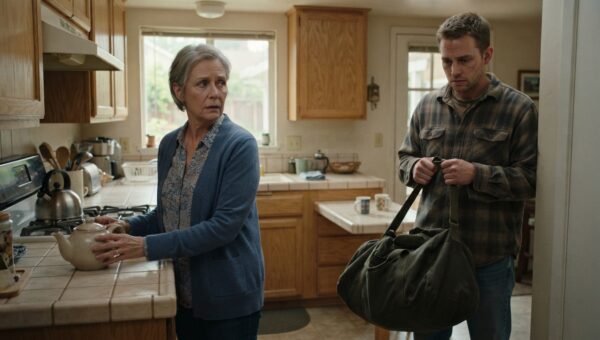
He walked through the kitchen door carrying his overnight bag, smelling of hotel soap and coffee. He looked fresh, rested, and impatient.
“Evelyn,” he called out, setting his keys on the counter. “Did the lawn service come by on Friday? The leaves are all over the driveway.”
I was sitting at the round kitchen table.
In front of me sat two identical manila folders, a copy of the black notebook pages, and a portable Bluetooth speaker.
Warren stopped when he saw the table. His eyes dropped to the black spiral binding in the photocopies, and the confident look on his face vanished.
“What is that?” he asked.
I pressed play on the speaker.
His own weak, trembling recorded voice filled the kitchen: *Evelyn, you have been a loyal wife, but you were never built to handle this kind of grief…*
Warren’s face went completely gray. His overnight bag slipped from his hand and hit the linoleum floor with a heavy thud.
“Turn that off,” he whispered.
I paused the recording.
“You called me boring, Warren,” I said, keeping my voice as level as if I were reading a grocery receipt. “You said my world was too small. But you spent four months writing a script so you could fake your own terminal death, steal two hundred and eighty-five thousand dollars from your company’s insurer, and run to Sarasota with Patricia.”
He opened his mouth, but nothing came out. He reached for the back of a kitchen chair to steady himself.
“Evelyn, wait,” he stammered, the words tripping over each other. “You don’t understand the pressure I was under. The firm is restructuring. I made a mistake. That notebook was just… it was an exercise. A way to blow off steam. I was never going to go through with it.”
“The forged claim form with the Kentucky clinic stamp is in Folder A,” I said, pointing to the manila envelope on the left. “Folder B is a petition for dissolution of marriage and a complete property settlement agreement drafted by Thomas Vance.”
“You went to a lawyer?” Warren’s voice rose, panic finally cracking through his composure.
“Folder B gives me the house on Sycamore Lane, fee simple, completely in my name,” I said. “It divides our retirement balances fifty-fifty down to the penny. And it requires you to vacate this house by six o’clock tomorrow evening.”
“And if I refuse to sign?” he asked, his hands shaking as he stared at the papers.
“If you do not sign Folder B by noon on Monday in Mr. Vance’s office,” I told him, “Folder A will be delivered by messenger to the compliance department at your insurance brokerage and to the state fraud bureau. You can explain your creative writing exercise to the state attorney general and the licensing board.”
Warren dropped into the chair across from me. He looked at the paper, then at the speaker, and finally buried his face in his hands.
He was not a calculating mastermind anymore. He was just a middle-aged man who had built a ridiculous, cowardly fantasy to avoid facing his own choices, and now the entire house of cards was falling around his head.
ENDING
Warren signed every page of the settlement agreement at ten o’clock on Monday morning in Thomas Vance’s conference room.
He did not have an attorney with him. He sat with his pen scratching against the legal paper, initialing every disclosure without raising his eyes once from the desk.
He moved his clothes, his golf clubs, and his personal computer into an extended-stay motel near the airport that Sunday night. Two weeks later, he quietly resigned from his insurance brokerage, citing personal family reasons, and took a junior consulting position with a firm sixty miles south in Dayton.
Patricia left the brokerage before Thanksgiving. I never asked where she went, and I never cared to find out.
The house on Sycamore Lane was formally transferred into my name in December.
I spent that winter cleaning out the rooms. I sold the heavy walnut desk from the study to a secondhand dealer in town and turned the space into a bright sunroom with two comfortable wicker chairs, a low table, and three large hanging ferns.
When January 14 arrived, the date Warren had penciled at the top of his funeral service outline, the weather was crisp and sunny.
There was no service at St. Jude’s Chapel. There was no guest list, no fake grief, and no crowd of confused friends whispering condolences in the pews.
I spent that Saturday morning at the public library downtown, returning a stack of gardening manuals and picking out three books on perennial borders. On the drive home, I stopped at the greenhouse on Route 4 and bought six bags of organic potting soil and a tray of early tomato seedlings for the kitchen windowsill.
When I unlocked my front door, the house was warm and completely still.
The front hallway smelled like fresh pine floor soap and the pot of vegetable soup simmering on the stove. I hung my wool coat on the brass peg by the door, took my shoes off, and carried the tomato seedlings into the sunroom.
I set the green plastic tray on the table right where the sun poured through the glass.
I sat down in the wicker chair with a fresh mug of black coffee, listened to the quiet hum of the house, and watched the afternoon light stretch across the floorboards. The world outside was cold, but the roof over my head was paid for, my name was on the deed, and every minute of my day was entirely my own.