PART 2
A strange, prickling coldness settled over my arms despite the physical exertion of the work. I stood there in the quiet meadow, listening to the soft rustle of autumn leaves and the distant caw of a crow overhead. The dark gray mortar looked surprisingly intact, shielded from eighty years of rain and ice by the heavy outer capstone I had just pried away.
I pulled off my heavy leather gloves, reached into my canvas tool tote, and pulled out my heavy-duty mason’s chisel and a bright LED flashlight.
I set the chisel blade against the brittle gray mortar edge and struck it sharply with the hammer. The mortar was old, dry, and brittle. With a sharp crack, large chunks of gray plaster broke away, falling into the dirt like dry breadcrumbs. I worked around the rectangular opening for fifteen minutes, chipping away the seal until the inner stone plug shifted. I grabbed the edge of the flat stone and pulled it out, setting it gently down in the grass.
The opening lay dark and silent before me. A faint smell wafted out into the cool afternoon air—a dry, metallic odor mixed with the stale scent of ancient dust, preserved wood, and cold earth.
I took a deep breath, knelt down on the damp leaves, clicked on the flashlight, and directed the bright white beam deep into the darkness of the stone chamber.
The beam illuminated a smooth, cedar-lined box resting in the center of the hollow space. Sitting atop the cedar box was a small, heavy iron tin, rusted around the latches, and a thick glass mason jar wrapped in oilskin paper.
My heart began to beat a steady, rapid rhythm against my ribs. My first thought was that I had uncovered a forgotten depression-era cache—perhaps gold coins, old deeds, or savings that Silas Thorne had hidden away before he disappeared in the snowstorm of 1944.
I leaned forward, reached my gloved hand carefully into the cold stone vault, and pulled out the glass mason jar first. The oilskin paper was cracked and stiff with age. I peeled it back to reveal the clear glass beneath.
Inside the jar sat a bundle of yellowed paper tied tightly with a strand of faded red twine, along with three black-and-white photographs preserved perfectly against the dampness.
I unscrewed the rusted metal lid of the jar, my fingers trembling slightly, and gently tipped the contents into my lap. I picked up the topmost photograph.
It showed a young woman in a high-collared cotton dress standing on the porch of our very farmhouse. She was holding a newborn baby wrapped in a thick wool blanket, smiling softly at the camera. But what made my breath catch in my throat was the man standing beside her. He was tall, lean, with sharp cheekbones and dark, intense eyes. He was wearing a heavy wool coat and resting his hand tenderly on the woman’s shoulder.
I flipped the photo over. Written in faded black fountain pen ink were the words: *Eleanor and baby Thomas. October 12, 1941. Before the shadow returned.*
I picked up the second photograph. The same young woman, Eleanor, was sitting on a wooden bench in town. But standing behind her, partially obscured by the shadow of a store awning, was a second man—a man whose face was identical to the man in the first photo, down to the shape of his jaw and the dark, piercing eyes.
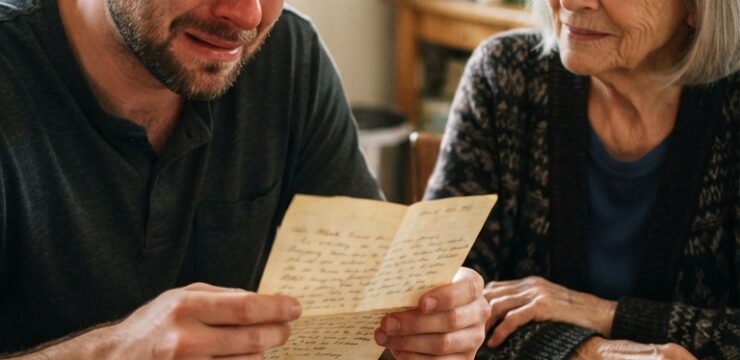
I unfolded the thick, handwritten letter, shielding the brittle paper from the autumn breeze.
PART 3
The handwriting was tight, frantic, and slanted, the ink faded to a deep sepia tone after eight decades in the dark.
“To whoever unearths this stone,” the letter began. “My name is Silas Thorne. If you are reading these words, I am already dead, and the mountain has finally claimed what was stolen.”
I leaned closer, my eyes darting across the yellowed pages as the cold wind whistled through the sugar maple above me.
“In the summer of 1940, my identical twin brother, Julian, returned to Blackwood after ten years in Chicago. I thought he had come home to reconcile. I did not know he was fleeing dangerous men, or that his mind had been twisted by debt and desperation. Julian wanted my land, my name, and my quiet life. He saw a way to erase his past completely—by taking mine.”
“For three years, he watched me from the woods. He learned my habits, my speech, my movements. Then, in the bitter November of 1944, as the great snow began to fall, he struck. He confronted me in the field behind the barn, intending to bury me beneath the snow and walk into my home as Silas Thorne, leaving ‘Julian’ to vanish forever.”
The air in my lungs felt like ice as the full, horrifying reality of the story began to take shape in my mind.
“We fought in the freezing dark,” the letter continued. “I survived, but Julian did not. I stood in the blinding snow over the body of my own brother, knowing that if I went to the town authorities, Julian’s creditors and the dark men searching for him would follow his trail straight to my door, endangering my wife Eleanor and our young son.”
“I made a terrible choice. I dressed Julian in my heavy winter coat, carrying him deep into the abandoned iron mine shaft at the north ridge, where no man treads. I let the town believe that Silas Thorne had vanished in the storm. I took my brother’s identity papers, left my home forever, and sealed this truth into the stone wall I had spent seven years building with my own hands.”
“I leave this record, my true land deed, and the family savings in the iron tin to my son, Thomas, should he ever return to this dirt. May God forgive me for the lie I lived to keep them safe.”
I sat frozen on the cold ground, the letter resting in my hands, my mind spinning. Old Arthur Vance had told us that Silas Thorne had vanished into thin air during the winter of 1944. But he hadn’t vanished. The man who had disappeared into the storm was the killer—and the man who had walked away, carrying the heavy burden of a stolen life to protect his family, was the real Silas.
I reached back into the stone chamber and pulled out the heavy iron tin. I lifted the rusted clasp. Inside lay an official notarized land deed from 1942, a gold pocket watch engraved with the initials *S.T.*, and forty-five crisp one-hundred-dollar bills from the 1930s—a fortune preserved in time.
I stood up slowly, looking toward the distant blue contours of the north ridge where the old iron mine lay hidden beneath decades of forest growth. The silence of the Vermont hills felt different now. It was no longer an empty, mysterious quiet, but a solemn, sacred space holding the secret sacrifice of a father who had given up his very name to protect those he loved.
ENDING
I carried the cedar box, the glass jar, and the iron tin back to the farmhouse. When I laid the contents out on the kitchen table and explained everything to David, we sat in silence for a long time, looking at the faded photographs of Eleanor, little Thomas, and the two brothers whose tragic struggle had remained frozen in stone for eighty years.
The next day, David and I drove down to the county registry in town. With the help of a local historian and an estate attorney, we managed to track down the lineage of Thomas Thorne. We discovered that Silas’s son had grown up in Vermont, served in the military, and passed away ten years ago, leaving behind a daughter named Sarah—Silas Thorne’s granddaughter—who was now a schoolteacher living in Burlington.
We invited Sarah to the farm on a crisp Sunday afternoon in early November.
Standing in our kitchen, holding her grandfather’s engraved gold pocket watch and reading the shaky, heart-wrenching words written in the 1944 letter, tears filled her eyes. For her entire life, her family had lived under the vague, uncomfortable shadow of a grandfather who had simply “abandoned” his homestead and vanished without a word. Reading Silas’s final confession restored his honor, proving that his final act on earth had been one of desperate, ultimate love.
We returned the cash, the pocket watch, and the personal family heirlooms to Sarah, who accepted them with deep, tearful gratitude. In turn, she officially validated our land title, ensuring that David and I remained the rightful, legal owners of the old Miller farm.
Before winter set in and the first heavy snowfall blanketed the valley, David and I returned to the stone wall in the back field.
We repaired the collapsed section carefully, resetting the heavy granite blocks and cementing the outer stones firmly into place. But we left the inner cedar chamber intact and empty, a quiet monument to the man who built it stone by stone.
Now, whenever I walk down to the back field on a quiet evening and look out over the rolling hills, I no longer see just a tumbledown pile of ancient rocks. I see a testament to love, sacrifice, and the enduring strength of the truth—a reminder that no matter how deep a secret is buried, the earth eventually brings the truth back into the light.