PART 2
My hands shook so hard I nearly dropped my phone onto the floorboards of my car. A half-sister. Two years older than me, born in the same small hospital, carrying the same biological blood.
I called the number she provided in the message. Ten minutes later, we agreed to meet at a Panera Bread halfway between our towns. I drove there in a total daze, my mind racing through thousands of questions that had been locked away since childhood.
When I walked into the bakery, I didn’t even need to look for a woman checking her phone. Standing near the booth in the corner was a tall, forty-four-year-old woman with dark wavy hair. As she turned toward me, my heart stopped. She had my nose. She had my long, slender hands, and the exact same slight dip in her left jawline. It was like looking into a slightly older mirror.
“Clara?” she whispered, her eyes filling with tears.
We sat across from each other at a quiet booth. Janet pulled a thick, worn accordion folder from her canvas bag and set it gently on the wooden table between our coffee cups.
“I grew up in foster care,” Janet explained, her voice trembling with emotion. “I was placed in the system when I was two years old. All I ever had was this folder. I searched every registry for two decades trying to find out what happened to my baby sister.”
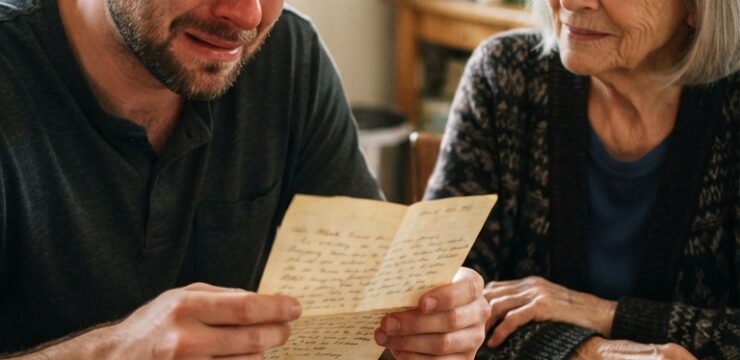
She unclasped the folder and pulled out a stack of yellowed papers: birth records, child welfare documents, and a faded, square color photograph from 1983.
She slid the photograph across the table toward me.
I picked it up with cold fingers. The photo showed two tiny girls sitting on a braided rug—a dark-haired toddler around two years old, and an infant lying on a yellow blanket beside her. Both children were wearing tiny, plastic hospital ID bracelets around their wrists.
“That’s me,” Janet said, pointing her finger at the toddler. “And that infant is you, Clara. I remember holding you. I remember the day the social worker came to the house and took us away.”
I turned the photograph over. On the back, written in blue ballpoint ink, was a brief list of names and dates recorded by a court caseworker. It listed our biological mother’s name, our birth dates, and down at the bottom, a section labeled: *Temporary Emergency Caregiver (Pre-Placement).*
Underneath that line was a third name.
I read it once. I read it again. The letters blurred together as the blood rushed to my ears, sounding like a deafening roar.
The caregiver listed as taking custody of both girls from county welfare in October 1983 was Evelyn Mercer—my adoptive mother.
PART 3
“No,” I whispered, shaking my head repeatedly. “No, this is wrong. My mother told me she got me through a private adoption agency. She said an agency called her three days after I was born.”
“Look at the court petition underneath the photo, Clara,” Janet said gently, pushing another document toward me.
I picked up the official, state-stamped ward paper from 1983. The typed legal document told a terrifyingly clear story.
In October 1983, our biological mother had suffered a severe health crisis and was temporarily hospitalized. County social services placed two-year-old Janet and three-day-old me into temporary emergency foster care. Evelyn Mercer—a licensed state foster parent at the time—was assigned to care for both of us for a sixty-day temporary evaluation period.
According to the official court notes attached to the file, Evelyn had taken a deep, immediate obsession to the newborn infant. But she didn’t want a two-year-old toddler.
The caseworker’s notes stated: *”Caregiver Mercer expressed strong reluctance to care for the older child, requesting immediate removal of the toddler to another home, while filing urgent private petition papers for exclusive custody of the infant.”*
Evelyn had actively separated two biological sisters. She had sent two-year-old Janet back into the cold machinery of the state foster system, while using her temporary position as an emergency caregiver to bypass the long adoption waiting lists and secure me for herself. Then, she resigned as a foster parent, cut all ties with the county, and raised me on a lie—telling me for forty years that I was a random orphan brought to her by a nameless agency.
I sat in the bakery, holding the yellowed paper, feeling forty years of my life crumble into dust. The woman who had tucked me in every night, who had kissed my scraped knees, and who had preached the importance of honesty and family, had deliberately abandoned my toddler sister to a life in institutional care so she could keep the baby for herself.
“She knew about you,” I choked out, tears finally spilling over my cheeks. “She knew you existed. She left you behind.”
“I spent sixteen years bouncing between seven different foster homes, Clara,” Janet said quietly, reaching across the table to hold my shaking hand. “I don’t hate you. I never hated you. I just wanted to know if my baby sister was safe.”
An hour later, I drove straight to the senior living community where Evelyn lived. My hands were gripped tightly on the steering wheel, my chest burning with a mixture of grief, rage, and profound betrayal.
I pushed open the door to Evelyn’s apartment. She was sitting in her favorite armchair near the window, knitting a blanket, looking small, fragile, and utterly innocent.
“Clara, dear!” she said, offering her soft, familiar smile. “What a pleasant surprise. You didn’t tell me you were stopping by.”
I didn’t kiss her cheek. I didn’t sit down. I walked over to her chair and set the 1983 photograph and the county ward document directly on her lap.
ENDING
Evelyn looked down at the paper. The soft, gentle expression on her face vanished, replaced by a sudden, rigid stillness. Her hands stopped knitting. For a long, terrifying moment, the frail old woman vanished, and I saw the calculating stranger who had made that choice forty years ago.
“Where did you get this?” she asked, her voice turning cold and flat.
“Her name is Janet,” I said, my voice trembling with suppressed rage. “She’s forty-four. She grew up in seven different foster homes while I slept in a cozy bedroom with matching curtains. You told me an agency called you out of nowhere. You lied to me my entire life.”
Evelyn didn’t cry. She didn’t drop to her knees or ask for forgiveness. She simply looked out the window at the gardens below.
“They were going to put both of you in the system, Clara,” she said softly, without a shred of remorse in her tone. “I wanted a baby. I couldn’t raise a toddler who was already traumatized and crying for her mother every night. I gave you a good life. I protected you.”
“You didn’t protect me, Evelyn,” I said, tears burning my eyes as I stood over her chair. “You stole my sister. You built my entire life on a foundation of cruel selfishness.”
I walked out of her apartment that afternoon and never went back.
In the months that followed, the rift between Evelyn and me remained permanent. I could not reconcile the loving mother who had raised me with the cold woman who had abandoned a two-year-old child to the foster system for her own comfort. Two months later, Evelyn passed away quietly in her sleep, leaving her estate to me in a final attempt to secure my forgiveness. I donated the proceeds of her house to a non-profit foundation that supports older children aging out of foster care.
The true healing in my life didn’t come from answers or inheritance—it came from building a real relationship with Janet.
Over the past two years, Janet and I have made up for forty lost years. She comes over to my house every Sunday for family dinners, sitting around the dining table with my daughter, Maya, and my grandchildren. We share childhood stories, laugh over our identical habits, and marvel at how two people separated by decades of deceit could find their way back to one another.
Sometimes, late at night, I look at the faded 1983 photograph sitting framed on my mantlepiece—the two little girls on the braided rug holding hands. We were separated by a lie, but we were brought back together by the truth. And for the first time in my life, I know exactly who I am, and where I belong.