PART 2
The heavy cardstock felt strange against my fingertips. I stared at the bold, black ink stamped across the top of the pass: *OHIO STATE PENITENTIARY – AUTHORIZED VISITOR*.
My brow furrowed in confusion. I looked at the date stamped on the pass. It was from a Sunday in late January of this year. Just a few weeks before Odell passed away.
My heart started to beat a little faster as I pulled at the rubber band. It snapped with a sharp crack, stinging my thumb, and the heavy stack of visitor passes spilled out over my lap and onto the floorboard of the truck. There had to be hundreds of them.
My hands were shaking violently as I started picking them up, flipping through them one by one.
*October 12, 2021. Sunday.*
*April 4, 2018. Sunday.*
*November 15, 2015. Sunday.*
Every single pass was dated for a Sunday. And every single pass had the exact same inmate identification number written on the visitor line.
A cold wave of dread washed over my chest. I couldn’t breathe. My mind started racing through a hundred terrifying possibilities. Who on earth was Odell visiting in a maximum-security state prison? Did he have a brother he had never told me about? Was he mixed up in something illegal? For nine years, my husband had been leaving our church, filling his thermos, and driving an hour up the highway to sit inside a prison visiting room.
I looked at the inmate number again. *Inmate #94402.*
There was something sickeningly familiar about those numbers. The state penitentiary was where they sent serious offenders. The date of the oldest pass was January 2015.
January 2015 was the exact month the nineteen-year-old drunk driver who killed my son was transferred from the county jail to begin serving his state prison sentence.
The realization hit me so hard the air was physically forced from my lungs. The ground seemed to tilt beneath the truck. My knees gave out completely. I couldn’t support my own weight anymore. I slid down the side of the truck seat, collapsing onto the hard, frozen dirt of the driveway. I sat there in the gravel, leaning against the running board, clutching the glossy visitor passes to my chest as a horrific, deafening roar filled my ears.
*No,* I thought, my vision blurring with panicked tears. *No, Odell. You couldn’t have. You wouldn’t.*
I dropped the passes onto the dirt. As the stack hit the ground, a single piece of folded, white notebook paper fluttered out from the center of the bundle, landing near the toe of my boot.
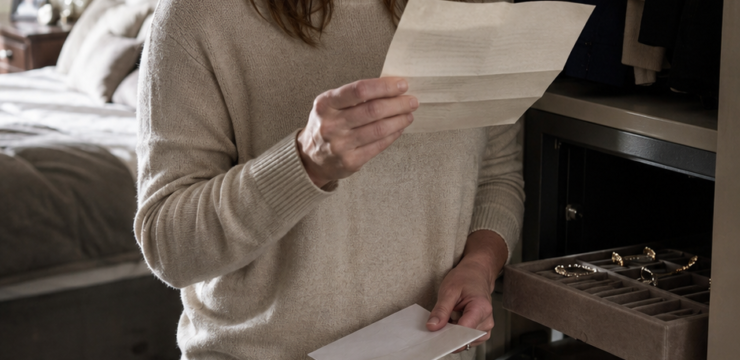
It was yellowed around the edges, clearly handled many, many times over the years. I reached out with a trembling, numb hand and picked it up. I slowly unfolded the paper.
The ink was faded, but the blocky, unmistakable print of my husband’s handwriting stared back at me.
*Martha,* the note read. *If you are reading this, it means I am gone, and I am so deeply sorry for keeping this from you. I didn’t know how to tell you. I go every Sunday so the boy who killed our son won’t sit in there alone.*
PART 3
I sat freezing in the dirt, my tears dropping onto the folded notebook paper, blurring Odell’s ink.
The note continued. *His own family abandoned him after the trial. He was nineteen, terrified, and broken. For a whole year, I hated him so much I couldn’t sleep. The anger was eating holes in my heart, Martha. It was turning me into a cruel, bitter man. But a good man once taught me that you have to forgive the darkest things in this world, or they will completely consume you.*
*I couldn’t bring our Jesse back. But I could make sure another young life wasn’t entirely lost to the darkness. I go every week. We drink coffee. We talk about Jesse. I make him promise to be a better man. He is so sorry, Martha. Please don’t hate me for this. I did it to keep my soul clean so I could be a good husband to you.*
I pulled my knees to my chest and sobbed. It was a violent, ugly cry that echoed across the empty driveway. I was crying for my dead son. I was crying for my dead husband. And, to my absolute horror, I realized I was crying for the profound, staggering weight of Odell’s grace.
For nine years, I had carried nothing but pure, unadulterated hatred for the boy who took my child. I had wished him pain. I had wished him death. Meanwhile, the man I slept next to every night was quietly carrying the cross of forgiveness, driving two hours every Sunday to sit across a metal table from our greatest enemy, offering him the grace of a father.
I sat by the truck for two hours until my tears finally stopped.
I looked up at the gray Ohio sky. I looked at the clock on the dashboard of Odell’s truck. It was one o’clock in the afternoon. It was Sunday.
I stood up, my joints stiff and aching from the cold ground. I walked inside the house, went straight to the kitchen, and brewed a fresh pot of dark roast coffee. I pulled Odell’s green Stanley thermos down from the cabinet and filled it to the brim.
I grabbed my purse, walked back out to the truck, and started the engine.
The drive up the highway felt like a dream. When I pulled into the bleak, heavily fenced parking lot of the state penitentiary, my hands were sweating. I walked through the security checkpoints, the metal detectors, and the heavy steel doors. I handed the guard Odell’s final visitor pass and my own driver’s license.
“I’m here for Inmate 94402,” I said, my voice shaking. “I’m Odell’s widow.”
The guard nodded gently and led me into the loud, brightly lit visiting room. I sat down at table 14. Ten minutes later, the heavy metal door on the other side of the room opened.
A young man walked out. He was twenty-nine now, wearing a faded orange uniform. His hair was neat, and his eyes were tired. He walked toward the table, expecting to see my husband. When he saw me sitting there instead, he stopped dead in his tracks. All the color drained from his face.
He slowly walked over and sat down across from me, his hands trembling as he rested them on the metal table.
“Ma’am,” he whispered, his voice cracking instantly. “Where is Mr. Odell?”
“Odell passed away two weeks ago,” I said quietly, unscrewing the lid of the green thermos.
The young man buried his face in his hands and wept. He cried with the sheer, agonizing grief of a boy who had just lost a father. He cried for the man who had sat with him every Sunday for nearly a decade.
“He saved my life,” the young man choked out, wiping his face. “He told me all about Jesse. He told me Jesse loved fishing, and baseball, and making people laugh. He told me I owed it to Jesse to do something good with whatever time I have left. I am so sorry, ma’am. I am so, so sorry.”
ENDING
I poured a cup of black coffee into the plastic lid of the thermos and slid it across the metal table toward him.
“Drink your coffee,” I told him gently. “Odell always said you liked it black.”
He took the cup with shaking hands, and for the first time in ten years, I looked at the boy who killed my son and did not feel hatred. I just saw a broken human being trying to find his way back to the light. We sat together for the entire two hours. He told me about the classes he was taking in the prison, about the trade he was learning, and about the promises he had made to my husband.
When the buzzer sounded, signaling the end of visiting hours, I stood up.
“I won’t be back next Sunday,” I told him honestly. “I don’t have Odell’s strength. I can’t do what he did.”
The young man nodded, tears welling in his eyes again. “I understand, ma’am. Tell him… tell him thank you.”
“I will,” I promised.
I walked out of the prison and back to Odell’s truck. As I drove home down the open highway, I rolled the window down, letting the freezing winter air hit my face. For the first time since the night Jesse died, the crushing, suffocating weight on my chest was entirely gone.
Odell didn’t just save that young man’s soul. In the end, by leaving that hidden note for me to find, Odell saved mine, too. He carried the heavy burden of forgiveness for nine years until I was strong enough to finally let go of the anger. I don’t go to the prison on Sundays, but I still fill that green thermos, drive out to the cemetery, and pour a cup of black coffee into the grass for the greatest man I ever knew.